 September 8, 2026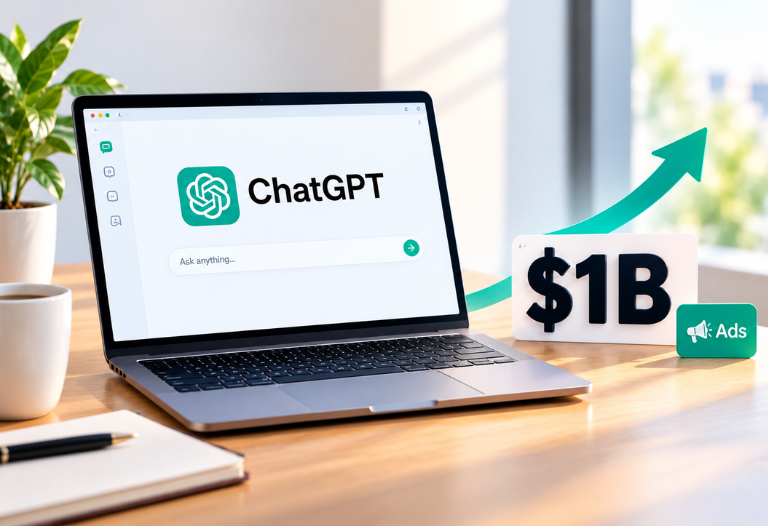
ChatGPT is becoming a serious advertising platform faster than many marketers expected. OpenAI announced on August 31, 2026, that ChatGPT Ads had reached a $1 billion annualized revenue run rate in less than 200 days. The company also said that tens of thousands of advertisers are now using the platform, with ChatGPT Ads expanding to more than 40 countries.
Reuters independently reported the same $1 billion annualized milestone, noting that OpenAI has been steadily expanding its advertising business into new markets. For business owners, though, the headline number is only part of the story.
The more important question is: What will convince advertisers to put more of their marketing budget into ChatGPT?
ChatGPT Ads Are Moving Into a New Stage
OpenAI began testing ads in ChatGPT in the U.S. in February 2026. The initial approach was deliberately cautious. Ads were designed to appear separately from ChatGPT’s responses, and OpenAI stated that advertisers would not be able to influence or change the answers users receive.
That distinction matters: People use ChatGPT differently from a traditional search engine. They may ask for product comparisons, recommendations, explanations, planning help or solutions to specific problems.
For example, someone searching Google might type:
“Best accounting software for small businesses.”
A ChatGPT user might ask:
“I run a 15-person service business and need accounting software that integrates with payroll. What should I compare before choosing one?”
The second query provides much more context.
That creates an interesting advertising opportunity because the platform can potentially understand the problem behind the search rather than just the keywords.
Advertisers Are Already Testing the Channel
The growth in advertiser participation suggests that businesses see enough potential to experiment. Business Insider, citing Sensor Tower data, reported that the number of ChatGPT advertisers grew from roughly 300 in April to more than 820 in July. The report also identified brands such as Home Depot, Intuit and Booking Holdings among advertisers using the platform.
That is important because early advertising platforms often start with a small group of experimental advertisers.
As larger brands enter, the conversation changes from:
“Should we test ChatGPT?”
to:
“Can ChatGPT consistently deliver a return that justifies a larger budget?”
That second question is much harder to answer.
ROI Will Determine Whether Spending Grows
For advertisers, traffic alone is not enough. Imagine an ecommerce company spends $10,000 on ChatGPT Ads and receives 1,500 visitors. On paper, that may look successful. But if those visitors generate only $7,000 in revenue, the campaign has a problem. If those same visitors generate $40,000 in revenue, the company may want to increase its budget.
This is why measurement becomes critical as an advertising platform matures.
AdExchanger’s recent coverage of ChatGPT Ads focused specifically on what advertisers want to see before spending more. The publication reported concerns around areas such as measurement, targeting, attribution, and the ability to understand campaign performance.
For a business owner, this is probably the most practical takeaway.
A new advertising channel does not earn a larger budget simply because it is growing. It earns a larger budget when it can prove business results.
Attribution Is Especially Important
One of the challenges with conversational platforms is that the customer journey amay not be as a as a traditional search ad. A user might see an ad in ChatGPT, visit the website, leave without purchasing, search the company on Google three days later, and then complete the purchase.
Which channel gets credit?
That question matters when you decide where your next $20,000 should go.
OpenAI has been adding tools intended to address this challenge. In its May announcement, the company introduced CPC bidding and said it was developing additional ways for advertisers to measure results. OpenAI’s newer advertising expansion also includes measurement and conversion tools designed to help advertisers understand what happens after an ad interaction.
The direction is clear: ChatGPT Ads needs to become more measurable if it wants to compete for larger performance-marketing budgets.
Targeting Will Become More Important as Budgets Grow
Another issue is targeting. A small business testing $500 or $1,000 in advertising may tolerate limited campaign controls. An enterprise spending hundreds of thousands of dollars cannot. Large advertisers typically want control over factors such as geography, audience, product category, bidding strategy and campaign objectives.
This is one reason OpenAI’s expansion of Ads Manager is significant. Businesses can increasingly manage campaigns themselves rather than relying entirely on direct sales or advertising partners. OpenAI has also expanded access to advertisers across regions including India, Europe, the Middle East and North Africa.
For businesses in India, this is particularly relevant.
A local SaaS company targeting U.S. customers, for example, could potentially use ChatGPT Ads to reach people researching software solutions while also testing different geographic and campaign strategies.
ChatGPT has a Different Kind of Commercial Intent
The biggest opportunity may not simply be audience size.
It is context.
Traditional advertising often relies heavily on keywords, demographics, browsing behavior and predefined audience segments. Conversational AI can provide another signal: what the person is actually trying to accomplish.
Consider someone asking:
“I need a CRM for a sales team of 25 people. We currently use spreadsheets and need better pipeline reporting. What should we look for?”
That person has already revealed several commercial signals:
- Company size
- Existing solution
- Business problem
- Desired capability
- Potential buying stage
For an advertiser selling CRM software, this can be valuable context.
However, businesses should not assume that every ChatGPT conversation represents purchase intent. Someone may simply be researching a topic. The value comes from identifying which types of conversations consistently lead to meaningful business outcomes.
OpenAI Is Building the Measurement Layer
OpenAI’s advertising developments show that the company understands the importance of performance marketing. Its advertising program has moved from an initial pilot toward self-service campaign management, CPC bidding and additional measurement capabilities.
OpenAI has also stated that ads are separate from ChatGPT’s answers and do not influence the model’s responses. Its current advertising documentation says advertisers cannot shape, rank, or alter ChatGPT’s answers.
That separation will be important for maintaining user trust. Advertisers may want visibility, but they cannot afford a platform where users stop trusting the recommendations because they believe every answer is influenced by advertising.
What Should Business Owners Do Now?
The $1 billion milestone does not mean every company should immediately shift its Google or Meta budget to ChatGPT.
- It does mean the channel deserves attention.
- If your customers frequently use ChatGPT to research products, compare services or solve problems before buying, testing the platform could make sense.
- Start small.
- Choose a clear conversion goal That might be a purchase, demo request, lead form submission or qualified consultation. Then measure the entire customer journey.
For example, a B2B company could run a limited ChatGPT campaign and compare:
Ad clicks → website visits → qualified leads → sales opportunities → closed revenue
That gives you something much more useful than impressions or clicks.
If the campaign produces fewer clicks but twice as many qualified leads as another channel, the smaller traffic number may not matter.
The Real Test Comes After the $1 Billion Milestone
OpenAI reaching a $1 billion annualized advertising run rate is a major signal, but it is not the final test for ChatGPT Ads.
The next phase will be about performance.
- Can advertisers measure conversions accurately?
- Can they target the right users?
- Can they understand which conversations lead to purchases?
- Can they scale campaigns without losing efficiency?
Those answers will determine whether ChatGPT becomes another experimental advertising channel or a meaningful part of the media budgets of businesses.
For now, the opportunity is worth watching closely. ChatGPT has already shown that advertisers are willing to spend. The next challenge is convincing them that spending more will produce measurable business growth.
Looking to Prepare Your Business for AI-Driven Search and Advertising?
As AI platforms such as ChatGPT become part of how customers research products, compare solutions, and make buying decisions, businesses need more than traditional digital marketing tactics. They need a strategy that considers how their brand appears across AI-powered search and conversational platforms.
At Primotech, we help businesses build AI-focused digital strategies that connect content, search visibility, data, and measurable business outcomes. Our team works across AI, software development, data engineering, and digital marketing to help companies adapt their online presence to changing customer discovery patterns.
If your business is exploring AI SEO, AI-driven customer acquisition, or ways to improve visibility across platforms such as ChatGPT, Primotech can help you evaluate where AI fits into your broader growth strategy.