Teams Without In-House QA
Get a working QA function in weeks, without recruiting, onboarding, or managing a new department.
Primotech QA Pods give you a ready-built team of automation engineers and testers who plug into your sprints, own your release quality, and sign off with evidence instead of guesswork.
Book a Free Consultation


Software now ships weekly, sometimes daily, but testing often still
runs like it did when releases were quarterly: manual regression at
the end, brittle scripts, and developers checking their own work. The
result is a release process that is slow or risky, usually both.
Hiring
a QA engineer takes months, pulling developers into testing slows the
roadmap, and adding manual testers only makes regression longer.
Meanwhile, hotfixes and support tickets pile up. A bug caught in a
sprint costs a conversation. The same bug in production costs a fix
and some trust.
A QA pod breaks the cycle with a dedicated
team that automates what repeats, tests what scripts miss, and gives
you an independent go or no-go before every release.
Manual regression grows with every feature, so release day keeps slipping and testers become the bottleneck.
Defects reach production because flows were tested alone, never together, and support tickets become your test report.
Brittle scripts fail on every UI change, so the team ignores red builds and real defects slip through.
Without an independent view, the assumptions that created a bug also hide it from testing.
Roles stay open for months, the backlog of untested work grows, and the people you have burn out.
Friday releases are off the table, hotfixes are routine, and nobody can say with confidence what is covered.
A pod doesn't test at the end and hand you a bug list. It works
alongside your
sprints, from the first story to the final sign-off.
Testers read requirements and acceptance criteria before development starts, so gaps and unclear rules get fixed while changes are still cheap.
Maintainable frameworks for web, mobile, and API testing that cut repeat manual effort and run on every build.
A separate team validates your releases without the delivery team's blind spots, then signs off with documented evidence.
Automated regression packs that shrink multi-day release checks to hours and stop old bugs from coming back.
Functional, contract, and data checks across services and third-party integrations, before a UI exists to expose the failure.
Functional, usability, and compatibility testing across the browsers, devices, and operating systems your customers actually use.
Realistic traffic simulation that shows where your system slows or breaks before launch day does it for you.
Vulnerability scanning and manual checks mapped to OWASP guidance, with test evidence that supports audit readiness.
Experienced testers explore the edge cases scripts miss, from odd user journeys to messy real-world data.
A review of your current process, coverage, and tooling that ends in a prioritized plan you can act on.
Get a working QA function in weeks, without recruiting, onboarding, or managing a new department.
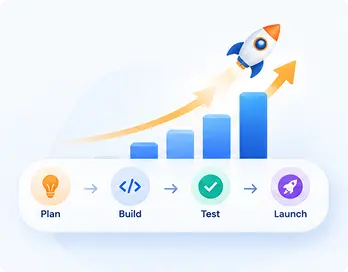
Add automation and regression coverage as fast as features ship, then flex the team up or down as needs change.
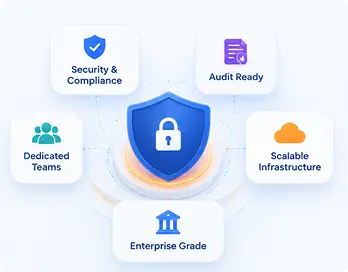
Bring in a separate team for independent QA testing, release sign-off, and audit-ready documentation.


We pick tools to fit your stack, not the other way around. Here is what our pods commonly work with.
Every pod is led by a QA lead and sized to your product.
Pricing depends on team size and scope, and a free consultation gets you
a clear estimate.
Team:
Best for teams building a first QA function or moving from manual to automated testing.
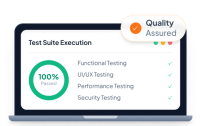
Team:
Best for growing products with frequent releases and a widening regression gap.
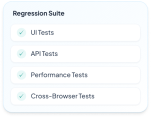
Team:
Best for enterprises and regulated products that need independent sign-off.
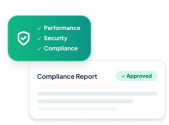
Team:
Roles mixed to fit your product
Best for complex ecosystems, unusual compliance needs, or specialist testing.
Tell us where releases hurt most. We'll recommend a pod and show you what the first 30 days look like.

A decade of building and testing production software.

Experience across products of every size and complexity.

From startups to established enterprises.

Independently ranked among leading IT service providers.

5.0 on Clutch, 5.0 on G2, 5.0 on GoodFirms.

Trusted by JetBlue, Toyota, Motorola, Harley-Davidson, Lenovo, and ABRAMS.

QA sits beside engineering, cloud, security, and AI teams when you need them.

NDAs, defined access controls, and deliverables that stay yours under agreed terms.

Clear milestones, sprint dashboards, and honest defect trends.
A 30-minute call to understand your product, release process, and biggest pain points.
We review coverage, tooling, and risks, then recommend the right pod.
Roles, size, tools, and overlap hours are agreed with you before anything starts.
Access, environments, and test strategy are set up, usually within [1-3 weeks].
Smoke tests and first regression coverage are running in your pipeline.
Regular reviews tune scope, and the pod grows or shrinks as your roadmap changes.
Real testing challenges. Smarter QA strategies. Measurable improvements.
We recommend technology based on the business problem, technical requirements, security needs, scalability expectations, and long-term operating model.

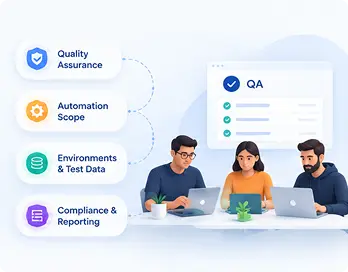
Effort goes where a failure would cost you the most.

More fast API checks and fewer slow UI tests keeps pipelines quick and stable.

Builds fail early, with clear reasons, before bad code reaches staging.

Reliable, masked data and stable environments stop false failures.

Unstable tests are tracked, quarantined, and fixed so results stay believable.

Requirements link to tests, and defect trends become release evidence.
A QA pod is a small, dedicated team of testers and automation engineers, led by a QA lead, that works as an extension of your product team. It owns test strategy, automation, and release sign-off for your product. You get a working QA function without hiring one.
Staff augmentation gives you individual people to manage. A QA pod is a managed team with a lead, a plan, and quality targets, so you review outcomes instead of supervising testers day to day.
Independent QA testing means a team separate from your developers validates the release. It matters when a bug would be costly, when you are in a regulated industry, or when you need sign-off you can show to a customer, board, or auditor.
Yes. Automation is excellent at repeating known checks quickly. Manual and exploratory testing finds the odd behavior nobody thought to script, so a good pod uses both.
Most pods can begin with an assessment within days of the first call. Full onboarding usually takes 1-3 weeks, depending on access, environments, and pod size.
Pricing depends on pod size, automation scope, tooling, and compliance needs. Book a free consultation and we'll give you a clear estimate for your product.
Yes. Pods work inside your Jira, repositories, and pipelines, whether you run Jenkins, GitHub Actions, GitLab CI, or Azure DevOps. We adapt to your stack rather than asking you to change it.
We sign an NDA before work begins, use access controls scoped to what each person needs, and prefer masked or synthetic test data. Your deliverables and IP stay yours under the agreed engagement terms.
Yes. You can start with a Foundation Pod and move up as releases speed up, or add a performance or security specialist for a single release. Scaling back works the same way.

A steady pod on a rolling monthly commitment.

A defined testing engagement with clear deliverables and dates.

A core pod with extra specialists added for specific releases.



Tell us about your AI project, integration needs, or white-label development requirements.