 September 24, 2026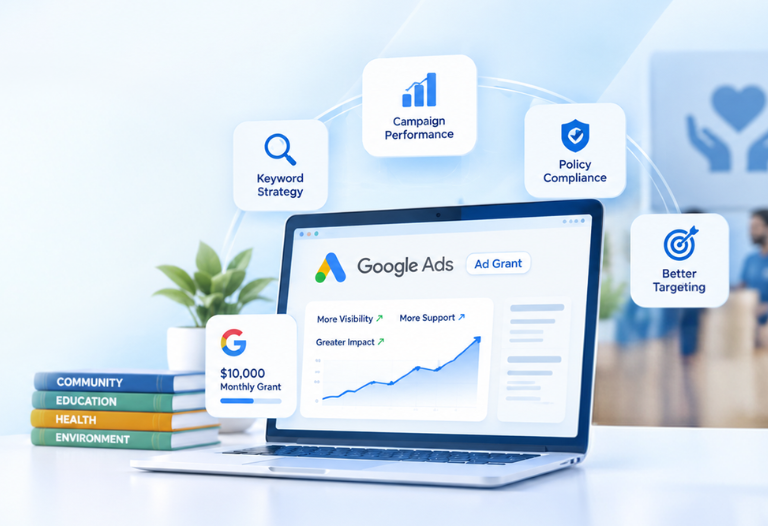
You finally have access to the Google Ad Grant, and the first thought is probably, “Now, how do we make the most of it?”
But there is another question worth asking before you start running campaigns: Could you actually lose it?
A Grant account can run into compliance and performance issues when requirements are overlooked, conversion tracking stops working, CTR falls or campaigns are not managed properly.
For a nonprofit team already focused on serving people, raising funds and running programs, managing another advertising account can quickly become overwhelming. And the last thing you want is to lose access to a resource that could help more people discover your organization.
So, how do you keep the Grant active, avoid preventable compliance problems and turn the advertising credit into something that actually supports your mission?
That is what this guide covers. From the 5% CTR requirement and conversion tracking to keyword selection, campaign structure, geographic targeting and landing pages, we will look at the areas that deserve regular attention in 2026.
Because getting the Grant is only the beginning. Keeping it, managing it properly and using it to reach the people your nonprofit serves is where the real work begins.
Before You Manage the Grant, Make Sure You Qualify
Before managing your Google Ad Grant, it is important to understand how the program works and who can qualify for it. The Google Ad Grant is part of the wider Google Nonprofits program, and eligible organizations need to meet Google’s requirements before they can access the advertising credit. Google provides eligible organizations with up to $10,000 USD per month in in-kind advertising credit for Search ads on Google.com.
The exact eligibility requirements depend on the type and location of the organization. Some government organizations, hospitals and healthcare organizations, schools, academic institutions and universities are generally excluded or handled through separate programs, while qualifying nonprofit organizations can apply through Google for Nonprofits.
The application process should therefore be treated as the starting point, not the end goal. Once an organization receives access, it still needs to maintain the account and follow the ongoing Ad Grants policies.
Get More From Your Google Ad Grant
Improve your Grant performance with better targeting, conversion tracking, and campaign optimization.
The Google Ad Grant Is Not a Set-It-and-Forget-It Program
It is easy to look at the Grant as free advertising and assume the hardest part is getting approved.
In reality, approval is only the beginning.
Google expects participating organizations to follow its Ad Grants policies and standard Google Ads policies. That includes requirements around account structure, keyword relevance, conversion tracking, CTR and other areas of account management. If an account becomes non-compliant, Google can deactivate it until issues are corrected.
For example,
- a food bank might have one person managing digital communications, donor emails and community events.
- A homeless shelter may have a small marketing team handling several responsibilities at once.
- An animal rescue may depend heavily on volunteers.
Nobody wants to spend their week inside Google Ads, but the account still needs attention.
Treat the Grant as an ongoing digital asset, not a one-time benefit. The goal is not simply to keep the account technically active. It is to make sure the advertising credit is helping the nonprofit reach people who need its services, want to support its work or are ready to take meaningful action.
What Can Put Your Google Ad Grant at Risk?
Small account issues can become bigger problems over time. Broad keywords, weak CTR, broken conversion tracking, or irrelevant landing pages can affect both performance and compliance.
Here are the key areas to watch.
1). Treat the 5% CTR Requirement as a Monthly Check, Not an Emergency Fix
The 5% CTR rule gets a lot of attention, but the important part is monitoring it consistently.
For applicable Ad Grants accounts, account-level CTR needs to remain at 5% or higher each month. If the requirement is missed for two consecutive months, the account can be temporarily deactivated. Google also recommends reviewing high-impression, low-CTR keywords when addressing performance issues.
Do not wait for a warning before checking your account.
For example, an environmental organization might have a broad conservation keyword generating thousands of impressions but very few clicks. An animal rescue organization could see similar results from a broad term like “animals,” while a food bank might attract searches about recipes or grocery stores through the generic term “food.”
In these cases, adding more ads is not necessarily the answer. Removing irrelevant or weak keywords can be more useful.
A simple CTR routine includes:
- Review account-level CTR every month.
- Check high-impression, low-CTR keywords.
- Review the searches triggering your ads.
- Add negative keywords when necessary.
- Pause keywords that consistently perform poorly.
- Improve ads when they do not match search intent.
2.) Make Conversion Tracking About Real Actions
A click is only the beginning. What happens after that click tells you whether the campaign is actually helping your nonprofit.
For one organization, the important action might be a donation. For another, it could be a volunteer registration, service inquiry or event signup. Google requires active and accurate conversion tracking for applicable Ad Grants accounts and at least one qualifying conversion per month.
Depending on your mission, conversions could include:
- Donations
- Volunteer registrations
- Membership applications
- Event registrations
- Service inquiries
- Support-line calls
- Newsletter signups
- Petition submissions
Consider a nonprofit that launches a new donation page. If a website update changes the thank-you page and breaks the existing tracking, donations may continue while Google Ads records no conversions.
That creates a gap between what is happening on the website and what the account reports.
For this reason, check conversion tracking whenever your website, forms, donation system or landing pages change.
Where appropriate, Google Analytics can also be connected with Google Ads, so meaningful actions recorded through analytics can be imported as conversions. This gives the nonprofit a clearer view of what happens after an ad click instead of measuring traffic alone.
3.) Get Your Google Ad Grant Account Setup Right From the Beginning
A poor Google Ad Grant account setup can create problems that become harder to fix later. Your campaigns should reflect your nonprofit’s services, audiences and goals.
Google requires at least two ad groups per campaign, with closely related keywords, relevant ads and appropriate landing pages. Its mission-based policy also restricts overly generic keywords and most single-word keywords.
Consider a food bank trying to reach people who need assistance, donors and volunteers. Putting all these audiences into one campaign makes it harder to create relevant messaging.
A cleaner structure could include:
- Food Assistance
Keywords related to food pantries, emergency food and food assistance.
- Donations
Keywords related to donating money, food or supplies.
- Volunteering
Keywords related to volunteering and community support.
Each audience has a different need. Someone looking for emergency food should reach an assistance page, while a potential donor should see a relevant donation page.
The goal is a clear connection between keyword → ad → landing page. Your ad copy should follow the same logic. Test different headlines and descriptions, then use CTR and conversion data to see which messages bring more relevant traffic. There is no need to change ads constantly, but running the same message indefinitely also means missing opportunities to improve.
There are a few additional account structure details worth checking. Google currently requires at least two sitelink assets for Ad Grants accounts. These sitelinks give users additional paths to useful pages, such as donation, volunteering, event or program pages.
Quality Score also deserves attention. Google’s Ad Grants policy requires keywords with a Quality Score of 1 or 2 to be paused or removed, so keyword quality should be part of your regular account review.
4.) Stop Chasing Search Volume and Start Following Intent
High search volume looks impressive, but it does not automatically mean a keyword is valuable.
Instead, ask: What is this person actually trying to do?
For a mental health nonprofit, “mental health” is extremely broad. The search could be for research, definitions, news or professional information.
A search such as “free mental health support near me” provides a much clearer indication of intent.
The same applies to other nonprofits. An animal rescue gets more useful information from “adopt a rescue dog near me” than simply “dogs.” A veteran support organization gets a clearer signal from “veteran housing assistance” than “veterans.”
Look for keywords that show clear intent:
- People searching for specific services
- People looking for local assistance
- Potential donors looking to contribute
- People searching for volunteer opportunities
- Users looking for a specific program or resource
Long-tail keywords are especially useful here because they usually provide more context about what the person wants. Instead of targeting a broad term such as “donation,” a nonprofit could focus on a more specific search such as “donate to animal rescue” or “donate to local food bank.”
Your keyword strategy should start with what your audience needs, not simply which keywords have the highest search volume.
5.) Make Geographic Targeting Match Your Actual Mission
Your geographic targeting should reflect where your nonprofit operates and where you need to reach people.
Google specifically recommends appropriate geographic targeting for organizations serving local communities, including food banks and houses of worship.
For example, a homeless shelter serving one city does not need its ads reaching people hundreds of miles away. The same applies to a local church, food bank or community counseling organization.
However, not every nonprofit has a local audience. A national environmental organization may want supporters across the country, while an international organization may serve one region and seek donors from several countries.
Before setting your targeting, ask:
- Where do you provide services?
- Where are your donors located?
- Where do you need volunteers?
- Which communities do your programs serve?
Your service area and supporter base may be the same, or they may be completely different. Your targeting should reflect that reality.
6.) Your Landing Page Has to Continue the Conversation
The visitor’s journey does not end when they click your ad. Your landing page needs to match what they searched for and make the next step clear.
If someone searches for “donate to animal rescue” and lands on a general homepage, they now have to find the donation option themselves. A better approach is to send them directly to a relevant donation page.
The same applies to other nonprofit goals. Someone searching for volunteer opportunities should reach a volunteer page. A person looking for food assistance should quickly find information about available services.
A good landing page should answer:
- Does this page match what I searched for?
- Can I quickly understand what the organization offers?
- What should I do next?
The page does not need to be complicated. It needs to be relevant, functional and easy to use. Google also requires participating organizations to maintain a high-quality, functional website that provides value and reflects the nonprofit’s mission.
For a stronger landing-page experience, check a few practical details:
- The headline should match the search and ad message.
- The main call to action should be easy to find.
- Important information should not be buried several clicks away.
- The page should work properly on mobile devices.
- The visitor should understand the next step without having to search around the website.
A person who clicks an ad for “veteran housing assistance” should not have to navigate through five pages before finding information about housing support. Relevance should continue from the keyword to the ad and finally to the landing page.
7.) Choose the Right Bidding Strategy for Your Conversions
Google’s current Ad Grants guidance supports conversion-focused Smart Bidding strategies such as Maximize Conversions, Maximize Conversion Value, Target CPA and Target ROAS for applicable campaigns.
But automated bidding is not a replacement for good account management. It depends on useful conversion data.
If Google is told that a homepage visit is a conversion, it receives a very different signal than when completed donations are tracked correctly.
That is why conversion tracking, campaign structure and bidding strategy need to work together. If your tracking is broken or your campaigns are poorly structured, simply changing the bidding strategy will not solve the underlying problem.
8.) Do Not Judge Your Grant Only by How Much You Spend
Here is an important mindset shift for 2026: using the full Grant is not the same as creating full impact.
Google describes the $10,000 monthly amount as available for advertising credit, not a guarantee that every account will spend the entire amount. Search volume, targeting, campaign structure and performance all affect delivery.
The latest M+R Benchmarks 2026 data also show why nonprofits should not measure the Grant only through fundraising. The report found an average Google Grants ROAS of $0.17, an average cost per donation of $793, and an average of 229 site visits for every $1,000 in Grant spend. These figures are benchmarks; not targets every nonprofit should expect to match.
Instead of asking only, “How much did we spend?”, ask “What did the Grant help us accomplish?”
Useful KPIs can include:
- Donations
- Volunteer registrations
- Service inquiries
- Support-line calls
- Event registrations
- Newsletter signups
- Program applications
- Qualified website traffic
A food bank might focus on people finding assistance. An animal rescue may track adoption inquiries and donations. An environmental nonprofit may focus on volunteers or recurring donors.
The right KPI depends on your mission. The Grant becomes more valuable when you measure it against those real outcomes rather than spending alone.
Test Your Ads Instead of Running the Same Message Indefinitely
Your keyword strategy and landing pages are only part of the equation. The ad copy itself deserves regular attention.
If one ad tells people to “Get Help Today” while another explains exactly what support the nonprofit provides, the second message might be more relevant to a specific search. Testing different headlines and descriptions helps identify which messages attract useful clicks and conversions.
Review ad performance alongside CTR and conversion data, then use what you learn to improve future campaigns. The goal is not to change ads constantly. It is to avoid assuming that the first version is automatically the best version.
Run a Regular Google Ad Grant Account Audit
Ongoing management becomes much easier when the nonprofit follows a regular audit routine rather than waiting for a problem to appear.
A practical account audit should review:
- Account-level CTR
- High-impression, low-CTR keywords
- Search terms and negative keywords
- Quality Scores
- Campaign and ad-group structure
- Sitelink assets
- Conversion tracking
- Landing-page relevance
- Geographic targeting
- Bidding strategies
- Grant utilization
- Policy or compliance notifications
This does not need to become a weekly project for a small nonprofit. The important part is having a consistent process so that problems such as broken tracking, irrelevant search terms or declining CTR do not remain unnoticed for months.
What Professional Google Ad Grant Management Actually Changes
If your internal team has the time and expertise, managing the Grant internally can work. If the Grant is repeatedly pushed down the priority list, professional management becomes a practical option. Good Google Ad Grant management services should go beyond creating ads.
Think of the account as an ecosystem:
Account health → Campaign structure → Keywords → Ads → Landing pages → Tracking → Conversions → Optimization → Compliance
Each part affects the next.
For example:
- Low CTR may be a keyword relevance problem.
- Donations not being tracked may be a website or donation-platform issue.
- Low Grant utilization may be linked to search volume or campaign structure.
- Conversions disappearing after a website update may indicate broken tracking.
- A suspension requires specific compliance issues to be identified and corrected.
A specialized Google Ad Grant agency can provide ongoing monitoring, fixing and improvement rather than occasional checks.
How Primotech Helps Nonprofits Manage Their Google Ad Grant
Managing a Google Ad Grant properly takes more than launching a few campaigns and checking the account once in a while. Your nonprofit needs someone to look at the relationship between search intent, campaign structure, ad performance, landing pages, conversions and compliance.
That is the approach taken at Primotech.
The focus is not simply spending more. The account is reviewed around actual goals such as donations, volunteers, service inquiries, community programs and critical support.
Google Ad Grant Account Setup
Primotech supports campaign planning, keyword research, ad groups, conversion goals, geographic targeting and landing-page alignment.
Account Audit and Compliance
The account is reviewed for campaign structure, CTR, keywords, search terms, policy issues, conversion tracking and Grant utilization.
Campaign and Keyword Management
The focus remains on keywords that match the nonprofit’s services, programs, donors and volunteers. Irrelevant terms are removed while campaign structure is refined around actual search intent.
Conversion and Landing-Page Optimization
Donations, volunteer registrations and service inquiries need accurate tracking. Landing pages should also match the intent behind the ads that send visitors there.
Ongoing Google Ad Grant Management
We do regular monitoring that covers CTR, search terms, conversions, keyword performance, campaign delivery, and compliance.
What Real Nonprofit Results Look Like With Primotech
Professional Google Ad Grant management is easier to understand through real account outcomes. Primotech has worked with nonprofits facing different challenges, from account suspensions and policy violations to low Grant utilization and weak conversion performance.
Result 1: Church Nonprofit Recovered From Suspension
For one church nonprofit, the starting point was far from ideal. The Google Ad Grant account had been suspended, more than 10 policy violations were present, and only 45% of the available Grant was being used. The account required more than a new set of ads. Campaign structure had to be rebuilt, policy issues resolved, landing pages and tracking fixed, and compliance restored. After the work, the account reached;
Results:
- 98% Grant utilization
- 107% growth in impressions
- Zero policy violations for 18 months
Result 2: Animal Welfare Organization Increased Conversions
An animal welfare organization was using only around 18% of its monthly Grant and experiencing low CTR and conversions. Primotech restructured campaigns, refined targeting, improved conversion tracking and optimized landing pages.
Results:
- 96% Grant utilization
- 76% increase in conversions
- 53% lower cost per donation
Result 3: Anti-Trafficking and Rescue Organization Improved Qualified Traffic
An anti-trafficking and rescue organization needed stronger campaign structure and more relevant traffic. Primotech worked on campaign structure, keyword targeting, conversion tracking and landing-page optimization.
Results:
- 92% Grant utilization
- 46% increase in qualified traffic
- 71% improvement in awareness and engagement
Do Not Wait Until Your Grant Is Suspended
Your nonprofit did not apply for the Google Ad Grant just to manage another advertising account. You applied because you want more people to find your organization, support your cause or access the services you provide.
The Grant gives advertising credit, but results depend on account management. Campaign structure, keywords, landing pages, conversion tracking and compliance all play a role. That is why Google Ad Grant management should be ongoing.
At Primotech, nonprofits can get support with Google Ad Grant account setup, campaign management, compliance, keyword optimization, conversion tracking, landing pages and ongoing account management.
If the Grant is underused, facing compliance issues or not getting results, talk to Primotech about managing it more effectively. The goal is not just to use the Grant, but to turn the opportunity into meaningful action for your mission.
Frequently Asked Questions
1.) What happens if Google Ad Grant conversion tracking stops working?
A tracking issue can prevent Google Ads from recording important actions such as donations, registrations or inquiries. Check tracking whenever your website, forms or donation system changes, and fix any broken conversion actions promptly.
2.) How often should a nonprofit review its Google Ad Grant account?
A monthly performance check is a practical starting point. Review CTR, search terms, keywords, conversions, landing pages, campaign performance and compliance regularly, with a more detailed account audit when significant changes are made.
3.) Can a nonprofit use the Grant for more than fundraising?
Yes. The Grant can support different nonprofit goals, depending on the organization’s mission. Campaigns can help people find services, volunteer opportunities, events, programs, support resources and other relevant information.
4.) What should a nonprofit do if its Grant account is suspended?
First, identify the specific compliance or performance issues that caused the suspension. Then correct those issues, review the account thoroughly and follow Google’s process for restoring the account rather than simply creating new campaigns.
5.) Is professional Google Ad Grant management necessary for every nonprofit?
Professional support becomes more useful when the account is consistently underused, compliance issues keep appearing or the internal team does not have the capacity for ongoing management.
6.) How should nonprofits measure whether the Grant is actually helping?
Start with the actions that matter to the mission. A food bank might measure assistance inquiries, an animal rescue could track adoption inquiries, and an environmental organization might focus on volunteer registrations or donations. Grant utilization is useful, but it should not be the only measure of success.
7.) How can Primotech help with Google Ad Grant management?
Primotech helps nonprofits with account setup, keyword research, campaign management, conversion tracking, and ongoing optimization.
8.) Can Primotech help fix Google Ad Grant compliance issues?
Yes. We can review the account, identify compliance gaps, and help correct issues related to CTR, keywords, conversions, targeting, and campaign structure.