 May 19, 2026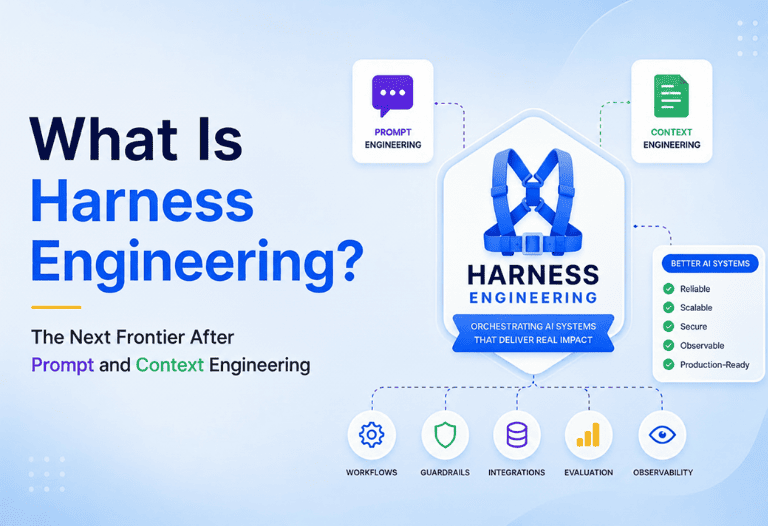
If you have been keeping up with the AI field over the past two years, you would have definitely noticed how rapidly engineering terminologies have evolved.
Initially, with the AI hype picking up, it was all about “prompt engineering.” Soon, it shifted to “context engineering.”
And now, all the serious discussions about AI are towards “harness engineering.”
Now, these shifts reflect a genuine development in our understanding of AI systems. They signify a deeper understanding of where AI systems face challenges in practice and of the changes necessary to address them.
From Prompt Engineering to Context Engineering
Prompt engineering seemed like a logical starting point. If the model responds to the inputs provided, then more effective inputs should lead to better outputs. This reasoning worked well for simple, single-turn tasks.
However, problems emerged when teams attempted to use those same models for more complex scenarios. For instance, a customer support bot might lose track of the conversation midway. A code assistant may perform excellently in demonstrations but fail silently during real-world use. Similarly, a document analysis tool could confidently provide answers to questions despite lacking the necessary information.
The fix, for a while, was context engineering which included feeding the model for more data, including more docs and instructions. It was all providing the model with data upfront to provide better results. But it still hit a wall.
Context lives inside the model’s input window. It’s fixed at the start of each interaction. It can’t update based on what the model discovers mid-task. It can’t grow when the task turns out to be more complicated than expected.
And past a certain point, stuffing more into the context window actually degrades output quality rather than improving it.
Context engineering was a better input strategy. What it couldn’t be was an execution strategy.
What Harness Engineering Actually Is
Here’s the shift that harness engineering represents instead of building a better prompt or loading a richer context; you build a better system around the model.
The harness encompasses everything outside the large language model (LLM) that influences its behavior in real-world situations. This includes the tools the model can utilize, the memory systems that retain information across sessions, the retrieval processes that fetch relevant data when needed, the safety measures that limit outputs to acceptable ranges, and the feedback mechanisms that allow the agent to observe outcomes and make adjustments.
Current research describes the harness as a key factor in determining AI capability. The agent execution harness, which includes the software system that manages execution loops, tool access, context, memory, lifecycle, and evaluation, is not merely a passive implement for the model’s capabilities. The design choices made in developing this harness are critical determinants of whether a capable model can effectively function as a reliable system.
Think of the difference between these two instructions:
- Context engineering approach: “Here is all the relevant documentation. Here are the instructions. Now generate the response.”
- Harness engineering approach: “Go read what you need. Run the analysis. Check the output. If something looks wrong, fix it. Then return the result.”
The first approach asks the model to work with what it’s been given. The second approach gives the model an environment it can work in.
Why the Harness Problem Is So Urgent Right Now
A 2026 estimate puts the number of AI agent projects that never make it to production at around 88%, with the harness being too fragile as the most common reason.
That number is worth sitting with. Not the model failing. Not the underlying technology being insufficient. The harness being too fragile.
Deloitte’s 2025 Emerging Technology Trends study found that while 30% of organizations are exploring agentic options and 38% are piloting solutions, only 14% have solutions ready for deployment, and a mere 11% are actively using these systems in production.
Gartner predicts over 40% of agentic AI projects will be canceled by the end of 2027, citing escalating costs, unclear business value, and inadequate risk controls.
That gap between the organizations exploring AI and the ones actually running it in production is not a model capability gap. The models are capable. The infrastructure around them isn’t keeping up.
The Three Pillars of a Well-Built Harness
1. Dynamic Retrieval Instead of Static Context
In context engineering, you preload knowledge. In harness engineering, you give the agent the ability to go find what it needs when it needs it.
This means RAG pipelines that retrieve relevant documents at query time, not at setup time. It means search tools the agent can call mid-task. It means memory systems that track what the agent has already discovered and avoid redundant lookups.
The result is an agent that works with current, relevant information rather than a fixed snapshot from the beginning of the session.
2. Guardrails That Enforce, Not Instruct
There’s a meaningful difference between telling an agent “follow our coding standards” and wiring a linter that blocks the output when standards are violated.
The first is probabilistic. The model might comply, or it might not, depending on how the prompt was worded and what else is competing for attention in the context window. The second is deterministic. The constraint isn’t optional.
Harness engineering formalizes this distinction: telling an agent to follow standards in a prompt is fundamentally different from wiring a constraint that enforces those standards at the execution layer. Real guardrails live in the harness, not in the instructions.
3. Closed-Loop Execution Instead of One-Shot Output
Traditional AI workflows are one-shot. The model generates a response. The user evaluates it. If it’s wrong, they try again with a better prompt.
Harness engineering replaces that with a feedback loop. The agent acts, observes the result, checks whether the output meets the success criteria, and corrects before surfacing the result to the user.
What This Means for Businesses Building AI Systems
If you’re evaluating AI vendors, building internal AI capabilities, or trying to understand why a promising pilot hasn’t made it to production, Harness Engineering is the framework worth paying attention to.
The question is no longer which model to use. The models are increasingly commoditized. Two teams running the same model can get dramatically different results based entirely on how the harness is designed.
Benchmarks reported by several AI engineering teams in 2025 show that improving the harness on the same model can outperform switching to a more capable model.
That means the competitive advantage in AI isn’t about access to the most powerful model. It’s about building the best execution environment around it.
For enterprises specifically, that involves several things that can’t be handled by prompt tuning alone: integration with existing systems, compliance with data governance requirements, handling of edge cases and failure states, observability into what the agent is doing and why, and the ability to update behavior without retraining the model.
How Primotech Approaches Harness Engineering
Building a harness that actually holds in production requires depth across multiple disciplines. Retrieval architecture. Orchestration design. Tool integration. Evaluation frameworks. Observability. Not every team has all of that in-house, and building it from scratch while trying to move quickly is a common source of the failure rates cited above.
Primotech works with enterprises to design and build AI systems where the harness is built right from the start, not retrofitted after the pilot fails. That means defining the execution environment before writing the first line of agent code, building feedback loops that catch failure modes before they surface to users, and treating the harness as a long-term infrastructure asset rather than a one-time project deliverable.
If your team is moving from AI exploration to AI deployment, the conversation worth having is about harness design, not model selection.
Conclusion
The shift from prompt engineering to context engineering to harness engineering reflects a maturing understanding of AI. The models were never the main bottleneck; the systems around them were.
If you’re serious about deploying AI that works reliably in production, harness engineering is now the foundation for everything else that is built on. The teams that get this right in the next 12 months will be very hard to catch.