 August 11, 2026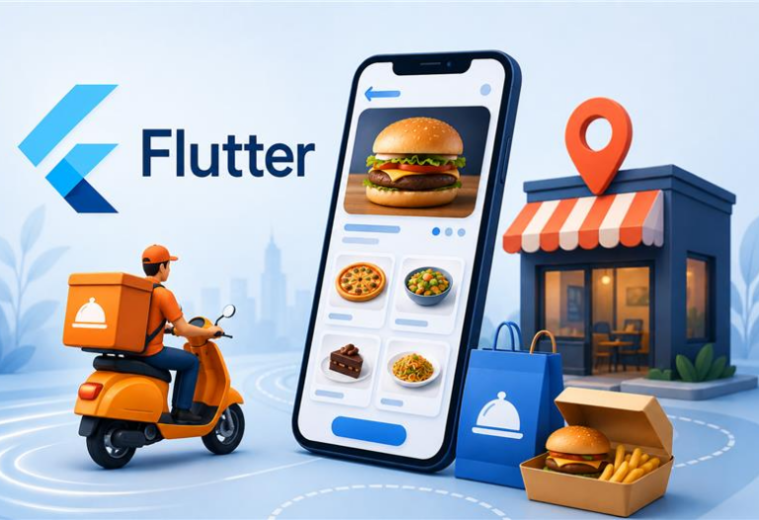
Food delivery is one of the few digital habits people almost never give up. What started as a lockdown convenience settled into a default, and whoever owns the moment a hungry person decides what to eat owns something valuable. For a restaurant brand or an aggregator, the app stopped being a marketing extra a while ago. It is the storefront now, and often the only one that matters.
So the question is rarely whether to build one. It is how to build it well, on a budget that survives contact with reality, without paying two teams to build the same thing twice for iOS and Android. That last problem is where Flutter made its name. This guide walks through why Flutter suits Flutter food delivery app development, the features a genuinely competitive platform needs, and where an AI layer now separates the Zomatos and DoorDashes from everyone still playing catch-up.
Statistics Behind Food Delivery in 2026
The market is big, and it is still climbing, which is the first reason to build the app properly rather than cheaply.
- Global online food delivery revenue is projected to reach roughly $1.51 trillion in 2026, counting both meals and groceries.
- The sector keeps growing at about 9 to 10% a year through 2030, well ahead of most of retail.
- By 2027, an estimated 2.5 billion people worldwide are expected to order through delivery platforms.
Demand at that scale rewards whoever ships first and iterates fastest. The framework under the app shapes both, which is where the choice of Flutter starts to matter.
Why Choose Flutter for Food Delivery App Development
Flutter is Google’s open-source framework for building apps from a single codebase. Several of its traits map directly onto what food delivery actually demands. It is also the framework most teams now reach for: Flutter is the most widely used cross-platform toolkit, favoured by around 46% of developers.
1. One Codebase for Both Platforms
This is the headline. Cross-platform food delivery app development means a single codebase runs on iOS and Android, so nobody builds and maintains the same product twice. The build is shorter, the cost is lower, and the app reaches the store sooner. In a category where the first-to-launch competitor tends to define the local habit, sooner is not a niceness. It is the whole game.
2. Faster Iteration With Hot Reload
Flutter’s hot reload shows code changes almost the instant they are made, without relaunching the app. In a food delivery build, where menus, promos, and checkout flows are constantly tweaked, that speed adds up quietly across a project. A fix reaches users the same afternoon rather than waiting until next week’s release.
3. Native-Like Performance
Flutter compiles to native machine code through Dart, which keeps things smooth under the exact conditions these apps face: a live tracking map, fast screen changes, an impatient thumb at checkout. Performance here is not a technical footnote. A stuttering tracking screen is a cancelled order, and a cancelled order is often a customer who does not come back.
4. A Rich, Consistent Interface
Appetite is visual. Flutter’s widget library supports the polished, photo-led design food delivery lives on, and the single codebase keeps that design identical across devices. Whether someone opens the app on a three-year-old Android or the newest iPhone, the brand looks and behaves the same. That consistency is a large part of why Flutter for food delivery apps works so well for design-driven brands.
5. Lower Cost to Build and Run
One team, one codebase, one thing to maintain. Both the initial build and the years of updates afterward cost less than a matched pair of native apps, and adding a feature means writing it once rather than twice. For a startup guarding its runway or an established brand watching its budget, that is often the deciding factor, and it is why custom Flutter app development appeals to companies of very different sizes.
Key Features of a Food Delivery App Built With Flutter
A food delivery app is really four connected products, not one. A strong platform serves the customer, the restaurant, the rider, and the administrator, each having its own interface built for the job. This multi-sided shape is where Flutter restaurant app development earns its keep, since one framework can deliver all four without splintering the codebase.
1. Customer App
Onboarding that gets out of the way: Sign-up by email, phone, or a social login, with no long form standing between a hungry user and the menu.
Search and filters that find the right thing fast: Cuisine, price, rating, dietary needs, delivery time. The faster someone finds dinner, the less likely they are to close the app.
Live order tracking: From kitchen acceptance to the rider’s dot moving on the map. People expect to watch the order approach, and they will refresh the screen either way.
Payments without friction: Cards and wallets and UPI, plus Buy Now Pay Later where the market expects it.
2. Restaurant Dashboard
Order management: Live alerts for new orders, and a one-tap way to accept or reject during a dinner rush.
Menu control: Editing dishes, flipping items in and out of stock, and running a promotion without waiting on a developer.
Analytics that inform the kitchen: What is selling, what is not, and what customers keep saying in reviews.
3. Delivery Partner App
Route optimisation: Map integration that hands riders the efficient path rather than the obvious one.
Earnings at a glance: A clear running total for the day and the week, because riders check it constantly.
Order notifications: Prompt, unmissable alerts for new jobs and status changes, built to work one-handed on a modest phone.
4. Admin Panel
User management: Control over customer, restaurant and rider accounts from one place.
Order monitoring: A live view of what is in flight, what is done, and what got cancelled and why.
Financial tracking: Revenue, transactions and commissions, laid out so the business can actually be steered.
Building an AI-Powered Food Delivery App
The current generation of platforms competes on intelligence, not just features. An AI-powered food delivery app puts the data the platform already collects to work, improving the experience and the economics at the same time, and adoption of AI across the sector is climbing quickly.
The applications worth building are practical rather than sci-fi. A recommendation engine learns what someone orders and surfaces the dish they are most likely to add, which lifts the basket size. Demand forecasting warns a kitchen that Friday night is coming, which cuts both waiting and waste. Smart dispatch assigns riders by real proximity and route instead of a plain queue, which shaves minutes off delivery. Delivery estimates that adjust for traffic and kitchen load set honest expectations and spare the support team a wave of “where is my order” messages. A decent chatbot handles the routine questions at 1am so nobody has to.
Flutter sits comfortably next to the machine-learning services and APIs these features need, so the AI layer can go into a Flutter build without a second app or a painful rebuild.
Choosing a Flutter App Development Company
The framework gets you most of the way. Execution decides the rest, and it is where builds quietly go wrong. When you weigh up a Flutter app development company, push past the portfolio screenshots. Has the team actually shipped a multi-sided platform with live tracking and real payments, or only tidy single-screen apps? Can they show performance under load, since a delivery app breaks at precisely the busy moments that pay the bills? Do they own the back end, the payment and map integration, and the AI, or just the front end? A partner who holds the whole stack removes the coordination risk that sinks so many projects halfway through.
How Primotech Builds Flutter Food Delivery Apps
At Primotech, we build Flutter food delivery apps designed to support the complete delivery ecosystem—from customer-facing mobile apps to restaurant management, delivery operations, payments, maps, and admin controls. By using Flutter, we can develop for both iOS and Android from a shared codebase while maintaining a consistent experience across platforms.
Our approach also brings AI and machine learning into the development process where they add real business value. Food delivery platforms can incorporate features such as personalized recommendations, intelligent delivery assignment, demand forecasting, and data-driven insights as part of the core product architecture.
We design the platform with scalability in mind from the beginning. Whether a business is launching in a single city or planning a multi-city food delivery platform, we build the underlying architecture to support future growth without requiring a complete rebuild. Backend systems, payment gateways, mapping APIs, notifications, and other integration are developed as connected parts of the platform.
As a Flutter app development company in Mohali, India, with a presence in the USA, we work with businesses looking to build and scale custom mobile applications. Our focus is on creating food delivery solutions that are reliable, scalable, user-friendly, and ready to evolve as business requirements grow.
Wind Up
Cross-platform reach, genuinely good design, and a cost that works for a startup or an enterprise: that combination is why Flutter has become such a natural fit for food delivery. Add an AI layer that sharpens both the customer experience and the unit economics, and you have a platform built to hold its own in a market that is still growing fast. The framework is a strong start. A partner who can build all four sides of it, and stand behind the result, is what turns a start into a launch.
Frequently Asked Questions
Why is Flutter a good choice for a food delivery app?
It builds for iOS and Android from one codebase, which cuts cost and time, and it delivers the smooth performance and photo-led interface food delivery depends on. For most businesses, no other option balances speed, quality and budget as well.
How long does it take to build a Flutter food delivery app?
It comes down to scope. A focused platform covering the core customer, restaurant, rider and admin sides usually takes a few months. A larger build with deep AI and multi-city support runs longer. The single codebase is one reason Flutter tends to reach launch faster than native development.
Is a Flutter app cheaper than building separate native apps?
Usually, and by a real margin. One team maintains one codebase instead of two, so the build and every update after it cost less. A new feature gets written once, not twice.
Can AI features be added to a Flutter food delivery app?
Yes. Flutter works well with machine-learning services and APIs, so recommendations, demand forecasting, smart dispatch and chatbots all fit in. The most useful AI improves the customer experience and the operating margin at the same time.
Does Flutter support live order tracking and payments?
Yes. Live tracking, map integration, and the payment methods customers expect, cards, wallets and UPI among them, are all well within reach, and all of them are essential to a competitive platform.