 March 2, 2026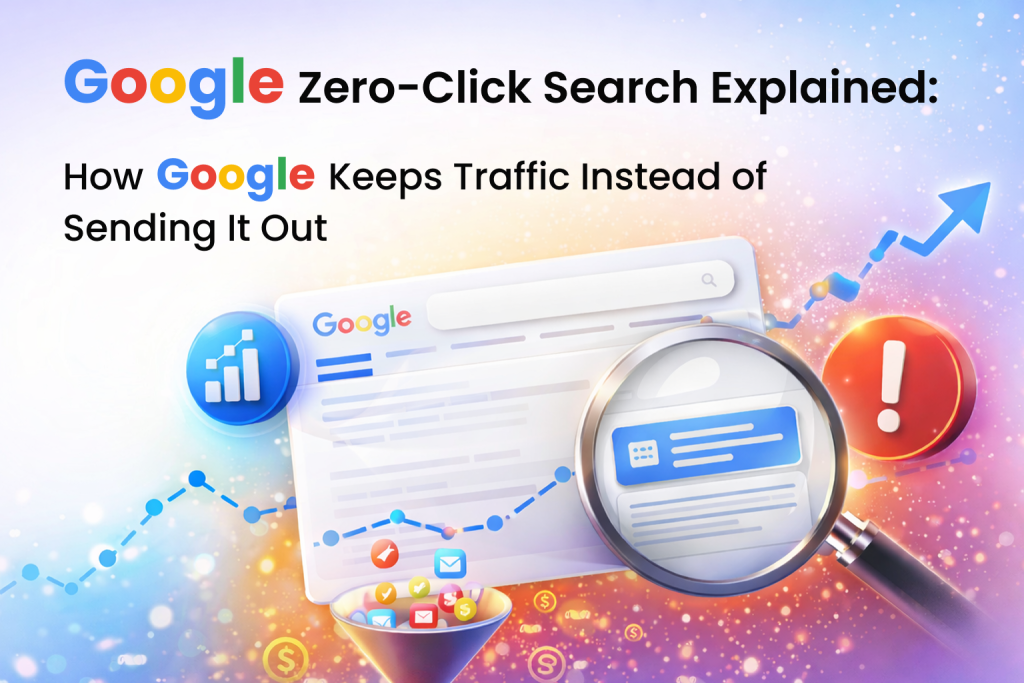
Google Zero-click search refers to queries where users get answers directly on Google without visiting a website.
Nowadays, everyone I talk to in marketing is saying the same thing.
“Our organic traffic is down. AI Overviews are eating our clicks.”
I agree that some of it is true. But there is a bigger story hiding in the data that nobody is talking about loud enough.
The clicks are not disappearing. They are being moved.
Here is what the independent research actually shows.
Ahrefs ran a 300,000 keyword study comparing December 2023 to December 2025. When an AI Overview is present on the SERP, the organic click-through rate for the top-ranking page drops by 58%. That is more than half your clicks gone.
Seer Interactive tracked 3,119 search terms across 42 organizations over 15 months, covering 25.1 million organic impressions. Organic CTR on AI Overview queries dropped from 1.41% to 0.64%.
Pew Research confirmed the same pattern from actual user browsing behavior: 8% click rate when an AI Overview is present, compared to 15% without one.
Zero-click searches now account for 69% of all Google queries, up from 56% in May 2024, according to Similarweb. That is a 13-point jump in a single year.
So yes. Organic is being hurt. That part is real. But here is what the same period also shows on the other side of the ledger.
Sundar Pichai described it as “Search saw more usage than ever before, with AI continuing to drive an expansionary moment.”
More queries, fewer organic clicks, and record ad revenue point to a deliberate evolution of Google’s business model.
What does this mean for e-commerce specifically?
In commercial and product verticals, things get much clearer.
An analysis of SERP composition data across e-commerce queries from January 2025 to January 2026 shows text ads captured between 7 and 13 percentage points of click share that previously went to organic results.
In product categories, when you add PLAs on top of text ads, paid search now commands between 19% and 36% of all clicks, depending on the category.
Some verticals essentially doubled their paid click share in a single year.
Google Shopping Ads alone are responsible for 76.4% of all retail search ad spend in the US. And the brands being cited inside AI Overviews are not just surviving the shift.
Seer’s data shows they earn 35% more organic clicks and 91% more paid clicks compared to brands not cited on the same queries.
So, if you are an e-commerce brand sitting on a paid search budget that has not moved in 12 months, your visibility on commercial queries has actually gone backwards.
Strategy for AI Search in 2026: GEO Builds Visibility, Paid Search Captures Buyers
AI Overviews changed the shape of the SERP. But it is Google’s financial incentives that are changing who gets the clicks.
These two things are not the same problem, and they do not have the same solution.
For informational queries, the answer is GEO strategy: being cite-worthy, earning AI citations, and building structured content that AI systems actually pull from.
Brands cited in AI Overviews see higher CTR across both organic and paid. That is an earned signal, and it compounds.
For commercial and transactional queries, the answer is paid search. Because the real estate on those SERPs is now a paid auction. If you are not in it, you are invisible.
→ Check where AI Overviews are triggering for your most valuable commercial keywords right now.
→ Audit how much of your paid search budget is allocated to transactional queries vs informational ones.
→ If you are measuring SEO success purely by traffic in 2026, you are measuring the wrong thing. Measure visibility across both paid and organic surfaces.
Here is the key takeaway for you!
Google Search is not broken. It is evolving toward a model where informational queries feed AI systems and commercial queries feed the ad auction.
The SERP is being restructured to send high-intent commercial clicks to paid placements. AI Overviews are the mechanism. Ad monetization is the outcome.
The brands that figure this out now will be in a very different position 18 months from now than the ones still waiting for their organic traffic to come back.
It is not coming back, at least not for commercial queries; you have got to adjust the strategy accordingly.
Brands that adapt their strategy now will gain a structural advantage in the AI-driven search economy. For questions, feel free to reach out to me at [email protected]