 May 20, 2026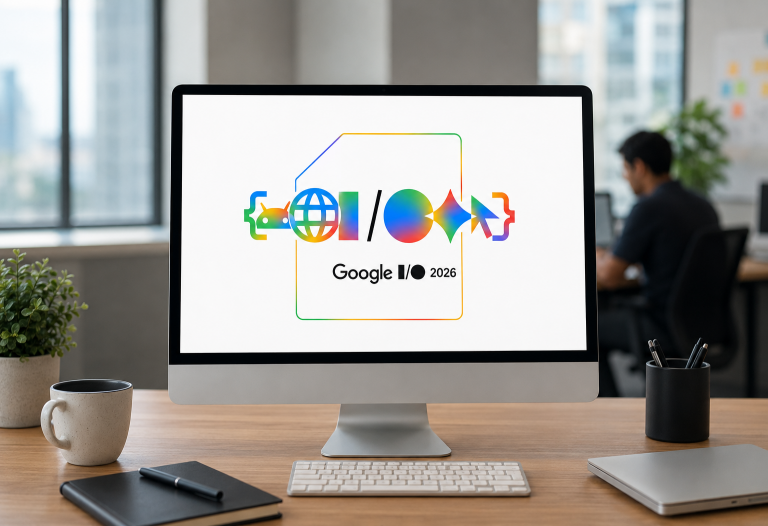
In its latest annual I/O developer conference held by Google on May 19, the announcements clearly indicate how the company is no more tiptoeing around AI.
This year’s event was less about previews and more about shipping. Search, the Gemini app, infrastructure, new hardware, content authenticity tools, and much more.
Google came with a full slate, and Sundar Pichai set the tone early in his keynote.
“We’re now in the part of the AI cycle where people want to see the value in the products they use every day,” he said.
That framing explains a lot about what Google announced, most of it is rolling out now or within weeks, here is a thorough breakdown of everything that matters from I/O 2026.
Google Search Has a New Brain
The headline announcement is a reminder for everyone to rethink how Search works. AI Overviews now has over 2.5 billion monthly active users, and AI Mode has already crossed 1 billion monthly active users in just a year since launching. Google is calling it the biggest upgrade to Search ever.
When people use AI-powered features in Search, they use Search more. Search has shifted from individual queries to something that feels more like an ongoing conversation, offering deeper insights and connecting users with the wider web.
The next step is what Google calls information agents in Search. These are personalized AI agents that run in the background, around the clock, to find what you need at exactly the right moment and help you to take action. They are rolling out this summer, starting with Google AI Pro and Ultra subscribers.
Search is also getting generative UI capabilities. With Gemini 3.5 Flash and Google Antigravity, Search will build custom experiences for individual questions, including dynamic layouts and interactive visuals. These features will be available for everyone in Search this summer, free of charge.
For longer-running tasks, Search can build persistent custom dashboards or trackers that users can return to and make progress over time, essentially mini apps built for specific tasks.
Gemini 3.5 Flash: Faster, Cheaper, More Capable
Google formally introduced Gemini 3.5 Flash, and the benchmarks are striking. Compared to 3.1 Pro, 3.5 Flash performs better across almost all benchmarks, particularly in coding. In terms of output speed, it is 4 times faster than other frontier models at the same intelligence tier.
The cost angle is notable too. Gemini 3.5 Flash delivers frontier-level capabilities at less than half the price of comparable frontier models. Google estimates that companies processing around 1 trillion tokens a day could save over $1 billion annually by shifting 80% of their workloads from other frontier models to 3.5 Flash.
Gemini 3.5 Flash is available today across Google’s products and APIs. Gemini 3.5 Pro is being used internally and is expected to arrive next month.
Gemini Omni: A New Class of Model
Google introduced Gemini Omni, a new model capable of generating output in any modality from any input. It starts with video outputs, with image and text to follow. The first model in the family, Gemini Omni Flash, is available today on the Gemini app, Google Flow, and YouTube Shorts, with API access for developers and enterprise customers coming in the coming weeks.
This is significant because it combines Gemini’s reasoning with Google’s generative media capabilities in a single model, rather than patching them together as separate systems.
Gemini Spark: Your Personal AI Agent
Gemini Spark is a personal AI agent inside the Gemini app, designed to help users navigate their digital lives by taking action on their behalf and under their direction. It runs on dedicated virtual machines on Google Cloud, operates around the clock without requiring the user’s laptop to stay open, and is powered by Gemini 3.5 and Google Antigravity.
Spark will integrate with Google’s own tools first, then extend to third-party tools via MCP in the coming weeks. Users can interact with it through the Gemini app and soon, via email and chat. On Android, a new UI layer called Android Halo will show live updates and task progress.
The Beta is coming to Google AI Ultra subscribers in the U.S. next week, with trusted tester rollouts starting this week.
Antigravity 2.0: Agent Development for Everyone
Antigravity is expanding beyond a coding environment into a platform for developing and managing cohorts of autonomous AI agents. Antigravity 2.0 is a new, standalone desktop application that serves as a central hub for agent interaction. It also includes an optimized version of Flash that is 12 times faster than other frontier models.
Internally, Google has been processing more than three trillion tokens a day through its AI developer tools using 3.5 Flash and Antigravity, doubling every few weeks. That scale has created a feedback loop that has directly helped improve the 3.5 model.
Infrastructure: $180-190 Billion Capex and 8th Gen TPUs
Google is not holding back on infrastructure spend. In 2022, Google’s annual capex was $31 billion. This year, it expects to spend approximately $180 to $190 billion, roughly six times that figure.
At Cloud Next, Google announced its 8th generation of TPUs, TPU 8t and TPU 8i, with a dual-chip approach. TPU 8t is built for large-scale pretraining, delivering nearly three times the raw computing power of the previous generation, and is capable of distributing training across more than 1 million TPUs globally. TPU 8i is built for inference with dramatically improved speed at every step. Both chips offer up to 2x better performance per watt than the previous generation.
Token Scale: From Trillions to Quadrillions
The numbers around AI adoption at Google are hard to ignore. Two years ago, Google was processing 9.7 trillion tokens per month. Last year, it grew to roughly 480 trillion. Today, it has jumped 7x to over 3.2 quadrillion tokens per month across its surfaces.
Over 8.5 million developers are now building with Google’s models monthly, model APIs are processing roughly 19 billion tokens per minute, and over 375 Google Cloud customers each processed more than one trillion tokens over the past twelve months.
SynthID Expands to Search and Chrome, OpenAI Signs On
Google’s SynthID watermarking technology, now three years old, has watermarked over 100 billion images and videos, along with 60,000 years of audio assets. Google is now expanding SynthID and Content Credentials verification to Search and Chrome, so users can see whether content originated from AI or a camera and whether it has been edited with generative AI tools.
OpenAI, Kakao, and Eleven Labs are adopting SynthID, joining Nvidia, which signed on last year. That is a meaningful signal for cross-industry standards of content authenticity.
Other Notable Announcements
Ask YouTube: Ask YouTube reimagines the search experience on the platform, making information more digestible by surfacing the most relevant videos and jumping directly to the part of the video most relevant to the user’s question. It is starting to test now and will roll out broadly in the U.S. this summer.
Docs Live: Users can verbally “brain dump” content and have Gemini organize it into a structured document. Future versions will also support direct voice editing. Docs Live is rolling out for subscribers this summer, with voice capabilities extending to Gmail and Keep at the same time.
Google Pics: Google Pics is a new AI image creation and editing tool built on the Nano Banana model. It treats every element in an image as an individual object, allowing users to create, swap, or refine specific details rather than editing flat images. It is available now to trusted testers and rolls out later this summer to Google AI Pro and Ultra subscribers.
Audio Glasses: Google’s intelligent eyewear includes audio glasses that offer spoken help in the user’s ear and display glasses that surface information visually. Both are hands-free and powered by Gemini. Audio glasses are launching first, coming later this fall.
Gemini for Science: Gemini for Science connects agentic platforms like Antigravity to over 30 major life science databases and tools, building on Gemini’s deep reasoning and research capabilities. Science Skills is available today on GitHub and directly in Antigravity.
Daily Brief: Daily Brief is an out-of-the-box agent coming to the Gemini app that delivers a personalized morning digest synthesized from the user’s inbox, calendar, and tasks. It prioritizes and suggests next steps rather than simply summarizing information.
Gemini App Growth: The Gemini app has surpassed 900 million monthly active users, up from 400 million at last year’s I/O. Daily requests have grown over seven times in the same period.
The scale and breadth of what Google announced at I/O 2026 makes it one of the more substantive developer events in recent memory.
The shift from single-query Search to persistent, agentic Search alone represents a structural change in how hundreds of millions of people interact with information online.
Developers and enterprises watching token economics will also have a lot to think through with Gemini 3.5 Flash’s pricing.
More details on individual announcements are available at blog.google.