 December 4, 2025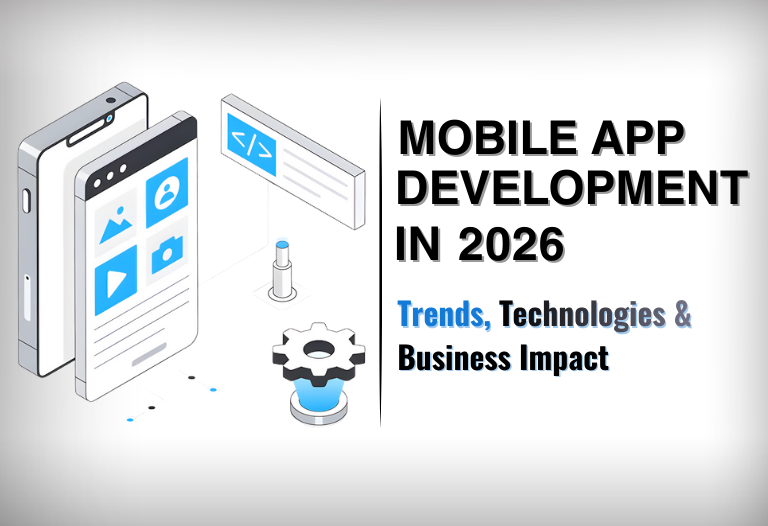
Mobile App Development is changing quickly. In 2026, new technology, automation, and more personalized experiences will shape how apps will be made. Many businesses now use Mobile App Development Services to reduce costs, reach customers faster, and deliver better digital experiences across all devices.
If you are a startup founder, product manager, or business looking for Mobile App Development solutions in the USA, knowing the latest trends can help you make better decisions and stay competitive.
This blog will help you understand the main trends, new technologies, and how mobile apps will affect businesses in 2026. The information is based on current technology, market reports, and the global digital economy.
Why Mobile App Development Matters More Than Ever in 2026
In the upcoming year, more people will use smartphones and mobile devices than ever. Users will expect apps to be fast, helpful, and tailored to their needs in every industry.
A few core reasons driving this growth include:
- AI-powered consumer behavior modeling
- The rise of 5G/6G connectivity
- Cross-platform ecosystems replacing traditional single-platform apps
- The expansion of IoT devices and wearables
- The shift toward automation-first business models
If businesses do not keep up with new Mobile App Development methods, they may lose money, customers, and their market position.
Top Trends Shaping Mobile App Development in 2026
Here are the main changes businesses should pay attention to.
1. AI-Native Mobile Apps Become Standard
AI is no longer a feature; it’s the foundation. In 2026, mobile apps will be AI-native, meaning they will:
- Predict user needs before actions.
- Personalize UI, content, and recommendations
- Automate repetitive workflows
- Improve security with behavioral biometrics.
- Enhance real-time decision-making
Examples:
- Financial apps predicting spending behavior
- E-commerce apps auto-building personalized shopping feeds
- Healthcare apps analyzing symptoms using multimodal AI.
- Fitness apps customizing routines based on biometric data
Companies offering modern Mobile App Development Services already integrate machine learning, NLP, emotion detection, and generative AI into app workflows. By 2026, this will be mandatory rather than optional.
2. 6G & Advanced Connectivity Will Revolutionize App Performance
With 6G expected to arrive by 2026 or 2027, mobile apps will improve in many ways:
- Near-instant app loading
- Zero-latency cloud gaming
- Smarter IoT interoperability
- Enhanced AR/VR performance
- High-quality video interactions
This means apps can be smaller and use cloud processing instead of relying on the device.
3. Super Apps Will Dominate Western Markets
What started in Asia is now expanding to the USA and Europe.
Super apps provide multiple services within one ecosystem–payments, travel, insurance, messaging, eCommerce, and more.
By 2026:
- At least 3–5 major US companies will release full-featured super apps.
- More brands will merge/partner to create integrated digital ecosystems.
- People are tired of switching between many apps, so super apps will become more popular.
This will reshape Mobile App Development in the USA, encouraging brands to integrate:
- Fintech
- E-commerce
- Communication tools
- AI assistants
- Wellness tracking
- On-demand services
In the future, platforms that offer many features will be more common than apps that do only one thing.
4. AR, VR & Spatial Apps Go Mainstream
Devices like Apple Vision Pro, Meta Quest, Samsung XR, and Google’s AI lenses are making immersive mobile experiences more common.
In 2026, mobile apps will adopt spatial features for:
- 3D product try-outs
- Virtual shopping
- Education
- Healthcare simulations
- Real estate walk-throughs
- Tourism
- Remote work collaboration
Industries benefiting most:
- E-commerce (virtual product trials)
- Gaming (mixed reality worlds)
- Real estate (AI-generated virtual tours)
- Education (interactive learning modules)
- Healthcare (remote diagnostics + visualization tools)
Companies offering Mobile App Development Services must be highly skilled in 3D design, computer vision, and AR/VR frameworks such as ARCore, ARKit, Unity, and Unreal Engine.
5. Voice & Multimodal Interfaces Take Over
Typing is slowly becoming outdated.
Apps in 2026 will interact through:
- Voice
- Gestures
- Images
- Camera input
- Audio commands
- On-screen recognition
AI models that use vision, speech, text, and actions will make apps easier to use.
For example:
A banking app could allow the user to simply say, “Transfer ₹5,000 to Aman,” while the camera scans facial gestures for authentication.
6. Instant Apps & Zero-Download Experiences
Making it easy for users to start using an app is very important.
Many users do not want to download new apps, so instant apps, web-based apps, and cloud-streamed apps will become much more popular in 2026.
Benefits:
- Try-before-you-download experiences
- Smaller app sizes
- Higher conversion rates
- Fast accessibility
This change is making businesses rethink how they approach mobile apps.
7. Low-Code & No-Code Platforms Boost Rapid App Delivery
By 2026, more than 50% of app prototypes and MVPs will be built using low-code/no-code tools.
These platforms allow startups and enterprises to:
- Launch faster
- Reduce development costs
- Test multiple ideas quickly.
- Build internal apps without deep technical expertise.
However, large and complex apps will still need robust Mobile App Development Services for security, scalability, and integration with other systems.
8. Web3, Blockchain & Decentralized Mobile Apps
Web3 is starting to be used in real ways, not just as a trend.
Decentralized apps (dApps) in 2026 will support:
- Identity verification
- Cross-border payments
- Tokenized assets
- Transparent supply chains
- Loyalty & rewards programs
- Smart contract-based automation
Users will be able to manage their data, identity, and transactions using mobile wallets in regular apps.
9. IoT & Wearable App Expansion
Smart homes, connected cars, and wearable devices are becoming a normal part of daily life.
Mobile apps in 2026 will act as command hubs for:
- Home automation
- Smart appliances
- Industrial IoT systems
- Fitness trackers
- Health sensors
- Smart vehicles
There is a big opportunity to create mobile dashboards that help control, monitor, and understand connected devices.
Emerging Technologies Transforming Mobile App Development
Beyond trends, certain technologies will define the architecture of mobile products in 2026.
1. Generative AI & Autonomous Workflows
Apps will increasingly generate:
- Images
- Videos
- Voice responses
- Real-time translations
- Auto-filled content
- Personalized reports
This will unlock autonomous workflows in which apps act proactively rather than waiting for user input.
2. Edge Computing for Lightning-Fast Processing
Edge computing means data is processed closer to the user’s device, not just in the cloud.
By 2026, this will become essential for apps requiring:
- Real-time responses
- High-speed analytics
- Offline capabilities
- Enhanced security
Examples:
- Autonomous drones
- Industrial IoT apps
- Advanced fitness or health analysis apps
3. Quantum-Safe Encryption
As quantum computing advances, older security methods will no longer be sufficient.
Apps will adopt:
- Post-quantum cryptography
- Advanced encryption models
- Secure digital identities
- Zero-trust architectures
Cybersecurity will be a top priority for Mobile App Development in the USA.
4. 3D Avatars & Digital Humans
Mobile apps will feature hyper-realistic avatars for:
- Customer support
- Telehealth
- EdTech
- Gaming
- Virtual try-ons
These avatars will use:
- Facial animation
- Emotion detection
- Real-time speech synthesis
This will make apps feel more personal and human.
Let’s break down the direct benefits businesses can expect by investing in modern Mobile App Development Services.
1. Reduced Operational Costs Through Automation
Apps equipped with AI and automation will reduce manual workloads by 40–60% in many industries.
Automations include:
- Chatbots for customer queries
- Predictive maintenance for machines
- Smart scheduling
- Auto-generated reports
- Document processing
This helps lower labor costs and improve efficiency.
2. Powerful Customer Acquisition & Retention
Mobile apps remain one of the most effective channels for engagement.
By 2026, apps will integrate:
- Real-time personalization
- AI-driven push notifications
- Smart loyalty programs
- Predictive recommendations
This can help attract new customers at a lower cost and retain them longer.
3. Data-Driven Decision Making
Apps will collect and analyze data in real-time, helping businesses make faster decisions related to:
- Sales
- Inventory
- Customer behavior
- Marketing
- Demand forecasting
Every industry—from retail to logistics—benefits from mobile-first intelligence.
4. New Revenue Streams
Through in-app:
- Marketplaces
- Subscription models
- Digital products
- Virtual goods
- AI-powered add-ons
Mobile apps can be a steady source of income.
5. Stronger Brand Loyalty & Trust
Brands with a smartphone presence gain:
- Higher visibility
- Consistent engagement
- Direct communication
- Better reputation
In 2026, apps will focus more on security, helping build customer trust.
6. Scalability & Global Reach
Mobile apps help businesses reach people anywhere. With cloud-based systems, companies can grow quickly to serve millions of users.
This is important for companies that use Mobile App Development in the USA, as global users expect fast performance,support for many languages, and round-the-clock service.
Mobile App Development Strategies for Businesses in 2026
Here are some of the best strategies companies can use:
1. Adopt an AI-First Mobile Strategy
AI should power recommendations, analytics, search, customer support, fraud detection, and automation.
2. Prioritize Cross-Platform Development
Use Flutter, React Native, .NET MAUI, or Kotlin Multiplatform to accelerate delivery.
3. Focus on Microservices & Modular Architecture
This allows seamless scalability and fast updates.
4. Implement Strong Cybersecurity Protocols
Use encryption, threat monitoring, and zero-trust frameworks.
5. Build Lightweight, Fast, User-Friendly Apps
Reduce app size, simplify navigation, and use modern UI/UX standards.
6. Invest in Testing & Performance Optimization
Good performance will be essential in 2026.
Conclusion
2026 is set to be a transformative year for Mobile App Development. The rise of AI, immersive technologies, automation, and next-gen connectivity will redefine digital experiences and business models worldwide.
Using modern Mobile App Development Services is now necessary for companies that want to stay up to date and meet customer needs. With new chances in fintech, healthcare, eCommerce, logistics, education, and business automation, mobile apps will continue to drive innovation in the digital world.
Whether you are building a new startup app or a large business system, choosing the right technology and strategy will help you succeed in the next wave of Mobile App Development in the USA and around the world.
FAQs
1. What are the biggest Mobile App Development trends in 2026?
The major trends include AI-native apps, 6G-powered experiences, cross-platform development, immersive AR/VR apps, Web3 security, and voice/multimodal interfaces. These technologies will make apps faster, smarter, and more personalized.
2. Why should businesses invest in Mobile App Development Services in 2026?
Modern app development helps businesses automate workflows, reduce operational costs, enhance customer engagement, and unlock new revenue streams. With AI and automation becoming essential, investing in expert Mobile App Development Services ensures long-term competitiveness.
3. How is Mobile App Development in the USA evolving?
Mobile App Development in the USA is shifting towards AI-driven personalization, cloud-native architectures, enterprise automation, cybersecurity improvements, and immersive user experiences. The USA is expected to lead innovations in fintech, healthcare, IoT, and super apps by 2026.
4. What makes a mobile app successful in 2026?
Success depends on speed, AI-powered personalization, strong cybersecurity, intuitive UX/UI, cross-device compatibility, and continuous updates. Apps that deliver seamless, predictive, and secure experiences will outperform competitors.
5. How much does mobile app development cost in 2026?
The cost of developing a mobile app depends on the features you need and how complex the app is. If you work with an offshore team, a basic native app usually starts at about $10,000. If you want more advanced features like artificial intelligence, integrations with other systems, or real-time updates, the price will be higher based on what you need.