 December 31, 2025
Google Ads has changed a lot in the last three years, much more than it did in the previous decade. In the past, you had to manage bids and keywords and make regular changes yourself. Now, artificial intelligence does most of the work. It predicts what people want, changes bids instantly, and tests different ads for you. This shift defines Google Ads in the AI era. For businesses, this means new opportunities but also more confusion. Campaigns can scale faster, but mistakes can become costly very quickly.
In this blog, we will explain what has changed, the most common mistakes advertisers make, and practical strategies that can help you succeed with Google Ads as we move toward 2026.
What Google Ads in the AI Era Actually Means
Today, Google Ads works more like a prediction tool than a regular ad platform. Instead of reacting to rules set by advertisers, AI evaluates millions of signals every second to decide which ad to show, when to show it, and how much to bid. These signals include user behavior, device type, location, time, historical performance, and conversion likelihood. This means advertisers no longer “control” every outcome. Instead, success depends on how well campaigns are structured and how clearly goals are defined.
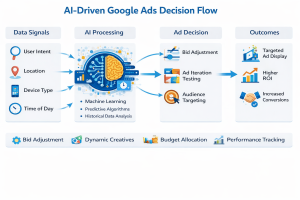 According to Google, advertisers using Smart Bidding see an average 19% increase in conversions at a similar cost per acquisition compared to manual bidding.
How AI Is Changing Google Ads Behind the Scenes
Understanding how AI is changing Google Ads requires examining how decisions are made today compared with a few years ago. Previously, advertisers decided on bids and targeted them manually. Now, AI evaluates intent and probability before an ad enters an auction.
- AI powered Google Ads systems:
- Predict which searches are most likely to convert.
- Adjust bids dynamically for each auction.
- Test ad combinations automatically
- Shift budgets toward higher-performing signals.
That is why campaigns with clear goals and accurate data usually do better than complicated setups that rely on a lot of manual changes.
Common Google Ads Mistakes to Avoid in 2026
Many advertisers struggle not because AI is ineffective, but because they apply old habits to a new system. These mistakes are especially damaging in AI-driven campaigns.
1. Overusing Broad Match Keywords Without Control
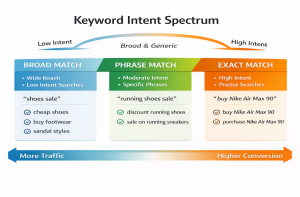 Broad match keywords are often suggested as a simple way to scale reach. However, without proper control, they often attract low-intent traffic.
Broad match tends to work only when:
- Conversion tracking is accurate.
- Smart bidding has sufficient historical data.
- Negative keywords are actively reviewed.
Without these conditions, AI explores too widely. As one small healthcare business owner noted, “Avoid using broad match keywords – they burn through my budget way too fast.”
Most advertisers achieve more consistent results by starting with high-intent exact- and phrase-match keywords and expanding cautiously.
2. Making Frequent Major Changes to Campaigns
AI systems need time and stability to learn. If you keep changing your bidding strategy, pausing campaigns, or making big changes to your account, the learning phase restarts.
This leads to:
- Short-term performance drops
- Inconsistent data signals
- Difficulty identifying what actually works
Allowing campaigns time to stabilize almost always leads to better long-term performance than constant adjustments.
3. Unquestioningly Accepting Google’s Automated Recommendations
Google Ads recommendations are generated automatically and often aim to increase reach or spend. While some suggestions are helpful, others may not align with business goals. Instead of accepting every recommendation, it takes time to review each one. Check if it will actually help you get better conversions, not just more clicks or views.
4. Weak Alignment Between Ads and Landing Pages
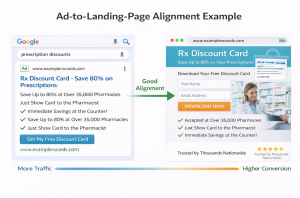 As shown in the example above, when ad messaging and landing page content stay aligned, users feel confident taking action, which helps Google’s AI correctly identify high-value traffic.
AI can drive traffic to your site, but it cannot fix problems if your ad message and landing page don’t match. When users don’t find what they expect after clicking an ad, bounce rates increase and conversion rates fall. This sends negative signals back to Google’s AI, affecting bidding and ad delivery. Make sure your keywords, ad copy, and landing pages all match to give users a better experience and AI optimization.
5. Incomplete or Incorrect Conversion Tracking
AI optimization depends entirely on data. If you do not track conversions correctly, Google Ads optimizes clicks rather than outcomes. Accurate tracking allows AI to understand which users are valuable and which actions matter most. Without it, bidding decisions become inefficient and unpredictable.
Traditional Google Ads vs AI-Driven Google Ads
Understanding the shift is easier when you compare older approaches with modern AI-driven systems. This evolution explains why many old tactics no longer deliver the same results.
| Aspect | Traditional Google Ads | AI Powered Google Ads |
| Bidding | Manual or rule-based | Real-time predictive bidding |
| Keyword focus | Exact keyword matching | Intent-based matching |
| Ad testing | Manual A/B testing | Automated asset optimization |
| Optimization speed | Slow and reactive | Continuous and proactive |
| Data reliance | Limited signals | Multi-signal machine learning |
Winning Google Ads Strategies for 2026
Avoiding mistakes helps your campaigns stay stable, but performance growth requires adapting strategy to how AI actually works today.
1. Using Smart Bidding as the Campaign Foundation
Smart Bidding is now the main tool for running Google Ads campaigns. It does the hard work that manual bidding cannot do anymore.
Instead of applying a single bid to everyone, Smart Bidding evaluates each auction in real time. Google’s AI looks at hundreds of signals at once, such as device type, location, time of day, search intent, past behavior, and likelihood to convert, and then adjusts the bid specifically for that user and moment.
As an advertiser, you don’t tell Google how much to bid. You tell it what success looks like. For example:
- Maximize conversions within a target CPA.
- Maximize conversion value at a target ROAS.
Once you set your goals, the system continuously learns from conversion data. It reallocates budget toward auctions that are more likely to drive results, while pulling back from low-probability traffic. This helps your campaigns perform better, something manual bidding cannot replicate in today’s complex auction environment.
2. Writing Ads That Help AI Learn Faster
Responsive Search Ads enable Google to test multiple headline and description combinations automatically. This removes guesswork and accelerates optimization.
Effective ad copy:
- Reflects real user intent
- Clearly communicates value
- Avoids repetitive messaging
Providing strong creative inputs helps AI identify winning combinations more efficiently.
3. Focusing on Intent Instead of Traffic Volume
AI evaluates intent signals, not just keywords. Two users searching for the same term may have very different conversion rates.
Campaigns structured around intent typically generate:
- Lower but higher-quality traffic
- Better conversion rates
- More efficient spending
This approach is increasingly common among businesses using structured PPC Marketing Services to prioritize outcomes over raw clicks.
4. Managing Automation Instead of Turning It Off
Automation is not the problem; lack of oversight is. Many advertisers get better results when they use smart bidding but avoid using too many default settings.
Helpful controls include:
- Disabling irrelevant networks
- Setting clear CPA or ROAS targets
- Reviewing search terms regularly
Your goal should be to guide automation, not eliminate it completely.
5. Strengthening Offers and Landing Page Experience
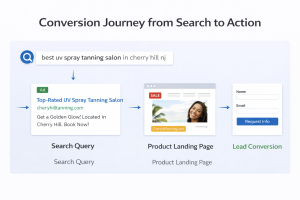 AI can optimize delivery, but it cannot improve weak offers or confusing pages. Users decide quickly whether an offer feels relevant and trustworthy. Make sure your offer is clear, your page is easy to use, and your ad message matches your landing page. This will help you get more conversions.
6. Preparing for Voice and Predictive Search Behavior
Search behavior is becoming more conversational. Voice queries and predictive suggestions are increasingly common within Google’s AI-driven ecosystem.
This shift requires:
- Natural language keywords
- Conversational ad copy
- Clear, direct landing page answers
Campaigns that reflect how users actually search are better aligned with AI-driven results.
AI Max for Search Campaigns: Supercharging Conversions
AI Max for Search campaigns uses advanced machine learning to optimize bids, target the right audience, and maximize conversions in real time. This makes it one of the top AI-driven strategies in 2025.
Key Benefits:
- Higher Conversions: ~14% more conversions at similar CPA.
- Better Keyword Performance: Up to 27% uplift for exact and phrase match keywords.
- Real-Time Optimization: Adjusts bids and targets dynamically.
- Efficient Scaling: Automates complex decisions for faster growth.
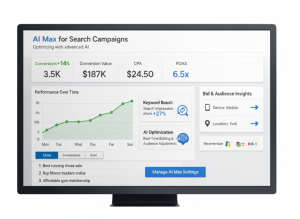
Why It Matters:
AI Max reduces much of the guesswork in campaign optimization. You can focus on your message and offers while AI delivers better results with the same budget.
Case Study: AI in Action
A local healthcare clinic that previously ignored AI tools and relied on manual bidding. Results looked like this:
| Metric | Before | After AI Optimization |
| CPA | ₹2,500 | ₹1,300 |
| Conversions | 40/month | 90/month |
| Click-Through Rate | 3.20% | 6.80% |
| ROI | 150% | 320% |
Key changes they made:
- Switched to Target CPA bidding
- Focused on exact match keywords
- Set clear conversion goals with Google Analytics 4 (GA4)
- Created responsive ad variations
- As a result, the clinic saw a big increase in both efficiency and conversions.
Why Human Experience Still Matters
While AI can handle many tasks, human judgment is still important for setting strategy, writing messages, and understanding results. AI works with the signals you give it, but people decide which signals are important. As a trusted PPC marketing company, Primotech Marketing team ensures campaigns are structured to help AI learn effectively, while maintaining clear, measurable goals such as lead quality, cost efficiency, and long-term growth. This balance of automation and human expertise allows businesses to achieve consistent results without losing strategic control.
Conclusion
Google Ads in 2026 is not about controlling every variable. It is about understanding how AI learns and builds campaigns that provide clarity, stability, and strong signals. Businesses that succeed with Google Ads strategies in 2026 will move away from outdated manual habits and focus on intent, data quality, and user experience. When you guide it correctly, AI becomes a powerful ally that improves efficiency and scalability rather than a source of uncertainty.