 November 13, 2025
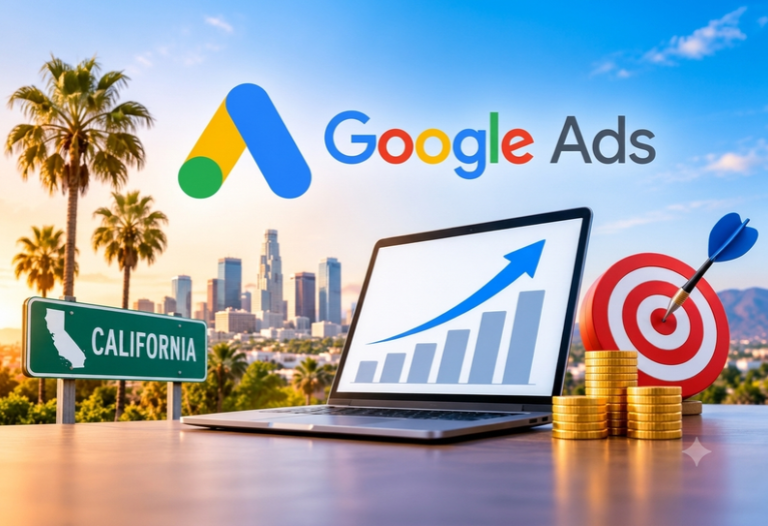
Advertising in California gives businesses access to customers actively searching for products and services. However, reaching those customers comes at a cost, especially in competitive industries such as legal services, healthcare, home improvement, and professional services.
The Best Google Ads in California strategy is not necessarily the one that generates the most clicks. It is the one that attracts the right customers, converts their interest into enquiries or sales, and generates enough value to justify the advertising spend.
Whether you run a local business in Los Angeles, a service company in San Diego, or an ecommerce brand serving customers across California, understanding advertising costs and campaign optimization will help you make better decisions.
How Much Do Google Ads Cost in California?
Google Ads operates through an auction system, so businesses do not pay one fixed price for every click. Your costs depend on keyword competition, location, ad relevance, bidding strategy, and the value advertisers place on a potential customer.
WordStream’s 2025 Google Ads benchmarks reported an average search advertising cost per click (CPC) of $5.26 across the industries studied in the United States. The average was $8.58 for legal services and $7.85 for home improvement and dental services. These are national industry benchmarks, not California-specific rates, so actual costs will vary.
What affects your advertising budget?
Several factors determine how much you need to invest:
- Industry competition: Businesses competing for high-value customers often pay more for clicks. A personal injury law firm, for example, faces different advertising costs from a local restaurant.
- Location targeting: A business targeting Los Angeles, San Francisco, or San Diego may face different auction conditions from one targeting a smaller service area.
- Keyword intent: Someone searching for “emergency AC repair near me” is likely closer to hiring a service provider than someone searching for “how air conditioners work.”
- Landing page performance: A relevant page that answers questions and makes contacting your business easy helps turn paid traffic into enquiries.
- Campaign objectives: Generating phone calls, selling products, and building brand awareness require different budgets and measurement methods.
How much should you spend on Google Ads?
Start with your customer acquisition goals instead of selecting a budget at random. Estimate how many leads you need, how many leads typically become customers, and how much profit each customer generates.
For example, a business targeting 20 leads per month at an estimated cost of $100 per lead would need a $2,000 monthly advertising budget. This is a planning estimate, not a guaranteed result.
Your total marketing cost may also include Google Ads management fees, landing page development, tracking setup, and creative production. Keep these expenses separate from media spend so you understand the actual investment required.
Once you have established a budget, focus on attracting qualified prospects rather than simply increasing traffic. These strategies help businesses identify wasted spending and improve campaign performance.
Is Your Google Ads Budget Working Hard Enough?
Get expert help with keyword targeting, conversion tracking, and campaign optimization so every dollar of ad spend moves you closer to qualified leads.
Proven Google Ads Strategies to Improve ROI
1.) Target High-Intent Keywords
Keyword selection determines which searches trigger your ads. Broad terms can generate traffic, but specific searches often provide better insight into what a potential customer wants.
For example, a California roofing company could target “roof replacement company in Sacramento” instead of relying entirely on the broad keyword “roofing.”
Use Google Keyword Planner to research search demand, competition, and estimated bids for your target locations. Review your search-term reports to identify irrelevant queries and add negative keywords where appropriate. Google Keyword Planner.
2.) Write Ads That Address Customer Needs
Your ad should quickly tell potential customers what you offer, where you operate, and why they should consider contacting you.
A Sacramento plumbing company might use a headline such as “Plumbing Repairs in Sacramento” and highlight same-day appointments if the business genuinely offers them. A clear call to action, such as “Request a Quote,” tells people what to do next.
Test different headlines, benefits, and calls to action. Pay attention to whether the resulting enquiries are relevant, not just whether one ad receives more clicks.
3.) Improve Landing Pages to Convert More Visitors
A successful ad campaign can still waste money if the website experience disappoints visitors. Sending everyone to your homepage often forces them to search for information they expected to find immediately.
Create dedicated landing pages for important services. A dental clinic advertising teeth whitening should direct visitors to a page explaining the treatment, pricing information where available, and how to book an appointment.
Make forms easy to complete, display contact information clearly, and check mobile usability. Even small improvements to the enquiry process can help you get more value from the traffic you already pay for.
4.) Focus Your Campaigns on Relevant Locations
California businesses do not always need to advertise across the entire state. A local contractor serving Orange County, for example, should prioritize its actual service area rather than spending money attracting enquiries from distant cities it cannot serve.
Review location reports to understand where clicks, leads, and sales originate. Adjust targeting based on business capacity and customer value, and check Google’s location options to ensure your campaign reaches the intended audience.
For businesses serving multiple cities, separate campaigns or clearly organized ad groups may also make it easier to tailor messages, budgets, and landing pages to local demand.
5.) Track Conversions and Choose the Right Bidding Strategy
Clicks tell you that someone visited your website. They do not tell you whether that person became a customer.
Set up conversion tracking for valuable actions, including completed purchases, qualified enquiry forms, and meaningful phone calls. Google Ads offers automated bidding strategies such as Maximize Conversions and Target CPA for lead generation, alongside Maximize Conversion Value and Target ROAS for businesses measuring sales value. These strategies depend on choosing suitable conversion goals and collecting reliable data. Source: Google Ads Smart Bidding.
Avoid counting every form interaction as a successful lead. Where possible, connect campaign data with your CRM to identify which enquiries become paying customers.
6.) Use Real Performance Data to Improve ROI
Consider a business spending $3,000 per month on Google Ads.
| Performance measure | Example result |
| Average cost per click | $6 |
| Total clicks | 500 |
| Landing page conversion rate | 5% |
| Leads generated | 25 |
| Cost per lead | $120 |
| Leads that become customers | 20% |
| New customers | 5 |
| Advertising cost per customer | $600 |
These figures are illustrative, but they show how to evaluate a campaign beyond clicks. If each new customer generates $1,000 in gross profit before advertising and other overhead, five customers generate $5,000 in gross profit against $3,000 in ad spend.
That leaves $2,000 before management fees and other business expenses. If customer acquisition costs rise or lead quality falls, profitability changes.
Review your search terms, lead quality, landing page conversion rate, and sales outcomes regularly. Increase budgets when the data supports growth, rather than assuming that more spending automatically produces better results.
Common Google Ads Mistakes to Avoid
Even a reasonable budget can underperform when campaign fundamentals are neglected.
- Targeting too many broad keywords: Focus on searches relevant to your actual products and services.
- Ignoring negative keywords: Exclude irrelevant searches that consume budget without creating useful opportunities.
- Sending all traffic to one page: Match each ad with a relevant landing page.
- Scaling campaigns too early: Verify conversion tracking and lead quality before increasing spending.
- Measuring revenue without considering profit: Account for product costs, service delivery, and customer acquisition expenses when evaluating returns.
Correcting these problems often provides a better starting point than simply increasing your advertising budget.
How Primotech Helps Businesses Improve Google Ads Performance
Getting consistent results from paid search requires research, testing, and ongoing campaign management. Primotech’s PPC advertising services cover keyword and audience targeting, ad copy, remarketing, conversion tracking, bid optimization, and performance reporting.
For businesses seeking Google Ads management California, Primotech can help develop a campaign around specific business objectives, whether that means generating qualified service enquiries, increasing ecommerce sales, or improving the efficiency of existing advertising spend.
The process starts with understanding your audience, competition, budget, and conversion goals. From there, campaign structure, ad messaging, landing pages, and tracking can be reviewed to identify opportunities for improvement.
If you are comparing options for the Best Google Ads agency in California, look beyond promises of cheap clicks or guaranteed results. Ask how the agency measures lead quality, reports spending, tests campaigns, and connects advertising performance with your business goals.
The right partner should explain what is working, where money is being wasted, and what needs to change. Primotech’s approach to paid advertising focuses on measurable performance and informed optimization rather than treating traffic as the final goal.
Frequently Asked Questions
1.) How much should a small business spend on Google Ads in California?
Your starting budget depends on your industry, keyword costs, sales targets, and customer value. Begin with an amount you can sustain while gathering meaningful performance data, then adjust spending according to lead quality and profitability.
2.) How long does Google Ads take to generate leads?
Some campaigns generate enquiries soon after launch, but consistent performance takes time to evaluate. Results depend on search demand, campaign setup, tracking accuracy, and landing page quality.
3.) Is Google Ads better than SEO for California businesses?
Google Ads provides paid visibility while campaigns run, whereas SEO focuses on improving organic search visibility over time. Using both can help businesses reach potential customers through different search experiences.
Conclusion
Successful Google Ads campaigns begin with realistic budgets, relevant keywords, useful landing pages, and accurate conversion tracking. The goal is not to win every auction or attract the most visitors. It is to reach people who are likely to become valuable customers and understand what each conversion costs your business.
If you want to improve your campaigns, connect with Primotech to discuss your Google Ads strategy, identify opportunities to reduce wasted spending, and build a plan focused on qualified leads and measurable ROI.