 October 30, 2025
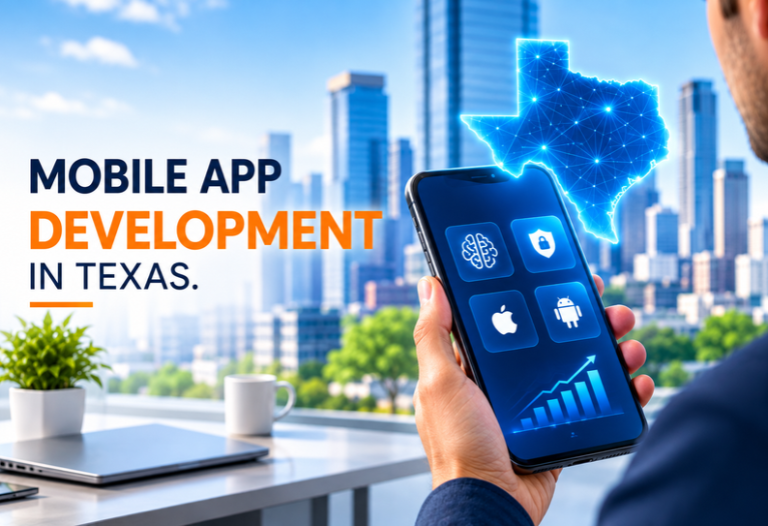
A business app is no longer just a mobile version of a website. Companies are using mobile applications to manage customer relationships, process payments, automate internal tasks, provide personalized experiences, and connect users with services in real time.
Texas has also become a major market for mobile app development, with development companies serving startups, SMBs, and enterprises across Austin, Dallas, Houston, Plano, and other business centers. Current industry directories list hundreds of app development firms operating in or serving Texas businesses, with services ranging from native iOS and Android development to cross-platform, AI, and enterprise application development.
But having an app is not enough. A business application needs the right combination of functionality, security, usability, and scalability to support its purpose.
This blog explains the essential features business apps need in 2026, current mobile app development trends, companies providing app development services in Texas, and what businesses should consider before starting a project.
Key Takeaways
- Business apps in 2026 need more than basic login, profiles, and notifications.
- AI, personalization, secure payments, analytics, integrations, and automation are becoming important parts of modern business applications.
- Security and privacy should be considered during architecture and development rather than added after launch.
- Cross-platform development is a practical option for businesses that want to serve iOS and Android users from a shared codebase.
- Texas has a broad mobile app development market, with companies offering different combinations of product design, mobile development, AI, backend engineering, and ongoing support.
Why Businesses in Texas Are Investing in Mobile Apps
Texas has a large business ecosystem covering technology, healthcare, retail, logistics, finance, real estate, education, and professional services. That diversity creates demand for mobile applications built around very different business requirements.
For some companies, the app is a customer-facing sales channel. For others, it functions as an internal tool for employees, field teams, partners, or suppliers.
A well-planned business app can help organizations:
- Give customers direct access to products and services
- Reduce manual processes
- Provide faster customer support
- Collect useful first-party data
- Connect employees with internal systems
- Automate repetitive workflows
- Deliver personalized recommendations
- Process transactions through mobile devices
- Track business activity in real time
The important point is that the app should solve a defined business problem rather than simply add another digital channel.
Planning a Business App in Texas?
Get expert help with mobile app strategy, iOS and Android development, AI integration, and scalable architecture so your app is built for real business growth.
Essential Features for Business Apps in 2026
The right features depend on the industry and purpose of the application. However, several capabilities have become increasingly relevant to businesses planning new mobile products.
1. Simple and Intuitive User Experience
Users should understand how to use the app without needing instructions for every action.
A business app should have:
- Clear navigation
- Simple onboarding
- Consistent interface elements
- Fast access to important functions
- Mobile-friendly forms
- Accessible typography and controls
- Clear error and confirmation messages
For example, a healthcare application might prioritize appointment booking and medical information, while a logistics application could place delivery status and route information at the center of the experience.
The interface should follow the user’s actual workflow instead of forcing users to navigate through unnecessary screens.
2. Secure User Authentication
Business applications often handle customer profiles, financial information, business records, or other sensitive data. Authentication therefore needs to go beyond a basic username and password.
Depending on the application, businesses might use:
- Multi-factor authentication
- Biometric login
- One-time passwords
- Role-based access
- Secure session management
- Account recovery controls
Different users should also receive access according to their responsibilities. An employee, administrator, customer, and business partner do not necessarily need access to the same information.
3. AI-Powered Features
AI is becoming a practical part of mobile product development rather than simply a feature added for marketing. Current 2026 mobile development discussions increasingly focus on AI-powered personalization, on-device AI, conversational interfaces, and AI agents. On-device AI is particularly relevant because some processing can happen directly on supported devices, which can help with privacy, responsiveness, and offline functionality.
Depending on the business model, AI features could include:
- AI-powered customer support
- Product recommendations
- Personalized content
- Predictive insights
- Document or image analysis
- Voice-based interactions
- Intelligent search
- Workflow automation
- AI assistants
The feature should have a clear purpose. Adding an AI chatbot to an app does not automatically make the application more useful.
4. Push Notifications
Notifications keep users connected to important updates without requiring them to open the application repeatedly.
Businesses can use notifications for:
- Order updates
- Appointment reminders
- Payment confirmations
- Delivery status
- Account activity
- Promotions
- Important service announcements
However, notification frequency matters. Excessive or irrelevant notifications can make users disable them altogether.
5. Secure Payment Integration
For ecommerce, food delivery, booking, subscription, financial, and service applications, mobile payments are often a core function. A business app should provide a secure payment experience through appropriate payment gateways and authentication mechanisms.
Depending on the business, payment functionality might include:
- Credit and debit cards
- Digital wallets
- Subscription payments
- Saved payment methods
- Refund management
- Transaction history
- Payment confirmation
Payment architecture should also account for the regulatory and security requirements relevant to the business and location.
6. Real-Time Data and Synchronization
Some business applications depend on information changing continuously.
Examples include:
- Delivery tracking
- Inventory management
- Ride booking
- Financial dashboards
- Appointment availability
- Customer support
- Field-service applications
Real-time APIs, cloud infrastructure, databases, and event-driven systems help keep information synchronized between users, mobile devices, and backend systems.
7. Analytics and Business Intelligence
An app should generate useful information about how customers interact with it.
Analytics can help businesses understand:
- Which features users access most
- Where users abandon a process
- Which screens receive the most engagement
- How users move through the application
- Which campaigns generate conversions
- Where technical problems occur
This information gives product teams a basis for improving the application after launch.
8. Third-Party Integrations
Most business apps do not operate independently.
They often need to connect with existing:
- CRM platforms
- ERP systems
- Payment gateways
- Marketing platforms
- Accounting software
- Maps and location services
- Customer support systems
- Cloud services
- Business databases
API integrations allow the mobile app to work as part of the wider technology ecosystem instead of creating another isolated system.
9. Offline Functionality
Not every user has a reliable internet connection all the time.
Offline functionality is especially useful for field-service, logistics, healthcare, construction, transportation, and other applications used outside traditional office environments.
An app could allow users to view previously loaded information, complete certain tasks offline, and synchronize changes when connectivity returns.
10. Scalable Architecture
A business app that works for 1,000 users needs a different approach from one expected to support hundreds of thousands of users. Scalability should be considered from the beginning through:
- Cloud infrastructure
- Efficient databases
- API architecture
- Caching
- Load management
- Monitoring
- Modular application design
This reduces the risk of major architectural changes when the business grows.
11. Strong Testing and Ongoing Maintenance
Launching the application is only one stage of the development process. Businesses need continued testing and maintenance for:
- New operating-system versions
- Device compatibility
- Security vulnerabilities
- Performance problems
- App crashes
- New integrations
- Feature updates
- User feedback
- Regular maintenance keeps the application functional as technology and business requirements change.
Mobile App Development Trends Shaping Business Apps in 2026
Technology trends influence how businesses plan their mobile products, but not every trend belongs in every application.
Here are several developments worth considering in 2026.
On-Device AI
AI processing is increasingly moving closer to the device. Apple’s developer ecosystem and Google’s Android ecosystem both support on-device AI capabilities, creating new opportunities for applications that need faster responses or more privacy-conscious processing.
Mature Cross-Platform Development
Frameworks such as Flutter and React Native continue to support applications across iOS and Android from shared codebases. Cross-platform development is particularly useful when businesses want consistent experiences across platforms while managing development resources efficiently.
Privacy-First Development
Privacy is becoming part of application architecture rather than something handled only through a privacy policy. Businesses should consider data collection, storage, permissions, encryption, authentication, and access control during the development process.
AI Agents and Conversational Interfaces
AI applications are moving beyond simple question-and-answer chatbots. Conversational systems and AI agents are being explored for tasks such as customer support, recommendations, search, and workflow execution.
Connected Devices and Wearables
Mobile apps increasingly work alongside smart devices, sensors, and wearable technology. This creates opportunities for healthcare, fitness, logistics, industrial, and consumer applications.
Mobile App Development Companies in Texas to Know
Texas has a large and varied mobile app development market. Current Clutch and DesignRush listings include companies specializing in mobile development, custom software, AI, UX/UI, and enterprise technology.
Here are several companies businesses may encounter when researching mobile app development in Texas.
1.) The BHW Group
The BHW Group is an Austin-based software development company listed by Clutch among Texas mobile app development providers. Its Clutch profile identifies mobile app development as a major service focus.
The company is relevant for businesses looking for a development partner with a strong mobile application focus in the Austin market.
2.) Primotech
Primotech provides mobile application development for startups, SMBs, and enterprises, with services covering native, cross-platform, hybrid, enterprise, testing, maintenance, UI/UX, consulting, third-party integrations, and AI/ML integration.
Its development capabilities include Android, iOS, Flutter, React Native, Ionic, Swift, Kotlin, and other technologies. The portfolio also includes mobile products across areas such as ecommerce, healthcare, food delivery, grocery shopping, property services, and other business use cases.
For example, the DelivZone case study describes a food delivery ecosystem with Android and iOS development, real-time order tracking, multiple restaurants, secure payments, and personalized experiences.
3.) Arbisoft
Arbisoft provides mobile application development from its Dallas presence. Its services cover iOS, Android, and cross-platform development, with experience across sectors including education, travel, fintech, healthcare, and ecommerce.
Its broader software engineering capabilities also make it relevant for businesses whose mobile application needs to connect with larger technology systems.
4.) Agency Partner Interactive
Agency Partner Interactive is based in Plano and appears in Clutch’s current Texas app-development listings. The company provides mobile app development alongside custom software development, UX/UI design, and web services.
This combination is relevant for businesses that need mobile development as part of a wider digital product.
5.) AppVerticals
AppVerticals is headquartered in Dallas and provides native iOS and Android development as well as Flutter and React Native development. Its mobile services also cover backend engineering, AI-powered applications, integrations, testing, and post-launch support.
The company positions its services around startups, enterprises, healthcare, fintech, logistics, and other business applications.
6.) Synergy Labs
Synergy Labs operates from Austin and provides native iOS, Android, and cross-platform application development. Its Austin service page describes a process covering discovery, UI/UX design, development, QA, launch, and post-launch support.
The company also highlights mobile projects involving social and business applications.
How to Choose a Mobile App Development Company in Texas
The right development partner depends on the application, business model, technology requirements, and expected scale.
Before signing a development contract, evaluate these areas:
Technical Expertise
Check whether the company has experience with the platforms and technologies required for your application.
Ask about:
- iOS and Android development
- Flutter or React Native
- Backend development
- APIs
- Cloud infrastructure
- AI/ML integration
- Database architecture
- Testing and security
Relevant Industry Experience
A company that has developed a similar type of application will already understand some of the technical and operational challenges involved.
For example, a healthcare application has very different requirements from a food delivery platform.
Portfolio and Case Studies
Look beyond screenshots.
Review whether previous projects demonstrate:
- Similar functionality
- Complex integrations
- Scalable architecture
- Real-world usage
- Measurable outcomes
- Long-term support
Development Process
Ask how the team handles discovery, design, development, testing, deployment, and maintenance.
A clearly defined process makes responsibilities easier to understand before development begins.
Post-Launch Support
Find out who handles bugs, OS updates, security patches, performance improvements, and future feature development after launch.
An app needs ongoing technical attention, especially when the business depends on it for daily operations.
Communication and Ownership
Clarify who owns the source code, design assets, infrastructure credentials, documentation, and intellectual property.
Also establish how progress updates, approvals, scope changes, and technical decisions will be handled.
Why Choose Primotech for Mobile App Development?
Businesses looking for mobile app development in Texas often need more than developers who know how to build screens. The application also needs backend systems, integrations, cloud infrastructure, testing, and a roadmap for future updates.
Primotech brings these capabilities together through its mobile app development services.
The team works across native and cross-platform development, including iOS, Android, Flutter, and React Native. Its services also cover UI/UX design, testing, maintenance, third-party integrations, enterprise applications, and AI/ML integration.
Primotech also offers dedicated mobile developers and flexible hiring models, including hourly, monthly, fixed-price, and dedicated-team options. Its website states that developer onboarding can begin within 48 hours, subject to project requirements.
For businesses that need intelligent mobile products, Primotech’s broader AI/ML and software engineering capabilities provide a way to connect mobile development with AI features, backend systems, automation, and other digital services.
What Is the Future of Business Mobile Apps in Texas?
Business applications are moving toward more connected and intelligent experiences.
Instead of functioning as standalone tools, future applications will increasingly connect:
- Customers with businesses
- Employees with internal systems
- AI with business workflows
- Mobile devices with cloud platforms
- Apps with IoT devices
- Customer data with personalized experiences
For businesses, the focus should remain on solving practical problems. A sophisticated technology stack does not automatically create a successful application. The product still needs a clear purpose, useful features, reliable performance, strong security, and an experience that users understand.
Conclusion
Mobile app development in Texas continues to cover a broad range of business requirements, from customer-facing ecommerce applications to enterprise tools and AI-powered products. The companies operating in this market also differ in their technical specialties, locations, project sizes, and service models.
For a business planning an app in 2026, the starting point should be the problem the application needs to solve. From there, features such as secure authentication, AI, payments, analytics, integrations, real-time data, and scalable architecture should be selected according to actual business requirements.
With experience across mobile development, AI/ML, cloud, backend engineering, and application integration, Primotech helps businesses turn mobile product ideas into scalable digital solutions.
FAQs
1. Does Primotech develop both iOS and Android apps?
Yes. Primotech provides mobile application development for both iOS and Android, along with cross-platform development using technologies such as Flutter and React Native.
2. Does Primotech offer AI integration for mobile applications?
Yes. AI/ML integration is included among Primotech’s mobile application services. This supports applications that require capabilities such as intelligent recommendations, automation, personalization, or other AI-driven functions.
3. Can Primotech help maintain an existing mobile application?
Yes. Mobile app maintenance and upgrades are part of Primotech’s listed services. These services cover ongoing improvements, updates, bug fixes, and application support.
4. What should a Texas business prepare before contacting a mobile app development company?
Businesses should have a clear understanding of the app’s purpose, target users, core features, preferred platforms, integrations, security requirements, and expected launch scope. A development team can then use this information to define the technical approach and project roadmap.
5. How important is post-launch support for a business app?
It is an important part of long-term app management. Operating systems, devices, third-party APIs, security requirements, and user expectations change over time, so businesses should plan for maintenance and future development rather than treating launch as the end of the project.