 February 19, 2026
Google has officially rolled out its AI-powered configuration feature inside Google Search Console to all users after more than two months of limited testing.
For marketers, SEO professionals, and digital growth teams, this is more than a feature update. It signals a deeper shift toward AI-assisted search analytics and conversational SEO workflows.
As someone who has spent over 15 years in digital marketing and AI strategy, I see this as a pivotal moment in how performance data will be interpreted and operationalized across organizations.
What Is Google’s AI-Powered Configuration?
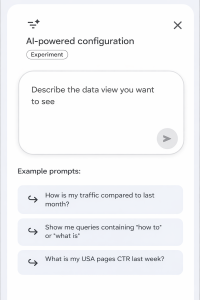
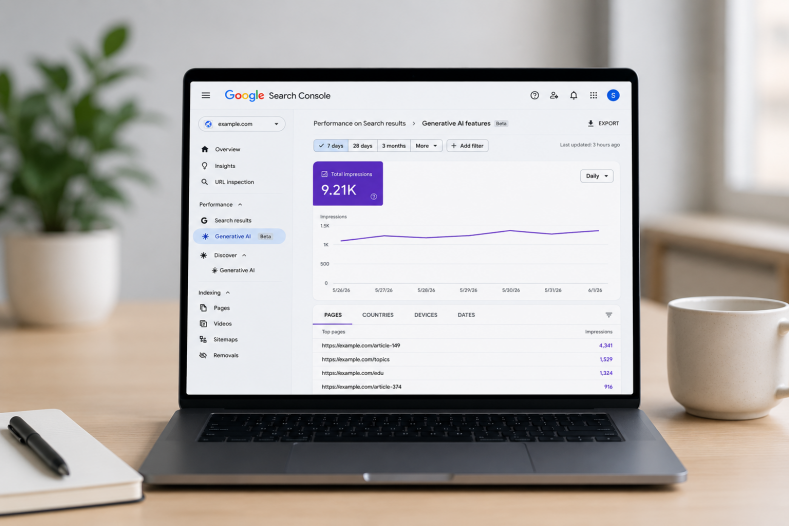
The new AI-powered configuration feature allows users to configure the Performance report using natural language.
Instead of manually selecting filters, metrics, comparisons, and date ranges, users can now type queries such as:
“Show me CTR trends for branded keywords in the last 90 days.”
“Compare mobile vs desktop impressions for product pages.”
“Identify queries with high impressions but low click-through rate.”
The system automatically transforms the prompt into structured filters and configurations within the report.
Google announced the full rollout publicly, stating:
“The Search Console’s new AI-powered configuration is now available to everyone!”
The feature appears as a banner within the Performance report labeled:
“New! Customize your Performance report using AI.”
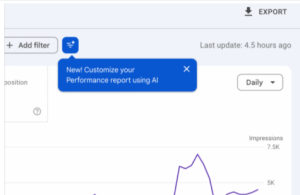
When activated, the interface opens a conversational input box that dynamically configures the report based on your request.
What the AI Tool Actually Does
Google designed the feature to handle three core analytical tasks:
1. Selecting Metrics Automatically
The AI chooses from four primary metrics based on your request:
- Clicks
- Impressions
- Average CTR
- Average Position
Instead of manually toggling metrics, the AI determines what matters based on context.
2. Applying Advanced Filters
It can narrow performance data by:
- Query
- Page
- Country
- Device
- Search appearance
- Date range
For marketing teams managing global SEO campaigns, this dramatically reduces configuration friction.
3. Creating Complex Comparisons
The tool can build advanced comparisons, such as:
- Custom date ranges
- Period-over-period analysis
- Multi-device breakdowns
This eliminates repetitive manual configuration and enables faster experimentation.
Why This Matters for AI in Marketing
This rollout reflects a broader trend: AI is no longer just powering content creation. It is now shaping how marketers interpret and interact with performance data.
At Primotech, we’ve long emphasized that AI in marketing is not just about automation. It’s about intelligence augmentation that helps teams uncover patterns they might otherwise overlook.
This update accelerates:
- AI-driven SEO workflows
- Conversational analytics
- Data democratization across teams
- Faster hypothesis testing
- Smarter content strategy optimization
For marketing leaders managing enterprise SEO, this significantly lowers the barrier to deeper performance analysis.
The GEO & AI SEO Implications
The implications extend beyond convenience. As AI systems increasingly shape search experiences, from AI Overviews to generative responses, you must adapt your reporting and optimization strategies now.
This tool makes it easier to identify underperforming high-impression queries, detect emerging keyword clusters, analyze device-based ranking gaps, and monitor CTR volatility tied to AI-generated search features.
For organizations focused on AI SEO and Generative Engine Optimization (GEO), the ability to ask strategic questions conversationally improves agility. However, it’s important to recognize the limitations I have identified here as well.
Current Limitations to Understand
The AI-powered configuration feature is currently available only in the Search results Performance report. It is not supported by Discover or by Google News reports. So, that’s a bummer!
Additionally, as with any AI system, I have noticed that it does not always capture the intent perfectly. You will need to cross-check initially.
A Larger Strategic Signal from Google
The bigger story for me here is that Google is normalizing conversational analytics inside core marketing tools. So, it is true now that we are entering an era where SEO analysis becomes prompt-driven, performance insights are AI-assisted, technical barriers to data analysis are reduced, and strategy is shifting from data gathering to insight interpretation.
My Perspective from the Field
Within the Primotech marketing and AI consulting ecosystem, we are already seeing organizations accelerate AI-driven marketing adoption by embedding conversational analytics into daily reporting workflows.
The organizations that will benefit most from this update are those that are able to integrate AI insights into a structured SEO strategy, align search performance with revenue KPIs, combine AI analytics with human strategic oversight, and continuously iterate based on measurable performance signals.
AI-powered configuration is another indicator that AI-native marketing workflows are becoming the standard. So, if you manage SEO, content strategy, or digital growth, I strongly recommend exploring the feature and testing different prompt-based analyses.
For questions, feel free to reach out to me at [email protected]