 June 4, 2026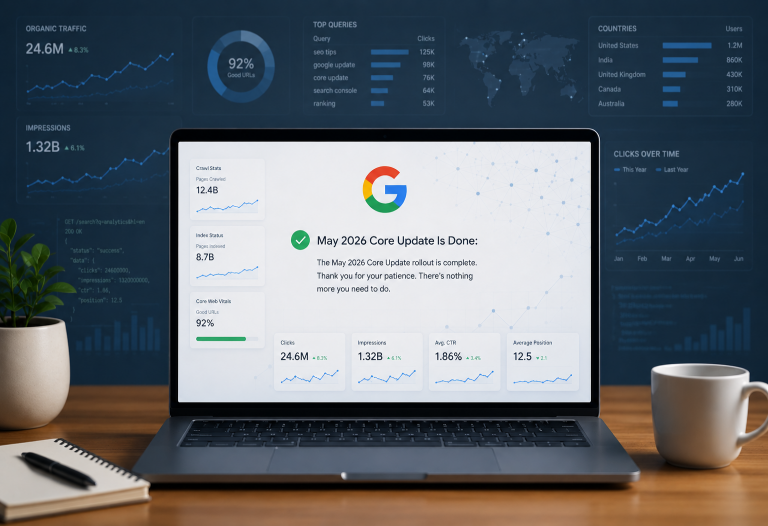
It took 12 days for Google to push through one of the more turbulent core updates of the year. The May 2026 core update started rolling out on May 21 and officially completed on June 2, 2026. If your rankings have been all over the place lately, that explains a lot.
It Hit Fast and Hard
Most core updates take a few days to warm up. This one didn’t bother with a slow start.
The update was announced on a Thursday afternoon and was already generating significant ranking movement by that Saturday. The first week was rough for a lot of sites, and then a second wave of large ranking shifts hit again on May 30th. There was even more volatility in the final 24 hours, right before Google called it done.
Two separate spikes inside a single rollout are not the norm. It caught a lot of site owners off guard, especially those who thought the worst was behind them after the first week settled down.
What Google Actually Said
Google updated its Search Status Dashboard and described the update as “a regular update designed to surface better relevant, satisfying content for searchers from all types of sites.”
Regular: That word does a lot of heavy lifting.
No new guidance was issued alongside this update. Google pointed everyone back to the same people-first content advice it has been repeating for years now. “There’s nothing new or special that creators need to do for this update as long as they’ve been making satisfying content meant for people,” the company said previously.
Where This Fits in a Busy Year
This is Google’s second core update of 2026. Before this, site owners had already dealt with a March 2026 core update, a March 2026 spam update, and a February 2026 Discover update.
That is four significant algorithm events in roughly four months. If your traffic has been inconsistent since February, you may have been absorbing overlapping effects without realising it.
So What Do You Do Now?
Here’s the thing: Google’s recovery advice has not changed, and it probably never will.
There are no specific actions to take after a core update hits your site. A rankings drop does not automatically mean something is broken. Google says the biggest recoveries typically happen after the next core update, not between them, though some partial recovery is possible in the interim.
If you got hit, start with a content audit. It is best to look at the pages that dropped and ask honestly whether they are genuinely helpful or whether they were built primarily to rank. Many businesses prefer to work with an AI SEO company to identify content deficiencies, improve user experience, and align their websites with Google’s evolving quality standards. That distinction is exactly what Google is trying to reward or punish with every one of these rollouts.
The Part Worth Taking Seriously
As Google sends less and less organic traffic to sites through AI Overviews and AI Mode, ranking in position one matters more than it ever has before. The total volume of clicks is shrinking. Whatever share is still available goes mostly to whoever is sitting at the top.
That changes how you should think about this update. It is not just about recovering lost ground. It is about building content strong enough to hold the top spots when the next update arrives, because there will be one, and it will matter just as much.
For queries, consulting, or collaboration opportunities, reach out to me directly at [email protected].