 April 14, 2026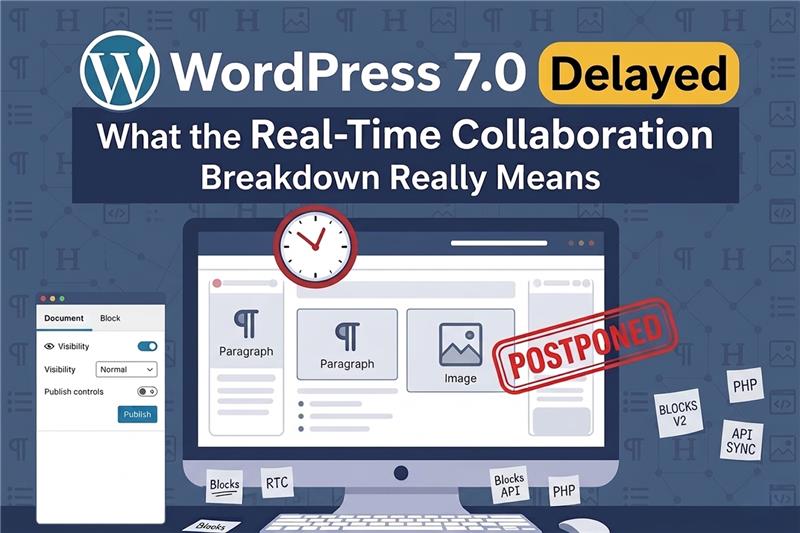
We’ve seen enough software release cycles to know that a delayed launch for a single feature usually means one of two things: the feature is genuinely hard to get right, or the architecture it has to sit inside wasn’t built for it. With WordPress 7.0, it looks like both.
WordPress version 7.0 seems to be getting delayed and the hold-up could be the real-time collaboration (RTC). Take note that this was supposed to be the centerpiece of Phase 3 in Gutenberg’s four-phase development roadmap, which covers block editor, full site editing, collaboration, and multilingual capabilities.
What is RTC?
The real-time collaboration (RTC) feature lets multiple users edit content and block-based design simultaneously inside the block editor.
The Beta Testing Looked Good but the Database Didn’t
Automattic has had RTC in beta since October 2025, available to enterprise-level WordPress VIP customers. The feedback from those tests was largely positive when teams were working within native WordPress blocks and custom blocks built to current best practices.
The official WordPress.org beta feedback noted that stress tests involving dozens of simultaneous editors, large content copying in parallel, and entire teams editing the same post held up well.
One technical lead at a major research institution reportedly told testers their team had “not run into any issues.” The problem was how the feature was storing data underneath.
The original build reused existing database tables to store editing events. That approach hit performance and scaling limits fast, and introduced multiple bugs. The fix requires building a dedicated database table for RTC from scratch. Until that’s stable and tested, 7.0 isn’t shipping.
Is This a Symptom of Something Bigger?
Joost de Valk, founder of Yoast SEO, used the delay to make a broader argument about WordPress’s core architecture. Writing on his blog, he said:
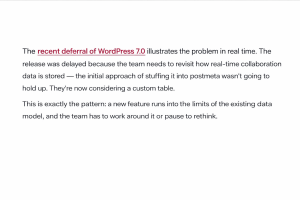 His position is that WordPress needs a meaningful rewrite of core code to be more secure, modern, and scalable and that this delay is a live example of what happens when new features collide with an aging data model.
What This Means for Shared Hosting Providers
Shared hosting environments are going to have to figure out what RTC means for resource allocation. When thousands of customers are running simultaneous multi-user editing sessions, the load profile looks completely different from traditional single-user publishing.
Questions that don’t have clean answers yet:
- Will hosts need to cap simultaneous editors by pricing tier?
- Will some hosting configurations limit the feature entirely for lower-tier plans?
Right now, nobody has definitive answers because the feature is still being rebuilt. What was tested on WordPress.com isn’t the final architecture. The new dedicated table approach is supposed to improve stability and scalability, but it hasn’t been tested at a shared hosting scale.
For anyone advising clients on WordPress infrastructure, this is the question worth tracking through Q2.
What Else Is Coming in 7.0
The delay is getting most of the attention. What’s getting less: a set of features designed to make AI integration within WordPress significantly easier to build and manage is also on the 7.0 roadmap, alongside RTC.
Those features are presumably still in the release, waiting on RTC to stabilize. For agencies and product teams building on WordPress, the AI integration additions may end up being more commercially significant than RTC itself when the release finally lands.