 March 10, 2026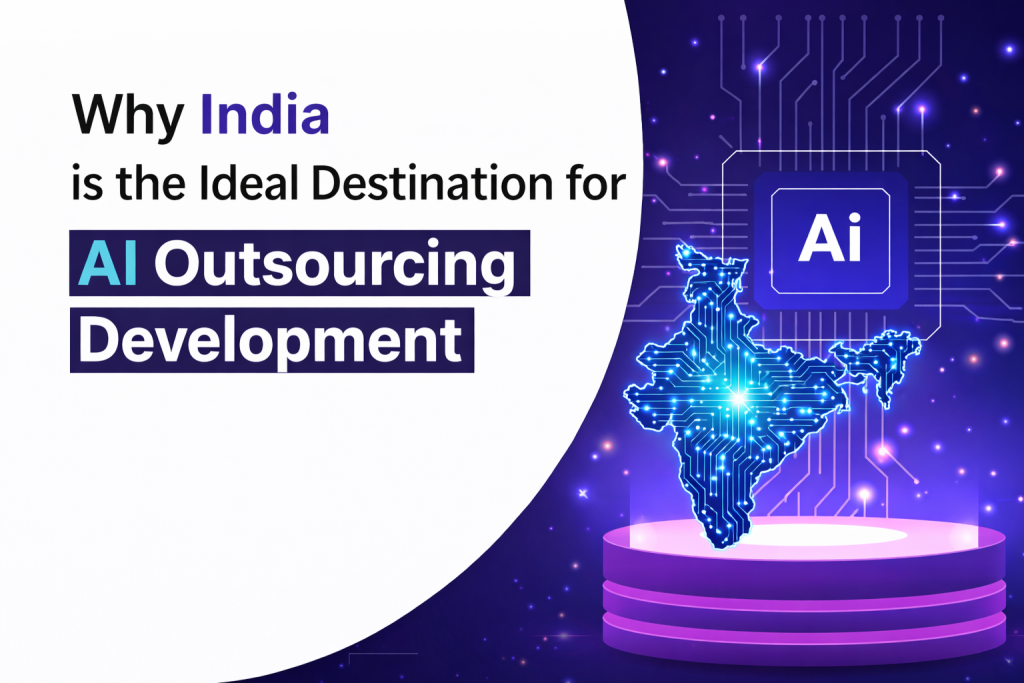
India is the ideal destination for AI outsourcing development because it combines one of the world’s largest AI talent pools, strong government-backed infrastructure, mature global delivery experience, and a 50–70% cost advantage over Western markets.
With over 5.4 million technology professionals, a $1.2 billion government-backed AI Mission, and an IT sector on track to surpass $400 billion by 2030, India offers an unmatched combination of talent depth, cost advantage, infrastructure maturity, and AI-specific innovation capacity that no other nation can replicate at a comparable scale.
For global enterprises building intelligent systems without the overhead of in-house AI teams, AI development partners in India should be a core part of their strategy.
The Strategic Moment We Are In
Let me be direct about something the industry hesitates to say: AI is no longer a technology problem. It is a talent and execution problem. The models exist. The APIs are accessible. The cloud infrastructure is commoditized.
What separates companies that win with AI from those that merely experiment with it is the depth and quality of the team building on top of that infrastructure.
That is precisely why the conversation around AI outsourcing development has shifted from a cost conversation to a capability conversation. And in that capability conversation, India consistently, decisively, and at scale wins.
I have worked with organizations across industries, from early-stage startups to multinational enterprises, and the pattern is always the same. Those who treat India as purely a cost lever end up with mediocre output. Those who treat India as a strategic partner in AI development achieve transformative outcomes.
The difference lies entirely in understanding what India actually offers, and I intend to lay that out clearly in this article.
Why India Specifically?
There is a tendency in business writing to drop a few impressive statistics and call it analysis. I want to do something more useful: connect the data to the decision you are making when choosing an AI outsourcing development company.
The Talent Infrastructure Is Unmatched
According to a Bessemer Venture Partners report, India produces approximately 2.6 million STEM graduates each year, more than triple the number produced by most leading nations.
This creates a deep bench of engineering talent that is not only numerous but also fluent in English, coding, and quantitative reasoning required for AI development.
This is the foundational reason Microsoft, Google, Amazon, and JPMorgan have built significant AI and development centers in India.
India’s AI market is projected to grow at a CAGR of 25–35% through 2027, reaching $17 billion, reflecting both the quality of the talent pipeline and the deliberate cultivation of AI-specific capabilities across India’s outsourcing ecosystem.
India has the world’s 2nd-largest installed AI talent base, which reframes the conversation entirely. When you outsource AI development in India, you are not accessing a workaround. You are accessing the single largest concentration of relevant expertise on the planet.
The Government Is Building the Infrastructure Around the Talent
What sets India apart from other outsourcing destinations in the AI era is the deliberate alignment between government policy and industry capability.
The IndiaAI Mission is backed by ₹10,372 crore (~$1.25 billion) in committed funding over five years to build compute infrastructure, data resources, and research partnerships at a national scale.
The mission has already exceeded its original GPU target of 10,000, with over 38,000 GPUs now onboarded at a subsidized rate of just ₹65 per hour.
India ranked third globally for AI competitiveness and ecosystem vibrancy in the Stanford Global AI Vibrancy 2025 report, and is the second-largest contributor to GitHub AI projects.
This is the difference between a country that excels in technology services and one that has made AI leadership a national priority. India is the latter.
The Cost Equation Has Become Even More Compelling
Yes, AI engineers in India are paid a fraction of what their equivalents in North America or Western Europe earn. The differential is typically 50-70% of fully loaded costs.
An AI engineer in the US commands $120–$200 per hour; their counterpart in India delivers comparable expertise at $45–$60 per hour.
But what the raw cost numbers miss is the compounding advantage. India’s IT sector is projected to expand at 8.7% annually through 2030, driven by firms delivering domain-specific automation that outperforms traditional models on speed, quality, and cost. The cost savings and speed advantages compound.
The Benefits of AI Outsourcing Development: What You Actually Get
I want to be precise about the genuine benefits of AI outsourcing and development, including the operational realities.
1. Access to Specialized Expertise at Scale
India’s AI talent demand is projected to grow from 600,000–650,000 professionals to more than 1.25 million by 2027, driven by a 25–35% CAGR in the AI software and services market.
When you work with an established AI outsourcing development company in India, especially one like Primotech, you gain immediate access to pre-vetted teams skilled in machine learning, NLP, computer vision, LLMOps, and generative AI implementation.
India’s GenAI startup ecosystem has seen a 3.7X surge in startup formation, reaching 890+ startups by H1 2025, with GenAI application startups growing 4X to exceed 740.
This ambient innovation environment means the practitioners you engage are building on frontier capability, not catching up to it.
2. Speed That Changes the Strategic Equation
The Indian AI talent pool already powers a growing IT sector, with AI/ML job openings rising at 67% year-on-year.
The ability to move from concept to deployment in 6 to 8 weeks, rather than the 6 to 8 months required by in-house recruiting, onboarding, and tooling procurement, is operationally convenient and is strategically decisive.
3. Follow-the-Sun Delivery Models
India’s time zone, 9.5 to 12.5 hours ahead of the US, is genuinely advantageous for AI development cycles.
Your product team works during US business hours, articulates requirements at the end of the day, and wakes up the next morning to review code, tested models, and deployment progress.
Bessemer’s AI Services Roadmap explicitly cites India’s follow-the-sun delivery model as one of the three pillars underpinning its $400B-by-2030 projection.
4. Flexibility Without the Overhead
AI projects are inherently iterative. When you maintain an in-house AI team, every pivot is expensive, from headcount decisions to retraining investments and capability mismatches.
When you work with an AI outsourcing development company, flexibility is built into the engagement model. You scale team composition by project phase, not by budget cycle.
5. Risk Distribution Across the Development Cycle
AI development carries real technical risk. An experienced AI outsourcing partner in India has navigated these failure modes across dozens of engagements.
The WEF’s Future of Jobs Report 2025 notes that 67% of companies operating in India are actively tapping into diverse talent pools to fill emerging roles, far above the global average of 47%, reflecting how deeply embedded India’s AI workforce has become in global delivery pipelines.
India’s AI Outsourcing Advantage: Key Data Points
(Source: Compiled from NASSCOM, Bessemer, Deloitte, Stanford AI Index, and Government of India data.)
| Metric | Data Point | Source |
| IT Sector Trajectory | Projected to surpass $400B by FY2030 | Bessemer Venture Partners |
| STEM Graduate Output | ~2.6M annually — 3× most leading nations | Bessemer Venture Partners |
| IT-BPM Workforce | 5.43 million professionals (FY2024) | Grant Thornton / NASSCOM |
| AI Market CAGR | 25–35% through 2027; $17B target | NASSCOM-BCG Report |
| Government AI Investment | $1.25B IndiaAI Mission; 38,000 GPUs deployed | Govt of India PIB |
| AI Talent Demand Growth | 600K–650K → 1.25M+ AI professionals by 2027 | Deloitte-NASSCOM |
| GenAI Startup Growth | 3.7X surge; 890+ startups by H1 2025 | NASSCOM GenAI 2025 |
| Global AI Competitiveness | Ranked 3rd globally (Stanford AI Vibrancy 2025) | Govt of India Parliament |
| AI/ML Job Growth | AI/ML jobs rising 67% year-on-year | NASSCOM-BCG |
| Outsourcing Cost Differential | 50–70% lower vs US/Western Europe for AI talent | Industry benchmark |
What AI Outsourcing Development in India Looks Like in 2026
The nature of what gets outsourced to India has changed fundamentally. A decade ago, outsourcing meant offloading repetitive coding tasks to lower-cost labor markets.
Today, it means engaging deeply with specialized AI development partners who operate at the technical frontier
Primotech India’s AI outsourcing development ecosystem in 2026 includes:
- Machine learning model development
- NLP and multilingual AI systems
- Computer vision pipelines
- Generative AI integration
- LLMOps and model deployment
- AI-driven product engineering
- End-to-end AI application development
The full-stack capability of leading Indian AI outsourcing development companies means you can engage a single partner like Primotech across the entire AI development lifecycle.
Context continuity across the AI development cycle is a significant driver of quality. The team that understands your data constraints is the same team making architecture decisions.
Choosing the Right AI Outsourcing Development Company in India
The quality distribution within India’s AI outsourcing market is wide. Getting this choice right is the most important factor in whether your AI outsourcing engagement succeeds. Here is how I think about the evaluation framework.
Look for Proven AI Depth
Many software development firms in India have added AI to their service listings. Adding a services page and building deep AI capabilities are not the same.
When evaluating an AI outsourcing development company, look for documented experience with model training and evaluation, MLOps infrastructure, production AI deployments, and the ability to discuss trade-offs in architectural decisions.
Prioritize Domain Specialization
India’s AI outsourcing market has matured to the point where genuine domain specialization is evident, particularly in fintech, healthcare, logistics, retail, and enterprise SaaS.
It specifically notes that India’s growth in AI talent demand is concentrated in industry-specific applications. Prioritize partners with sector-specific track records over broad portfolio claims.
Treat IP Protection and Data Governance as Mandatory
India’s DPDP Act 2025 provides a robust framework for data protection, and its long track record in IT services means contractual IP protection is well established and enforceable.
Ensure your engagement model includes clear IP assignment clauses, data-handling protocols that meet your jurisdictional requirements, and security frameworks appropriate for the sensitivity of the data your AI systems will process.
Evaluate Communication Architecture
The best technical team in the world will underperform if the communication architecture of your engagement is poor. Assess how your prospective AI outsourcing partner handles requirement capture, progress reporting, escalation paths, and knowledge transfer. The goal is a partnership that builds organizational capability.
How to Structure Your AI Outsourcing Development Engagement
Start with a Scoped Pilot
Do not begin an AI outsourcing relationship with your most mission-critical project. Begin with a well-scoped, high-visibility project that allows you to assess your partner’s technical capability, communication practices, and delivery discipline in a lower-risk context.
Invest in the Relationship Architecture
The difference between a successful AI outsourcing development engagement and a frustrating one is almost never about technical capability on the India side. It is about relationship architecture on both sides. Assign a dedicated internal owner. Build structured communication cadences. Create explicit knowledge transfer protocols.
Define Outcome Metrics
AI development success is measured by model performance on real-world data, user adoption, and business impact. Define success metrics at the engagement level, not just the feature level, and build your governance model around those outcome metrics.
Plan for Long-Term Partnership
AI systems require ongoing maintenance, retraining as data evolves, and capability expansion. The most valuable AI outsourcing relationships are long-term partnerships in which the India-based team develops a deep understanding of the organization over time. Structure your initial engagement with that long-term trajectory in mind.
Conclusion
The recent collaboration between NVIDIA and Reliance to build AI supercomputers in India, the IndiaAI Mission’s AIKosh platform with over 3,000 datasets and 243 AI models, and India’s first sovereign large language model developed by Sarvam AI are not incremental improvements to an existing service delivery model.
These are the foundations of a global AI innovation hub.
The combination of large-scale technical talent, government-backed AI infrastructure, mature delivery ecosystems, and favorable economics gives India a structural advantage that few markets can replicate at a comparable scale.
For organizations serious about building and deploying AI systems efficiently, the question is no longer whether to consider India, but how.
Yes, it is about how quickly you can identify and engage the right AI development partner.
If you are evaluating an AI initiative and seeking a grounded technical perspective, contact the Primotech AI Consulting team to explore the right engagement model today!
FAQs: AI Outsourcing Development in India
Is India a good destination for AI outsourcing and development?
Yes. India offers one of the world’s largest AI talent pools, strong government investment in AI, mature IT delivery frameworks, and a 50–70% cost advantage over Western markets.
How much does AI outsourcing cost in India?
AI development in India typically ranges from $30 to $50 per hour for experienced engineers, depending on specialization, project complexity, and partner maturity.
What types of AI projects are commonly outsourced to India?
Organizations frequently outsource machine learning systems, generative AI integrations, NLP platforms, computer vision solutions, LLMOps pipelines, and full-stack AI product development.
Is data security safe when outsourcing AI development to India?
Yes, provided you work with a reputable vendor. India’s DPDP Act 2025 strengthens the regulatory framework, and mature AI partners implement enterprise-grade security and IP protection protocols.
How long does it take to start an AI project with an Indian partner?
Most established vendors can assemble a team and begin development within 2–4 weeks, with initial prototypes often delivered in 6–8 weeks.
What should I look for in an AI outsourcing partner in India?
Prioritize proven AI deployment experience, domain expertise, strong MLOps capability, transparent communication processes, and clearly defined IP and data governance policies.