 March 31, 2026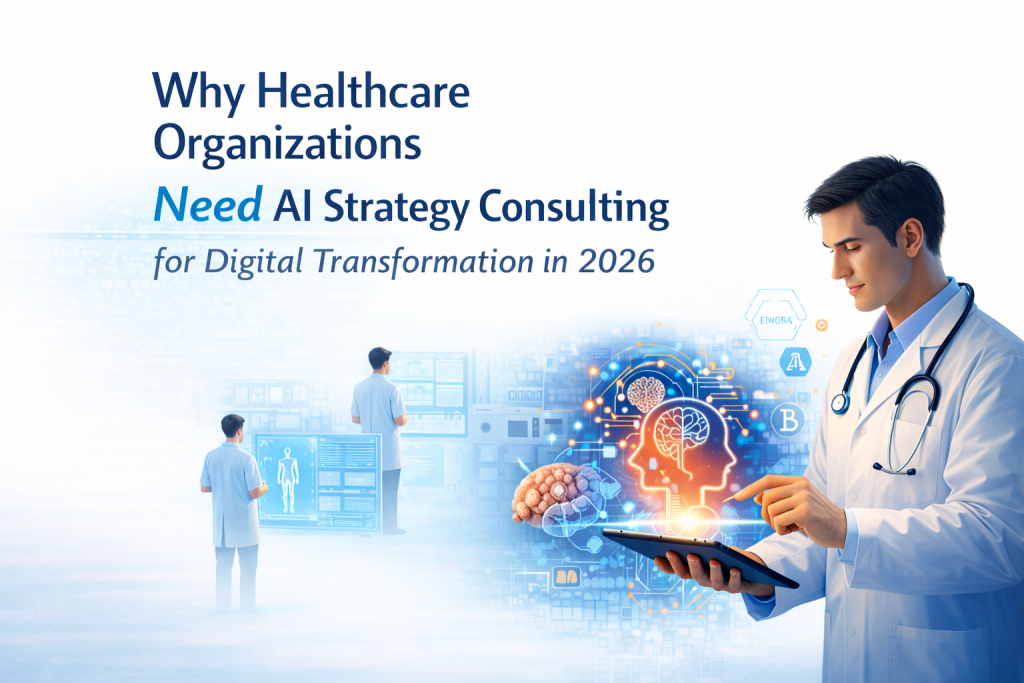
AI strategy and consulting for healthcare is becoming one of the most important drivers of digital transformation across the global healthcare industry.
In 2026, healthcare organizations in the US and globally are under real pressure, and it is coming from multiple directions at once.
Patient outcomes need to improve. Operations need to run leaner. Costs need to come down.
And all of this has to happen inside one of the most regulated, data-complex environments any industry has ever had to navigate.
Over the past five years, artificial intelligence has produced some genuinely powerful tools for healthcare: predictive diagnostics, intelligent automation, and personalized treatment planning. The capability is not the question anymore.
Walk into any health system today, and you will find AI scattered across departments in disconnected modules.
The one that frustrates us most, and we have seen this more times than we can count, is the scheduling chatbot paired with a support agent so poorly trained that it cannot answer a basic patient query.
That is not a technology failure. That is a strategy failure.
We have tracked a direct drop in patient satisfaction scores at health systems where these kinds of half-built conversational AI tools were deployed without any real planning behind them. The voice agent could not resolve the issue. It could not route the patient forward. It just looped, and patients gave up. That gap, between buying AI and actually using it well, is what this article is about.
For healthcare leaders who have been watching pilots pile up while the ROI stays stubbornly invisible, 2026 is the year that gap starts costing real money.
According to a 2025 HFMA report, 88% of health systems are already using AI internally, yet only 18% have a mature governance structure and a fully formed AI strategy. You read that right. Nearly nine in ten health systems are running AI without a real strategy to back it up.
A Black Book Research survey of 182 hospital leaders found that 70% had experienced at least one AI pilot failure due to weak endpoints, workflow misalignment, or data gaps. If that describes your organization, you are not the exception. You are the majority.
Why 2026 Is the Breaking Point for Healthcare AI
The market numbers are worth understanding, not because they are impressive in isolation, but because they signal what the competitive landscape looks like for health systems moving too slowly.
The AI in healthcare market is projected to grow from $21.66 billion in 2025 to $110.61 billion by 2030, at a CAGR of 38.6%. That capital is flowing into health systems, technology vendors, and consulting firms simultaneously. The organizations on the receiving end of that investment will widen the gap on those still running AI as a side project.
The ROI case is no longer theoretical either. The average return on AI investment in healthcare is $3.20 for every dollar spent, with most organizations realizing those returns within 14 months.
That is a strong business case by any standard. So if your health system is not seeing numbers anywhere near that, the question worth asking is not whether AI works. It is whether your strategy for deploying it does.
What has changed in 2026 specifically? A few things are converging that make this year different from the previous three.
Labor costs and workforce shortages show no sign of stabilizing. The fastest-growing predictive AI use cases in hospitals right now are billing simplification and appointment scheduling, both driven by the need to automate high-volume, staff-intensive workflows.
Organizations that have not built those capabilities yet are absorbing costs that their competitors are beginning to eliminate.
The regulatory environment has also shifted. The AI governance executive order from 2025 has put pressure on health systems to document how their AI tools are built, monitored, and audited.
According to Black Book Research, 80% of hospital leaders say it is difficult to verify vendor AI claims without a formal governance structure in place.
Running disconnected AI tools without governance is no longer just an ROI problem. It is a compliance and liability problem.
Patient expectations are the third factor, and the one most leadership teams underestimate. People interact with AI in their banking apps, their streaming services, and their e-commerce platforms every single day.
When they hit a healthcare chatbot that cannot answer a simple question about their upcoming appointment, the contrast is jarring.
NVIDIA’s 2025 State of AI in Healthcare report found that 86% of healthcare industry respondents say AI is critical to their organization’s future. Patients are starting to expect that same seriousness from their providers.
Health systems that build a real AI strategy in 2026 are positioning themselves for compounding returns over the next five years. Those still running isolated pilots will not just fall behind. They will become significantly more expensive to fix.
What AI Strategy and Consulting Actually Means in Healthcare
Most healthcare leaders we talk to have already had a bad experience with some version of this.
A vendor came in, ran a few workshops, recommended their own platform, and left.
Or a consulting firm delivered a strategy document that lived in a shared drive and went nowhere. That is not AI strategy consulting. That is AI theater.
What it actually looks like is an honest audit.
It tells us where the data lives, how clean it is, which AI tools are already deployed somewhere in the system, and whether any of them have moved past a pilot into something being used at a real scale.
That last question tends to catch people off guard.
In our experience working with healthcare clients, most organizations already have more AI capability than they think. The tools are there. The integration and the plan to scale them are not.
Data fragmentation is still the deepest problem in healthcare AI, and it does not get enough attention in these conversations.
You can license a sophisticated machine learning platform, but if it is being trained on inconsistent EHR data spread across three legacy systems with different formatting conventions, the model will not perform regardless of how good the underlying technology is.
We have seen this derail projects at health systems that had strong clinical leadership and serious financial commitment. Everyone assumed the AI was the hard part. The data layer turned out to be the wall.
Once the audit is done, the engagement moves into use case prioritization. Picking the right problems matters more than picking the right tools.
Revenue cycle management, prior authorization, clinical documentation, and patient triage keep surfacing as strong starting points because they share the same underlying characteristics: enough structured data to train on, a workflow that does not change every six months, and a success metric that someone in the CFO’s office actually reviews.
Those areas have the data density and workflow structure that AI needs to perform well. Governance is the piece most competing articles skip entirely, and it is arguably the most important. Health systems with a formal AI governance council are twice as likely to hit ROI within 12 months.
Organizations with ownership structures and monitoring dashboards in place get there in roughly 7.5 months on average, compared to 13.5 months for those without.
Who owns the model when something goes wrong?
Who monitors for performance drift as patient populations shift?
If those questions do not have clear answers before deployment, the organization is not running an AI strategy. It is running a live experiment on patients.
Change management is where most rollouts quietly fall apart. The technical deployment is usually the part that goes fine. What breaks is trust clinical teams that were never brought into the process, workflows that were not redesigned around the AI output, and no clear owner for maintaining the system after go-live. We have sat in post-mortems on failed AI projects where the model was actually performing well. Nobody was using it because nobody had been taught why they should.
The Pilot Graveyard: Why Most Healthcare AI Never Scales
80% of AI projects in healthcare fail to scale beyond the pilot phase. That number gets cited a lot, but rarely does anyone sit with what it actually means operationally. It means the majority of health systems have already spent money on AI.
They ran a pilot, it worked in a controlled setting, and then it quietly died somewhere between the demo and real clinical use. The vendor moved on. The internal champion got reassigned. The data team had three other priorities.
And now the project lives in a shared drive somewhere, referenced occasionally in a board deck as “ongoing exploration.”
We call this the pilot graveyard. And in our experience working across healthcare organizations, it is far more crowded than most leadership teams want to admit.
IBM’s Watson Health is the most famous example. What started as a celebrated moonshot partnership with Memorial Sloan Kettering, built on the promise of AI-powered cancer treatment recommendations, eventually collapsed under the weight of its own ambition.
IBM acquired companies worth $5 billion to build it out, employed 7,000 people at its peak, ran national ad campaigns, and ultimately sold the entire division for roughly $1 billion.
The technology was not the problem. The problem was deploying AI without the clinical workflow integration, data quality infrastructure, and change management that real-world use demands.
The pattern repeats at every scale.
A 2024 survey of 43 US health systems found that 77% identified lack of AI tool maturity as the biggest barrier to deployment, followed by financial concerns at 47%, and regulatory uncertainty at 40%.
Those are not technology problems. They are strategy problems.
They are what happens when organizations buy tools before they have answered the foundational questions about data readiness, use case fit, and organizational capacity to absorb change.
Healthcare organizations often fall into a “build it, and they will come” mindset, chasing technological novelty without accounting for clinical fit or long-term integration.
Projects end up mimicking historical data rather than reliably predicting future outcomes, which is a critical flaw in environments where accuracy directly affects lives.
The fix is not a better tool. It is a better process for deciding which tools to deploy, when, and how. That is the core of what AI strategy consulting delivers.
The Real Benefits of AI Strategy Consulting in Healthcare
There is no shortage of articles listing the benefits of benefits of AI strategy consulting in healthcare. Most of them read like vendor brochures. We are going to be more specific, because the benefits look very different depending on whether your organization has a strategy behind the deployment or not.
Clinical outcomes improve when AI is deployed with intent
The clinical evidence is strong, but context matters. Decision-making accuracy in clinical settings has improved by over 30% in structured AI deployments, and early-stage cancer detection rates have climbed 40% where AI assistance has been properly integrated into diagnostic workflows.
Those results do not come from tools dropped into a system and left alone. They come from deliberate deployment with clinical protocols designed around the AI output.
A study found that AI transcription tools cut physician note-taking time by roughly 20% and trimmed after-hours documentation work by 30%. At Mass General Brigham, physicians using ambient AI documentation tools saw a 21% absolute reduction in burnout prevalence within 84 days, according to a study published in JAMA Network Open.
That last number matters more than it looks. When a well-implemented AI tool gives a physician two hours back, that time goes into patient care and clinical judgment, the work that actually requires a medical degree. It does not go into typing notes at 10 pm.
Operational efficiency gains are measurable and fast
Healthcare organizations that have deployed comprehensive AI solutions report 13 to 21% increases in staff productivity, with some achieving ROI within the first quarter of implementation. Those are not five-year projections. Those are organizations that built a plan, identified the right workflows to automate, and executed against a roadmap.
A hospital in Norway used predictive analytics to reduce emergency room congestion by modeling hourly patient flow, which allowed clinical staff to be allocated more effectively and improved patient throughput without additional hires.
Organizations that implement AI broadly across administrative functions are reporting 20 to 40% reductions in administrative costs.
That is a real line item on a real budget. But it only happens when the deployment covers the right functions with the right data infrastructure underneath it.
Financial returns follow a strategic structure
A Deloitte report shows that among healthcare organizations that actively track AI outcomes, 52% report moderate ROI, 30% report high or very high ROI, and only 18% report low or break-even returns. 45% of organizations using generative AI achieved a measurable return within 12 months.
The organizations reporting poor returns are not the ones that deployed the wrong technology. They are the ones that deployed without the tracking and governance structure needed to measure and optimize performance.
You cannot improve what you do not measure, and you cannot measure it if nobody defined success criteria before the system went live.
What We Built for Healthcare Professionals: A Primotech Case Study
When a healthcare professional platform came to us, the problem they described was familiar. They had a massive and growing library of clinical content, but engagement was dropping.
Specialists were not finding the material most relevant to their practice. General practitioners were being served the same content as oncologists.
Nobody was getting a personalized experience, and the platform’s value proposition was quietly eroding.
The solution was not to publish more content. It was to make the existing content work harder through intelligent delivery.
We built a content recommendation engine that used machine learning to create individual professional profiles for each user.
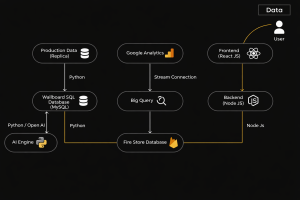
Rather than a simple tagging system, the model pulled signal from multiple directions at once: a clinician’s stated specialty, their actual reading and engagement behavior on the platform, and the clinical patterns visible in the types of content they kept returning to.
A cardiologist who kept gravitating toward heart failure management articles, regardless of what they searched for, told the model something useful. It listened.
The architecture paired two complementary filtering approaches. One looked at what clinicians with similar profiles and behavior patterns were engaging with.
The other analyzed the clinical substance of the content itself to assess relevance. Neither approach alone was sufficient.
Together, they allowed the system to make useful recommendations even for newer users who had not yet built up a behavioral history on the platform, something most recommendation systems struggle with early on.
What changed for users was noticeable quickly. Professionals started spending more time on the platform and engaging with content outside their primary specialty, because the recommendations were surfacing clinically relevant adjacent knowledge they would not have found through search.
The platform stopped feeling like a library and started feeling like something that understood what they were working on.
The reason it worked is the same reason most healthcare AI projects fail when they do not. We spent the first phase of the engagement on the data architecture, understanding the structure of the content library, the quality and consistency of the user behavior data, and what gaps needed to be addressed before the machine learning layer could produce anything reliable.
The recommendation engine was the visible output. The invisible work that made it perform was everything we did before building it.
That is the approach we bring to every healthcare AI engagement. The strategy has to precede the technology, every single time.
Book a consultation with Primotech
Building an AI Strategy Roadmap for Healthcare: How It Actually Works
Here is something that goes missing from most roadmaps: the organizations that have the most successful AI deployments in healthcare are rarely the ones that moved fastest. They are the ones who were honest about where they started.
We have seen health systems with genuinely impressive technology budgets build elaborate AI infrastructure on top of data that was fragmented across four different legacy systems, inconsistently coded, and missing critical fields in roughly 30% of records.
The models trained on that data performed beautifully in the sandbox. In live clinical environments, they were close to useless.
Nobody caught it early because nobody had done the foundational work of understanding what the data actually looked like before the vendor got involved.
That data assessment is where every real AI strategy starts, and it is consistently the work that organizations most want to skip. It is not exciting. It does not generate a demo. But what it generates is the difference between an AI system that works in the real world and one that works in a presentation.
Healthcare AI integration follows a maturity curve where early-stage organizations that skip foundational data assessment almost universally hit the same wall: models that perform in controlled testing and fail in live clinical environments because the real-world data looks nothing like what the model was trained on.
Every organization that hits that wall thinks they are the exception when they are building. They realize they are the rule after deployment.
Beyond the data question, there is the question of what problem you are actually trying to solve. This sounds obvious, but in practice, it is where a lot of healthcare AI strategy falls apart before it starts.
“We want to use AI to improve patient outcomes” is not a use case.
“We want to reduce prior authorization turnaround time from 4.2 days to under 48 hours by automating the initial documentation review” is a use case.
The specificity of the problem definition determines whether you can actually measure success, which determines whether you can actually improve the system over time.
Then there is the adoption problem, which is where more healthcare AI projects quietly die than anywhere else.
The technical deployment is usually the part that goes roughly according to plan. What does not go according to plan is getting a clinical team to change how they work based on a system that was built without much of their input, deployed with minimal training, and handed over to them with an expectation that the value would be self-evident.
A health system without a documented AI strategy and governance structure is accumulating regulatory exposure that will eventually need to be addressed under worse conditions than today.
How to Choose the Right AI Consulting Partner for Healthcare
Most healthcare leaders spend more time evaluating their EMR vendor than their AI consulting partner. Now that is a mistake that gets obvious about six months into a failed engagement.
Without specialized guidance, hospitals routinely spend $200,000 to $500,000 on pilots that never survive compliance review, EHR integration, or clinical adoption.
A bad consulting engagement does not just cost money. It burns internal credibility for AI broadly, and rebuilding that trust with clinical leadership takes years, not quarters.
So what actually separates a partner worth hiring from one selling a good demo?
Ask them about a project that went sideways. Not hypothetically, a real one, from a real healthcare client. What broke, how did they find out, and what did they do about it?
A firm that can only walk you through wins has either not done much real work or is not being straight with you.
The implementation stories that get messy are where the actual capability lives, and a partner who has been through a few of them will talk about it differently than one who has not.
Then get specific on the technical side. Ask them to walk you through the hardest EHR integration they have done. What broke first? Anyone who has actually done this work can describe it in granular detail because they lived it, the HL7 message failures, the authentication gaps, the data mapping inconsistencies across systems that were never designed to talk to each other.
A general answer about following integration best practices means they have read about it more than they have done it.
The same goes for compliance: ask them to explain how they would document your AI system for a HIPAA audit. If the answer stays vague, their real compliance experience is probably vague too.
Look at where governance appears in their proposal. If it shows up after the technology selection and deployment sections, or gets a single paragraph near the end, that placement reflects how they actually prioritize it.
Governance that gets designed after a model is live is not governance. It is an incident documentation.
Ask for real adoption numbers from past healthcare engagements. What percentage of clinical staff were actually using the system at 30, 60, and 90 days? How long did it take to hit real adoption across a department?
If they cannot give you specifics, they have successfully deployed AI that clinicians quietly stopped using. That is a very common outcome, and it does not show up on a reference call unless you ask directly.
One last question worth asking before you sign anything: what will your internal team be able to do at the end of this engagement that they cannot do today? A partner that builds dependency is an ongoing cost. One that builds internal capability is a real investment.
Where Does Your Organization Go From Here
The health systems that will look back on 2026 as the year they got ahead of this are not the ones with the biggest AI budgets.
They are the ones that started with an honest read of where they actually stood, picked a small number of high-impact use cases grounded in real data readiness, got governance in place before the first model went live, and took clinical adoption as seriously as the technical build.
We have worked with healthcare organizations at every stage of that process. Some came to us before they had done anything and needed to figure out where to start. Others came after a pilot failed and needed to understand why.
A few came after several pilots failed and needed someone to help them explain to their board why the strategy, not the technology, was what needed to change.
The content recommendation engine we built for a healthcare professional platform is one example of what that kind of structured approach produces.
The AI did not work because we had better technology than anyone else. It worked because we spent the first part of the engagement understanding the data, defining what success actually meant in a way that could be measured, and building the delivery architecture around how the platform’s users actually behaved rather than how we assumed they would.
That groundwork is what made the model perform when it went live, and what made it keep performing afterward.
That is the work. It is not as exciting as the demo. But it is what actually changes how a healthcare organization operates.
If your organization is evaluating how to move from AI pilots to real operational impact, the Primotech team works with healthcare leaders to design and implement practical AI strategies grounded in clinical workflows and data readiness.
Start the conversation with our healthcare AI strategy consultants!