 April 29, 2026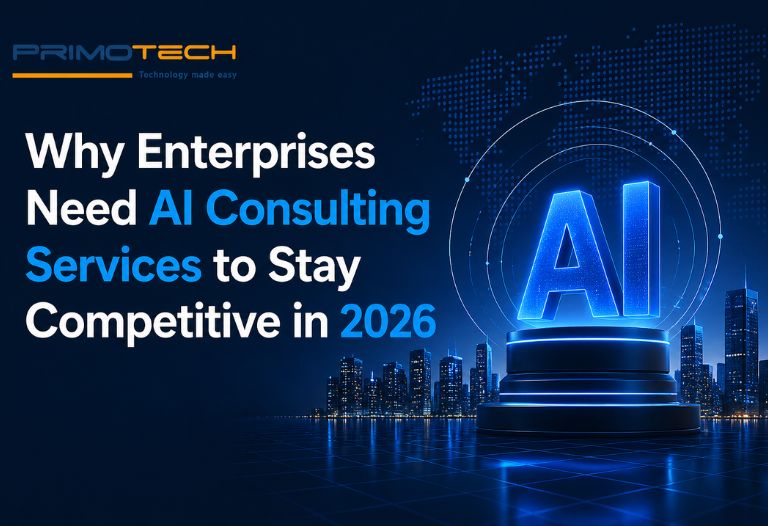
Let’s start with a number that should bother every enterprise leader: 95%.
That’s the share of enterprise AI pilots that delivered zero measurable P&L impact, according to MIT research. Not “below expectations.” Zero. And yet the same organizations running these pilots are increasing AI budgets. Gartner puts worldwide AI spending at $2.52 trillion in 2026. That’s a 44% jump year over year.
Spend more, get less. It’s the defining paradox of enterprise AI right now.
The technology isn’t broken. Generative AI, machine learning, and agentic systems are genuinely capable of transforming how large organizations operate. The problem is almost always the same: enterprises buy AI tools the way they buy software licenses, then wonder why nothing changes. Real AI transformation requires strategy, governance, clean data, and organizational alignment that most internal teams don’t have time to build — especially while running the actual business.
That’s the case for AI consulting services for enterprises in 2026. Not theory. Not future-state. Right now.
The Market Numbers Tell an Interesting Story
The global AI consulting market is expected to reach $14.07 billion in 2026. By 2035, analysts peg it at $116.63 billion — a 26.49% CAGR over nine years. Large enterprises are the fastest-growing segment within that, projected to grow at a 27.9% CAGR through 2035.
Those numbers reflect something real: enterprises have concluded, at scale, that they need outside expertise to make AI work. This isn’t vendor hype. These are budget decisions made by CFOs who’ve already burned money on failed pilots and want different results.
What does the AI landscape actually look like inside enterprises today? Deloitte’s research surveyed 3,235 leaders and found roughly three groups. About a third are using AI to genuinely transform — new products, rebuilt processes, different business models. Another third is redesigning workflows around AI in meaningful ways. The remaining third? They’re using AI at the surface. Efficiency tweaks—no real change to how the business runs.
Only that first group is building anything durable.
The importance of AI in enterprises isn’t about having AI. It’s about being in that first group — and the gap between groups is growing every quarter.
Why Enterprises Keep Failing at This
The Data Problem Nobody Talks About Honestly
Ask most executives about their AI readiness, and they’ll point to the tools they’ve purchased. Ask a consultant who’s been inside a dozen enterprise AI implementations, and you’ll get a different answer: the data was a disaster before AI ever entered the conversation.
Gartner found 63% of organizations either don’t have AI-ready data practices or genuinely aren’t sure whether they do. Think about what that means in practice. You’re building a system that learns from your data, makes decisions based on your data, and produces outputs your teams will act on — and the foundation is broken. The AI performs exactly as designed. The inputs are the problem.
Data governance, pipeline architecture, master data management: none of it is exciting work. But enterprises that skip it and jump straight to model deployment consistently end up in the same place. Expensive pilots. Unreliable outputs. Skeptical business users who stop trusting the system after the third wrong answer.
Good AI consulting services for enterprises first fix the data problem—every time.
You Cannot Hire Your Way Out of This Fast Enough
The AI talent market in 2026 is genuinely brutal for enterprises. Data scientists, ML engineers, AI architects, domain specialists, and responsible AI practitioners — assembling a team that covers all of this is a multi-year, high-cost effort. 45% of organizations cite talent shortage as their top AI barrier. That number has barely moved in three years.
And here’s the part that often gets missed: even if you hire the engineers, you still need the institutional knowledge. Someone who’s navigated three enterprise AI transformations and knows which mistakes are coming knows things that a brilliant new hire simply doesn’t have yet. That experience is what you’re buying when you work with an established AI consulting company for enterprises. Not bodies. Not credentials. Accumulated pattern recognition from real deployments.
Strategy That Floats Free of Accountability Goes Nowhere
McKinsey is direct about this: enterprise AI failure is a “business challenge, not a technology challenge.” Leadership inertia. Misaligned use case prioritization. No clear measurement of outcomes. Business units are chasing impressive-sounding pilots while nobody tracks whether the underlying problem has been solved.
The pattern is familiar to anyone who’s been inside a large organization during an AI push. Vendors pitch platforms. Enthusiastic teams run demos. Someone approves a budget. Six months later, the vendor gets paid, the pilot is presented at an all-hands, and then, quietly, nothing happens next.
What breaks this cycle? A structured approach to use case selection, with value-versus-feasibility scoring that forces honest conversations about what AI will actually change. McKinsey’s data shows organizations that do this achieve 30-50% faster time-to-value. Not because the technology is better. Because they’re working on the right things.
Regulation Is No Longer a Future Problem
Two years ago, AI governance was something enterprises put on a roadmap and revisited later. That era is over.
The EU AI Act is live. US state-level legislation is multiplying. Banking regulators, healthcare authorities, and government procurement bodies are adding specific AI requirements around explainability, bias auditing, data handling, and human oversight of automated decisions. BCG surveyed 2,700 global executives and found that only 28% feel fully prepared. The other 72% are carrying regulatory exposure they may not yet fully understand.
The risk here isn’t just fines. It’s the deeper problem of deploying AI systems that can’t be audited, can’t be explained to regulators, and can’t demonstrate they’re working fairly. If something goes wrong — a biased credit decision, an unexplainable insurance denial, an autonomous system making an error with real consequences — organizations without proper governance infrastructure have no defense.
Experienced AI consulting service providers build this in from the start. Model documentation, fairness testing, data lineage, and explainability frameworks. It costs more upfront. It costs far less than a regulatory crisis later.
What Enterprises Actually Get From Good AI Consulting
Breaking the Pilot-to-Production Barrier
The place where enterprise AI programs go to die is the gap between “pilot worked in the lab” and “running reliably in production at scale.”
Integration with legacy systems is harder than expected. Change management is underestimated. Governance structures for production AI don’t yet exist in most organizations. The organizational habits and workflows that AI needs to embed into resist change, sometimes actively.
AI consulting companies for enterprises have been here before. They have deployment playbooks built from previous implementations — they know which integration issues appear consistently, which change management approaches work sector by sector, and how to build operating models that make production AI sustainable. Most enterprises trying to do this internally are solving problems that have already been solved elsewhere. They’re paying consultant fees one way or another — either to an external partner or in the form of internal time lost reinventing wheels.
The Agentic AI Shift Is Happening Now
If you haven’t been tracking AI trends for enterprises in 2026 closely, here’s the one development that matters most: agentic AI is moving from experimental to operational.
Agentic systems don’t just respond to prompts. They plan, reason across multiple steps, access data from different systems, and take actions — sometimes significant ones — with minimal human involvement at each step. Gartner predicts 40% of enterprise applications will embed task-specific AI agents in 2026, up from under 5% a year ago. Cisco projects 56% of customer support interactions will involve agentic AI by mid-2026. By 2028, Gartner estimates AI agents will intermediate over $15 trillion in B2B spending.
The competitive implications are hard to overstate. Enterprises deploying effective agentic AI across supply chain, finance, and operations run with structural advantages in speed and cost that compound over time.
The risk side is equally real. McKinsey specifically flagged that agentic AI opens vulnerabilities that can “disrupt operations, compromise sensitive data, or erode customer trust.” Gartner’s projection: over 40% of agentic AI projects will be canceled by 2027 due to inadequate governance. The organizations that navigate this well will have proper architecture and controls in place before the problems arrive. The ones that don’t are running an expensive experiment with an unpredictable blast radius.
Building AI Capabilities Competitors Can’t Easily Buy
There’s a version of AI adoption that’s essentially undifferentiated: buy the same tools your competitors are buying, use them in roughly the same ways, and compete on execution. That’s better than nothing. It’s not a moat.
The enterprises building durable competitive advantage are using AI consulting to build proprietary capabilities — models fine-tuned on their own operational data, AI systems tailored to their specific workflows and regulatory environment, and organizational AI literacy that lets them move faster with each new capability. 73% of enterprises are now leveraging AI to deliver operationally personalized services rather than generic outputs. That shift from generic to specific is where the real competitive value lives.
Finance and banking show this most clearly. With a 22.3% share of the global AI consulting market in 2026, the sector has moved well past generic AI tools. Custom fraud detection models trained on proprietary transaction data. Risk systems are built around specific portfolio structures. Customer experience AI that reflects the nuances of a particular bank’s product set. You can’t buy that off a shelf. You build it with expertise.
Industry-by-Industry: Where the Returns Are Coming In
Financial Services: Over 80% of global banks are running AI-powered fraud prevention. The impact on actual fraud rates has been significant — up to 35% reduction at institutions with mature implementations. Customer service automation has reduced operational costs by 25% at leading players.
Manufacturing: Process turnaround times have improved by up to 18% in enterprises running AI-powered automation, per Infosys data. Predictive maintenance and supply chain optimization are generating returns quickly because data quality in manufacturing environments is often better than in knowledge work environments.
Healthcare: Clinical decision support, administrative automation, and diagnostic AI are reshaping operations. The consulting challenge here is significant — data privacy requirements are strict, regulatory oversight is close, and the consequences of errors are high. Expert guidance on responsible AI deployment is not optional in this sector.
Retail and e-commerce: Demand forecasting and inventory optimization deliver fast ROI. Personalization at scale is the long game, and enterprises building it now have years of model improvement ahead of competitors starting from scratch.
Across all sectors, enterprises implementing AI with a solid strategic foundation report an average 34% improvement in operational efficiency and 27% in cost reduction within 18 months. That’s not from technology. It’s from technology deployed with a plan.
The Window for Easy Catch-Up Is Closing
There’s a comfortable story enterprises tell themselves about AI: “We’ll learn from the early movers, avoid their mistakes, and adopt when the technology is more mature.” That story made sense in 2022. It doesn’t hold up in 2026.
The organizations investing seriously in AI now are building three things that late movers cannot quickly replicate. First, proprietary training data generated by production AI systems — the longer these systems run, the better they get, and that improvement is not transferable. Second, organizational AI capability and literacy make each subsequent AI deployment faster and cheaper. Third, governance infrastructure and institutional knowledge that lets them move faster with new AI capabilities while managing risk responsibly.
Accenture’s research found that three out of four C-suite executives believe organizations that don’t effectively scale AI within five years risk going out of business entirely. 92% of companies plan to increase AI investment over the next three years (McKinsey). 88% of executives are specifically increasing AI budgets in 2026, driven by the potential of agentic AI (PwC).
The competitive gap is compounding. Every quarter is not neutral.
What Primotech Delivers
Primotech provides AI consulting services for enterprises focused on one thing: turning AI investment into competitive outcomes that show up in the business.
Every engagement starts with an AI readiness assessment — a clear-eyed look at your data infrastructure, technology landscape, talent gaps, and organizational maturity. No assumptions. No generic roadmaps pulled from a template. An honest picture of where you are and what the path forward actually requires.
From there, we build the strategy, data foundations, governance architecture, and implementation plan that get you from intention to production. We stay through deployment because that’s where most programs either break through or stall.
Our consultants have deep experience across AI strategy, data engineering, ML development, agentic AI architecture, and responsible AI governance — with industry-specific knowledge in financial services, healthcare, manufacturing, and technology. We know what separates the enterprises getting genuine AI returns from the ones running expensive experiments. The difference is almost never the technology.
If 2026 is the year your organization stops experimenting and starts scaling, we should talk.
Frequently Asked Questions
1. What exactly do AI consulting services for enterprises cover?
They cover the full AI adoption lifecycle — strategy, data infrastructure, model development, system integration, governance, change management, and ongoing optimization — at enterprise scale and complexity. The distinction from general IT consulting is the specialized depth: AI strategy, ML architecture, responsible AI practice, and the organizational change expertise needed to make AI actually get adopted and used. Most enterprise AI failures are not technology failures. They’re strategy and governance failures. That’s the core of what AI consulting addresses.
2. Why can’t enterprises build this capability internally?
Many try, and for certain use cases, it makes sense. The challenge is the breadth of expertise required — data engineers, ML architects, AI governance specialists, domain experts with industry knowledge, and change management practitioners. Assembling that team takes years. 45% of organizations cite talent shortage as their primary AI barrier, and the market for strong AI professionals is intensely competitive. Working with an AI consulting company for enterprises gives you immediate access to a team that has already solved problems very similar to yours. That accumulated experience matters more than headcount.
3. We’ve already run several AI pilots. Does it make sense to bring in consultants now?
This is actually one of the most common entry points. Enterprises that have run pilots have real data about what’s working and what isn’t — which is valuable. The challenge of scaling from a controlled pilot to production-grade enterprise deployment is where most programs stall. Integration complexity, change management, governance gaps, and operational reliability at scale are all hard problems that experienced consulting partners have navigated before. Starting from pilots is often a better position than starting from scratch.
4. What should we look for when evaluating AI consulting service providers?
Four things matter most: demonstrated production deployment experience (not just strategy work), genuine industry-specific domain knowledge in your sector, a mature and practical approach to responsible AI and governance, and evidence they can manage organizational change — not just technical implementation. The technical capability to build models is widely available. The ability to embed AI into real workflows, use it reliably by real teams, and govern it responsibly over time is where good partners separate themselves from average ones.
5. What are the key AI trends for enterprises in 2026 to plan for?
The most consequential ones right now: the shift from generative AI pilots to production agentic AI deployment; industry-specific AI models replacing generic tools as the source of real competitive differentiation; AI governance moving from a compliance exercise to a boardroom-level risk management priority; and composable AI architectures that let enterprises assemble best-of-breed capabilities across their tech stack. Each of these trends requires strategic and technical expertise to capture value from without creating new risks.
6. How long until we see real returns from an AI consulting engagement?
Early use cases — automation, process efficiency, and analytics enhancements — are typically demonstrable within 3 to 6 months. Enterprise-wide transformation with measurable business impact generally takes 12 to 24 months to reach scaled production. The timeline depends heavily on starting conditions, particularly data readiness and organizational change capacity. A good consulting partner is honest about this upfront and structures the engagement to deliver visible early wins while building toward longer-term results.
7. How do AI consulting services connect to broader digital transformation goals?
AI consulting should not sit apart from broader transformation work. The most effective engagements are those in which AI strategy is explicitly linked to the business outcomes the organization seeks to achieve — revenue growth, cost efficiency, customer experience, and risk reduction. AI consulting service providers who ask about business goals before recommending technology and who design programs with clear linkage to those goals are the ones whose work actually moves the needle on transformation rather than adding another layer of complexity.
“Primotech works with enterprises to design and scale AI programs that deliver measurable competitive advantage. To discuss your organization’s AI priorities for 2026, reach out to our consulting team.”