 April 24, 2026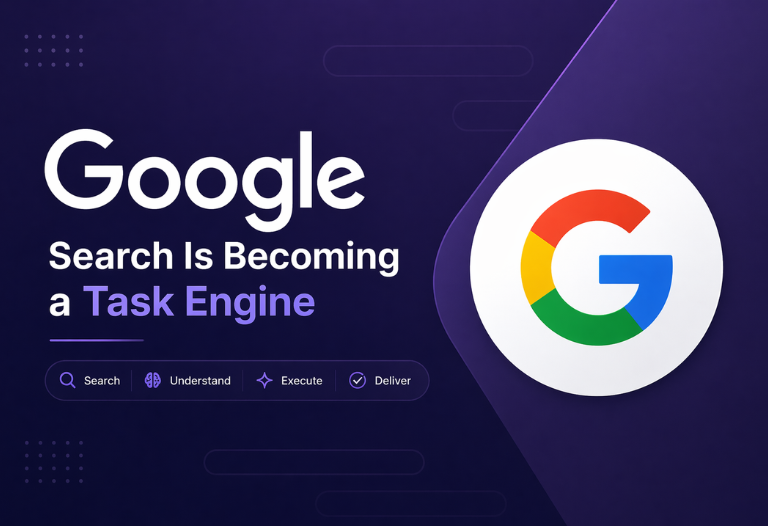
I’ve been saying for a while that the next big google search shift wouldn’t look like a search update. It would look like Google doing things for you instead of pointing you toward them. That’s exactly what’s happening right now, and most businesses I talk to are still treating it like a future problem.
It isn’t.
Hotel Price Tracking: Small Feature, Big Signal
Google quietly rolled out individual hotel price tracking globally. You search for a specific hotel by name, head to the Prices tab on desktop or mobile, toggle price tracking on, and Google emails you when rates shift for your selected dates. No third-party app. No manual rechecking.
This sounds like a consumer convenience feature. It is. It’s also a signal about where the platform is headed.
Google Flights price alerts have worked this way for years, so adoption here will be fast. The more important observation is what Google is doing structurally: removing the reasons a user would need to leave Search to accomplish something. Every feature like this is one less click to a third-party site.
Agentic Calling: Google Will Make the Phone Call So You Don’t Have To
This one is bigger than it looks, and I want to make sure it lands properly.
Google’s AI Mode now supports agentic calling. You describe what you’re looking for, add a “near me” qualifier, and Google’s AI contacts local stores directly to check inventory and availability on your behalf. The feature launched on Search in November last year and is now rolling out inside AI Mode in the U.S.
Think about what that means operationally. An AI system is calling your business, pulling information, and deciding whether to include you in its response to a user. If your inventory data is stale, your hours are wrong, or your Google Business Profile is incomplete, you don’t just rank lower. You get skipped entirely by a system that never gives you a chance to make the case yourself.
That’s a different kind of invisibility than dropping from position three to position seven.
Canvas: Search That Builds You an Itinerary
The Canvas tool inside AI Mode takes a travel query and turns it into a full itinerary in a side panel, pulling from real-time flight and hotel data, Google Maps reviews and photos, and relevant web content. You describe the trip, Canvas assembles a plan, you tweak it conversationally, and it updates. Currently live on desktop for U.S. users in the AI Mode Labs experiment.
The travel application is the obvious one. The underlying architecture applies everywhere. Google is building a layer between users and websites where tasks get completed without a click ever happening.
What Seven Travel Features Tell You About One Strategic Direction
Google has highlighted seven travel features for this season:
- AI Mode trip planning via Canvas
- Individual hotel price tracking
- Restaurant booking assistance
- Agentic store calling
- Real-time translation
- Ask Maps for trip stops
- Google Wallet for airport travel.
Sundar Pichai has been talking about task-based search as Google’s direction for a while. These features are what it looks like when it ships.
The Visibility Problem
Here’s where I want to be direct, because I see this gap in strategy conversations constantly.
Traditional search rewarded whoever ranked highest.
Task-based, agentic search rewards whoever’s data is most structured, accurate, and machine-readable. Those are not the same competition. Winning one doesn’t automatically mean you’re positioned for the other.
If an AI agent is calling your store, checking your inventory, assembling a trip that includes your hotel, or recommending your restaurant, it needs clean, consistent, accessible data to do it. Outdated listings aren’t just bad user experience anymore. They’re the reason an AI excludes you from a response that the user never even sees you miss.
Domain authority and backlinks still matter. They’re just no longer sufficient on their own.
What to Actually Do About This
Four things worth doing now, before this becomes an urgent conversation rather than a proactive one.
- Your operational data is now marketing data: Pricing, inventory, availability, and hours- these now determine whether AI systems can surface your business. So, treat them accordingly.
- Get your structured data right: Schema.org markup is how AI systems read and use your content. If your site still isn’t using it properly, that’s a gap with real commercial consequences in an agentic search environment.
- Audit your local listings for consistency: Google Business Profile, directories, and your own site inconsistencies across sources reduce AI systems’ confidence in your data. Consistency is a competitive advantage now, not just housekeeping.
- Reframe how you think about content: The question isn’t only whether a page will rank. It’s whether an AI agent can use the information on that page to complete a task on a user’s behalf.
One More Thing
The ten blue links aren’t disappearing this quarter. But they’re sharing the interface with something that operates on entirely different logic, and the businesses that understand that logic now are building an advantage that will be very hard to close in 12 months.
At Primotech, this is the work we’re doing with clients right now, building the data infrastructure, structured content, and AI search visibility frameworks that position brands to be cited, surfaced, and acted on inside these new search environments.
If you’re trying to figure out what your search strategy looks like in an agentic world, that’s exactly the conversation worth having.
Feel free to reach out to me for any questions, or book a consultation with me at [email protected]