 June 12, 2026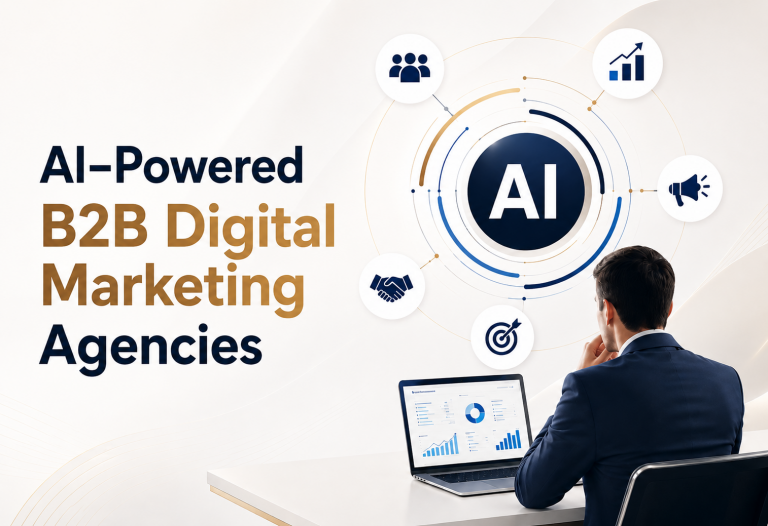
Most B2B businesses have a digital marketing presence. A website, some content, a LinkedIn page, perhaps paid campaigns running. What many of them do not have is a program that produces pipeline with consistency and predictability, that is directly connected to how their buyers research, evaluate, and decide. This is where AI-Powered B2B Digital Marketing Agencies are helping businesses create smarter, data-driven growth strategies.
That disconnect is what is driving the growing demand for B2B digital marketing agencies with AI expertise in 2026.
This blog covers what is creating that situation, what resolves it, and why businesses across industries; including those targeting US and global markets, are treating this as a leadership decision rather than a marketing line item. It examines what AI actually contributes to B2B marketing in practice, what a well-built strategy looks like, and what separates agencies that deliver measurable pipeline outcomes from those that deliver activity reports.
If your digital marketing is not producing the qualified interest your business should be attracting, the reasons behind that are worth understanding clearly.
What Is B2B Digital Marketing And Why It Is Different
B2B digital marketing is the practice of using digital channels to market products and services to other businesses rather than individual consumers.
In B2C marketing, a single person sees an ad, makes a decision, and completes a purchase often within hours or days. According to Gartner in B2B, the average purchase involves 6 to 10 decision-makers, which takes 3 to 12 months to complete, and requires multiple points of evidence before any commitment is made. The content, channels, and strategy required to move a B2B buyer through that process are fundamentally different from what consumer marketing demands.
89% of B2B researchers use the internet during the research process, according to Google. They are reading comparison articles, evaluating vendor credibility, reviewing case studies, and forming opinions long before they speak to anyone. That research journey is where B2B digital marketing either spawns opportunity or dissolves it.
The channels that matter most in B2B are search engines, LinkedIn, email, and content-driven platforms. The metrics that matter are qualified leads, pipeline value, and revenue attribution.
B2B vs B2C Digital Marketing
Understanding why B2B requires a different marketing approach is the starting point for understanding why specialized agencies with AI capability are in demand.
Target audience
B2C targets individuals making personal purchasing decisions. B2B targets organizations, department heads, technical evaluators, and C-suite executives.
Decision timeline
B2C purchases are often impulse-driven or short-cycle. B2B purchases involve budget approvals, stakeholder alignment, competitive evaluations, and contract negotiations.
Content requirements
B2C content is designed to create desire and urgency. B2B content is designed to build credibility and answer precise questions at each stage of a longer evaluation process. Whitepapers, case studies, technical comparisons, and ROI calculators serve B2B buyers. Lifestyle imagery and short-form promotions serve B2C.
Channel priorities
80% of B2B social media leads are derived through LinkedIn according to its own data. Email marketing, organic search, and webinars are consistently the top-performing B2B channels. Social platforms like Instagram and TikTok dominate in B2C.
Relationship depth
B2B purchases are rarely one-time transactions. They establish ongoing business relationships, which means trust-building is not optional – it is built into the marketing strategy from the beginning.
These differences explain why businesses are specifically seeking B2B digital marketing agencies rather than generalist marketing firms.
Why the B2B Buying Journey Has Made Digital Marketing Non-Negotiable
Gartner’s research on B2B buying behavior shows that buyers spend only 17% of their total purchase journey in direct conversation with vendors. The remaining 83% is independent research conducted across search engines, industry publications, LinkedIn, peer review platforms, and competitor websites.
By the time a buyer contacts a vendor, their shortlist is already formed. Their preference is largely established. The decision that appears to happen in a sales conversation was actually shaped weeks or months earlier.
This creates a clear business problem. Companies with strong digital presence, high search rankings for relevant queries, credible LinkedIn authority, well-structured content across the decision journey, are being evaluated and shortlisted during that 83%. Companies without it are not part of the consideration set regardless of how strong their sales team is.
The businesses investing in B2B digital marketing agencies with AI expertise in 2026 have understood this. They are not treating digital marketing as a support function. They are treating it as the primary mechanism through which buying decisions get influenced because that is what the data shows it has become.
What AI Specifically Contributes to B2B Digital Marketing
AI in B2B marketing ranges from genuinely impactful to largely surface-level. The applications that actually move pipeline are worth understanding specifically.
Intent data and account identification
AI-powered intent data platforms monitor research behavior at the company level across the broader web. When an organization begins showing concentrated activity around topics related to your category like comparison searches, solution queries, integration questions – that signal surfaces before the company contacts anyone. This allows outreach and content to reach target accounts while opinions are still being formed, not after decisions have been made. For businesses running account-based marketing programs, this changes the timing and relevance of every interaction.
Predictive lead scoring
Most B2B lead scoring systems are built on assumptions that are never validated against real conversion data. AI builds the model from actual historical close data including company types, behavioral patterns, and content engagement sequences that preceded signed contracts, then applies that learning forward.
Sales teams prioritize their time based on what the data shows actually convert, not on assumptions about what should convert. Companies using AI-powered predictive scoring report a 20 to 30% improvement in sales qualified lead rates.
Buyer Intent Content Strategy
AI tools map what your target buyers are actively searching at each stage of their decision process and identify exactly where your current content falls short. Content investment moves from opinion-based to evidence-based. You stop producing content that seems relevant and start producing content that answers verified buyer questions at the right point in their decision journey.
Marketing automation that adapts
B2B buying cycles run months. A prospect who downloads a whitepaper in January may not be ready to evaluate vendors until May. AI-powered automation keeps those prospects engaged with relevant content calibrated to where they are in their journey, without requiring manual oversight of each account’s progression.
Performance attribution across long cycles
One of the persistent challenges in B2B marketing is attributing revenue to specific marketing activities across a buying cycle that involves multiple touchpoints over many months. AI-driven attribution models connect the dots across that timeline, giving marketing and leadership accurate visibility into which activities are actually producing pipeline.
The Numbers Behind the Investment Decision
The performance data on AI-integrated B2B digital marketing is consistent enough to use as a planning benchmark.
B2B companies focused on inbound marketing like SEO, content, and email nurture see their cost per lead drop by 80% after just five months of consistent execution, compared to outbound methods. That advantage does not plateau — it compounds as organic authority builds, creating an increasing cost gap between inbound-led businesses and those still dependent on outbound programs.
Email marketing structured around B2B buying cycles returns approximately $42 for every $1 invested, making it the highest-ROI channel in the B2B marketing mix. The condition is that the sequences are designed around a decision process that runs months, not days.
The first organic search result captures an average of 27.6% of all clicks according to Backlinko’s analysis of four million Google search results. For high-intent B2B queries like vendor comparisons, solution category searches, and implementation questions, that position determines whether your brand enters the buyer’s consideration set or remains entirely absent from it.
81% of B2B buyers say content has a significant impact on their buying decisions, and that is not a content preference to simply accommodate. It is the documented buying behavior of the exact decision-makers B2B companies are trying to reach.
According to IBM, organizations that followed AI implementation of best practices to a significant extent reported a median ROI of 55% on generative AI. Partial adoption produced partial results.
Content marketing-led B2B companies generate 3 times as many leads per dollar invested compared to those without a structured content program, according to Content Marketing Institute.
What a Well-Built B2B Digital Marketing Strategy Covers in 2026
A functioning B2B digital marketing strategy is not a list of channels. It is a connected system where each element reinforces the others, and the whole is measured against pipeline outcomes.
Precise ICP definition
Before any campaign, channel, or content piece, the ideal customer profile has to be documented with specificity including industry, company size, decision-maker roles, buying triggers, and the specific problem the business solves better than alternatives. Every downstream decision depends on this clarity.
B2B SEO built around decision journey intent
A strong B2B SEO strategy is not built around keyword volume. It maps every search a buyer makes from first recognizing a problem through to selecting a vendor, with content built at each stage with genuine depth. That kind of organic presence compounds over time in a way paid channels cannot replicate. 61% of B2B companies cite SEO and organic traffic as their top inbound marketing channel.
LinkedIn as a pipeline channel
LinkedIn drives 80% of B2B social media leads and 94% of B2B marketers distribute content on the platform. The businesses treating it as a structured pipeline channel are generating qualified conversations consistently. The ones using it purely as a brand presence are measuring follower growth instead of pipeline.
Email nurture calibrated to buying cycle length
A prospect who engages with content in February may not be ready to evaluate vendors until July. The nurture sequence covering that window determines whether your brand remains credible and present when their evaluation begins — or whether a competitor who stayed consistent earns that consideration.
Account-based marketing for high-value targets
Aligned ABM strategies deliver a 208% increase in marketing-generated revenue and grow profits 27% faster over three years, according to Revenue Memo’s 2026 ABM analysis. AI makes genuine ABM personalization operationally viable at scale.
Performance reporting tied to revenue
Pipeline growth, qualified lead rates and revenue attribution tell you whether the strategy is working. Traffic and engagement figures do not.
Why B2B Digital Marketing Agencies in India Are Managing Global Programs
The B2B digital marketing companies in India running programs for US and international clients have built genuine specialization in B2B specifically. Buying cycles are longer, stakeholder structures are more complex, and the relationship between content, SEO, and pipeline requires a different operational framework. Agencies that work exclusively in B2B develop depth in these areas that generalist operations do not accumulate.
AI digital marketing agencies in Mohali, Bengaluru, Pune, and Hyderabad have built this specialization alongside genuine AI capabilities. Intent data platforms, predictive lead scoring, AI-assisted content strategy, and pipeline-connected reporting are built into how programs are designed from the start.
For US companies evaluating B2B marketing partners, the relevant criteria are not geographic. Does this agency understand B2B buyer behavior in your target markets. Can they demonstrate how their programs are built. What do pipeline outcomes look like for comparable clients. Agencies with genuine depth answer those questions directly.
What Has to Be in Place Before AI Adds Value
AI amplifies what is already functioning. It does not create clarity where positioning is vague. It does not improve conversion on a website with structural problems. It does not fix the disconnect between sales and marketing teams working with different definitions of a qualified lead.
If the ideal customer profile lacks precision, AI-powered targeting distributes that imprecision at a greater scale. If the value proposition does not differentiate clearly, AI-optimized campaigns communicate that more efficiently to the wrong audience.
The foundation has to exist first. ICP clarity, a website that converts, sales and marketing alignment, and a value proposition that holds up against alternatives. Agencies worth engaging will assess that foundation honestly before recommending where to invest. That assessment at the start is usually a reliable indicator of the quality of guidance that follows.
How Primotech Supports B2B Growth
Primotech helps businesses build and execute B2B digital marketing strategies designed to increase visibility, generate qualified leads, and support long-term business growth. Our team combines expertise in SEO, content marketing, social media marketing, paid advertising, website optimization, and analytics to create marketing programs that align with business objectives.
As a digital marketing and technology company, we understand that modern B2B growth requires more than isolated campaigns. We help businesses strengthen their online presence through search-driven content, performance-focused SEO, targeted advertising, and marketing strategies built around how today’s buyers research and evaluate solutions.
Alongside our digital marketing services, Primotech brings experience in AI, software development, data analytics, cloud solutions, and business technology services. This broader technology background allows us to support organizations looking to improve digital experiences, streamline operations, and build scalable growth strategies.
We’ve worked with businesses across technology, SaaS, professional services, and other industries, supporting both domestic and international markets. Our focus remains simple: helping companies attract the right audience, build credibility, and create measurable business opportunities through effective digital marketing.
If you’re looking for a B2B digital marketing partner that combines marketing expertise with strong technology capabilities, let’s talk or drop mail [email protected] .
Conclusion
The demand for B2B digital marketing agencies with AI expertise in 2026 is a direct response to documented changes in how B2B buyers research, evaluate, and decide. 89% use the internet throughout their research process. 83% of that journey happens independently before vendor conversations begin. 80% prefer content over advertising as the format through which they receive information.
The businesses responding to this with AI-integrated B2B digital marketing programs built around buyer intent. Predictive lead intelligence, account-based strategy, and revenue-connected reporting are building pipeline assets that compound over time. The businesses that are not; are competing at a disadvantage that grows larger with every month that passes.
Hiring a B2B digital marketing agency like Primotech with genuine AI expertise is not a technology decision. It is a decision about whether the marketing program is built for how buyers actually behave in 2026.
Frequently Asked Questions
Why businesses hire B2B digital marketing agencies with AI expertise in 2026?
83% of the B2B buying journey happens independently before buyers engage any vendor. Businesses need a digital presence inside that research phase. AI makes that presence precise, identifying in-market accounts earlier, scoring leads against real conversion data, and attributing marketing activity to pipeline. Agencies combining B2B specialization with genuine AI capability produce measurably different outcomes.
What does a B2B SEO and content marketing strategy need to include in 2026?
A full intent map of the buyer’s decision journey from problem recognition through vendor selection. Content built with genuine depth at each stage. Technical SEO, conversion architecture on every content piece, LinkedIn distribution, and reporting connected to qualified leads and pipeline – not traffic. 61% of B2B companies cite SEO and organic traffic as their primary inbound channel.
How long does it take to see results from B2B digital marketing?
Paid marketing campaigns can generate leads within 2–3 months, while SEO typically shows results in 4–6 months. Long-term SEO efforts often deliver the best ROI and sustainable business growth over time.
How can businesses evaluate an agency’s AI capabilities?
Ask how the agency uses AI for lead generation, audience targeting, and performance tracking. Agencies with genuine AI expertise can explain their processes, tools, and results with clear examples and measurable outcomes.
What causes most B2B digital marketing programs to underperform?
Three patterns consistently. ICP lacks precision, so campaigns reach nobody specifically. Misalignment between marketing and sales on what a qualified lead actually is. And organic investment cut right before the compounding returns would have started.