 March 12, 2026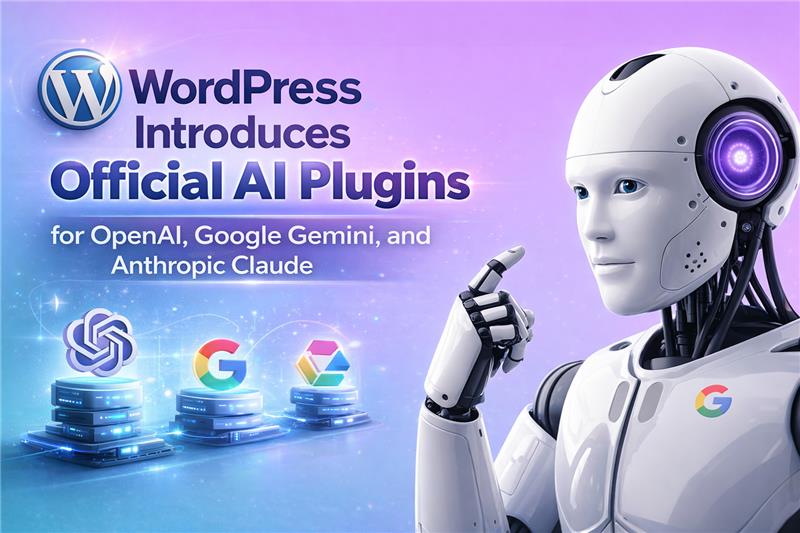
Every developer and agency head I’ve spoken to recently has been asking the same thing: when does WordPress actually become a platform for building AI-powered applications, not just publishing content?
That answer just landed.
WordPress has officially released plugins for OpenAI, Google Gemini, and Anthropic Claude. The story here is not “AI features in WordPress.” The real story is the infrastructure underneath it.
A Single SDK to Connect Them All
The three plugins connect through the PHP AI Client SDK, a unified framework that gives developers one interface for building AI-powered features regardless of which model they’re working with.
In practice, instead of writing a custom integration for OpenAI, rebuilding it for Gemini, then doing it again for Claude, developers work with one shared architecture. Provider credentials are managed in one place and reused across any compatible plugin.
For anyone who’s been handling these integrations manually, this is a great step forward.
What Each Plugin Actually Does
The OpenAI plugin supports text generation via GPT models, image generation through DALL-E, function calling, web search, and text-to-speech. Available models surface dynamically through the API, so new releases show up automatically.
The Anthropic Claude plugin is built for reasoning-heavy use cases. It supports Claude’s extended thinking capability, function calling, and text generation. If you’re building document analysis workflows, AI agents, or anything requiring multi-step reasoning, this is the one to focus on.
The Google Gemini plugin brings multimodal capabilities: text generation, image generation via Imagen models, and function calling. For developers building applications that work across text and visual content, this opens up real possibilities.
Getting Started
Requirements are straightforward: PHP 7.4 or higher, and an API key from your provider of choice.
If you’re on WordPress 6.9, the PHP AI Client SDK needs to be installed separately.
WordPress 7.0, expected in April 2026, bundles the SDK by default. That’s the version where this becomes truly plug-and-play.
Why This Matters
WordPress powers more than 40% of websites globally. When a platform at that scale standardizes how AI gets integrated, it changes what’s feasible for the average agency or developer.
You can now build:
→ AI chat assistants directly inside a client’s site
→ Automated content workflows running on a schedule
→ Intelligent site search powered by a language model
→ Image generation tools embedded in editorial workflows
→ AI-driven plugins that adapt to user behavior
The conversation around AI in WordPress has mostly been about AI-generated blog posts and chatbot plugins bolted onto existing themes. This is a different category entirely.
WordPress is providing the infrastructure layer and positioning itself as a development platform for AI-powered applications.
If you’re thinking through what this means for your stack or your clients, feel free to reach out to me.