 November 16, 2026
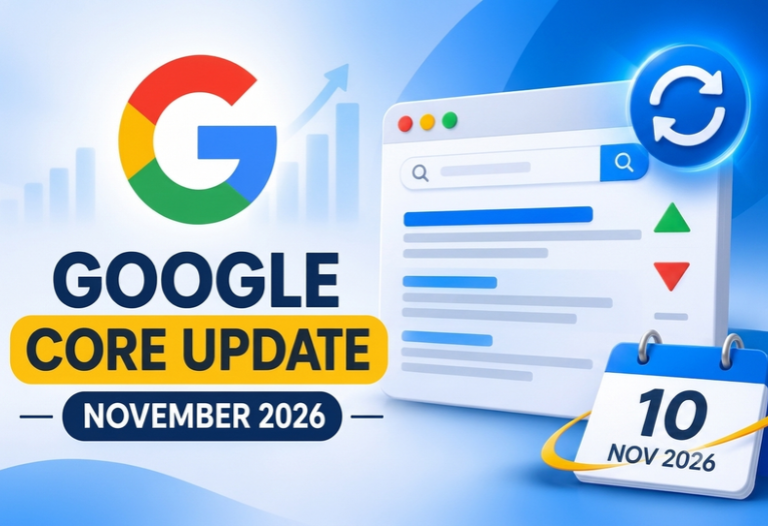
Google has started rolling out its November 2026 core update, giving SEOs and marketers another major search ranking change to watch before the end of the year. The rollout began on November 10 at 10:06 a.m. Pacific Time and applies globally across all languages. Google says the update may take up to two weeks to complete.
This is Google’s third announced core update of 2026, following the March and May core updates. So far, Google has not provided a specific objective for the November release beyond describing it as a regular update designed to better surface relevant, satisfying content from sites across the web.
If you are monitoring organic traffic or rankings, here is what Google has confirmed about the update, what the rollout means for SEO performance, and what you should and should not change while the update is still underway.
What Is the Google November 2026 Core Update?
The Google November 2026 core update is a broad update to Google’s search ranking systems. Unlike a manual action aimed at a specific website, a core update changes how Google’s systems evaluate and rank content across search results.
Google describes this release as a regular update intended to better surface relevant and satisfying content for searchers. It does not identify a particular industry, content format, SEO tactic, or type of website as the target of the November update.
That distinction is important because ranking changes during a core update are often followed by theories about what Google has changed. Some of those observations can eventually prove useful, but they should not be treated as confirmed algorithm changes unless Google provides evidence for them.
When Did the November Core Update Start?
Google began the November 2026 core update on November 10, 2026, at 10:06 a.m. Pacific Time. The Search Status Dashboard currently lists the update as active, with ranking identified as the affected product.
Google expects the rollout to take up to two weeks. If it takes the full estimated period, the update could finish around November 24, although Google will confirm the actual completion date through its Search Status Dashboard.
That timing creates an additional challenge for marketers. A full two-week rollout would put the end of the update close to U.S. Thanksgiving, Black Friday, and Cyber Monday. Ecommerce sites comparing traffic before and after the update will therefore need to separate algorithm-related changes from normal seasonal demand.
A ranking change during this period does not automatically tell you what caused it.
The November Update Is Google’s Third Core Update of 2026
The November release follows two earlier core updates this year.
| Core update | Started | Completed |
| March 2026 core update | March 27 | April 8 |
| May 2026 core update | May 21 | June 2 |
| November 2026 core update | November 10 | Still rolling out |
The March update took 12 days and 4 hours to complete, while the May update took 11 days and 21 hours. The November rollout is currently expected to take up to two weeks.
There were also several other ranking updates between the major core releases, including spam updates in March, June, August, and September. That makes the timing of a ranking change important when analyzing what happened to a website.
What Has Google Actually Confirmed?
Google’s announcement is relatively limited, and that is worth keeping in mind when evaluating early reports about the update.
Google has confirmed that the November core update:
- Started on November 10, 2026
- Applies globally
- Covers all languages
- May take up to two weeks to complete
- Is a regular core update
- Is designed to better surface relevant, satisfying content
- Is the third announced core update of 2026
What Google has not confirmed is just as important.
There is currently no official statement saying the November update specifically targets AI-generated content, affiliate websites, ecommerce, local SEO, programmatic content, link building, or any other individual SEO practice.
Google also has not published a new detailed breakdown of the systems changed in this release.
So if certain categories of websites appear to be affected during the first few days, those patterns should be treated as observations rather than confirmed update objectives.
Seeing Ranking Changes After the Google Core Update?
Get expert help reviewing your Search Console data, affected pages, and content so you can respond with evidence, not guesswork.
What Could SEOs Notice During the Rollout?
Core updates can produce noticeable movement in search results while they are rolling out. Some sites may gain visibility, others may lose rankings, and some may see little change. The important part is not to treat every daily movement as the final outcome.
A page that drops several positions on one day could move again later in the rollout. Likewise, an early increase does not necessarily mean the site has permanently benefited from the update.
For that reason, it is more useful to watch broader trends across important pages and queries than to react to individual ranking changes.
1. Organic traffic changes
Look at your overall organic traffic as well as traffic to your most important landing pages.
If traffic falls for one day, that alone does not establish a core update impact. A sustained change across multiple pages and queries is more meaningful.
2. Ranking changes
Monitor priority keywords, but look for patterns rather than isolated movements.
A small movement from position 4 to position 6 is very different from a page dropping from the first page to the third or fourth page.
3. Query and page-level changes
Search Console can help identify which queries and pages are gaining or losing visibility.
However, Google recommends waiting until the core update has finished before conducting the main analysis. It also recommends waiting at least another full week after the rollout before comparing performance.
4. Changes in the search results
If an important page loses rankings, look at what replaced it.
The useful question is not simply, “Why did my page drop?”
It is:
“What are the pages now ranking above it doing differently?”
They might provide more original information, better satisfy the search intent, offer stronger evidence, answer the question more completely, or simply be considered more relevant by Google’s updated systems.
That comparison can provide more useful insight than trying to identify one new algorithm factor.
Google Has Not Said the Update Targets AI Content
AI-generated content is likely to be one of the first subjects discussed whenever a major Google update rolls out, but there is currently no official statement connecting the November 2026 core update specifically to AI-generated content.
That does not mean AI-assisted or AI-generated pages cannot be affected. It means there is not enough evidence yet to say that AI content itself is the target.
Google’s broader guidance continues to focus on helpful, reliable, people-first content rather than whether a particular tool was used to produce the content.
The distinction matters because a site owner should not assume that a ranking decline means they need to remove AI-assisted content. The more useful question is whether the content actually provides a valuable, accurate, original, and satisfying answer to the searcher.
One Search Console Data Issue to Keep in Mind
There is also a separate reporting issue that SEOs should know about while analyzing the November rollout.
Google confirmed a logging error affecting the Generative AI performance report in Search for data from November 9 through November 11. The issue caused a decrease in reported impressions, but Google says it affects data logging only.
That means the reported drop should not be interpreted as an actual decline in visibility in Google’s AI search experiences.
The timing makes this particularly important. The reporting issue overlaps with the beginning of the November core update, so anyone preparing an SEO performance report should avoid treating those Search Console numbers as evidence that the core update reduced AI-search visibility.
Should You Change Your SEO Strategy Right Now?
Probably not based on early ranking movement alone.
Google has not released new guidance recommending a specific action for the November update. Its existing core update guidance continues to emphasize creating helpful, reliable, people-first content rather than making quick changes in response to ranking fluctuations.
That means this is not the time to:
- Rewrite large sections of your website based on an unconfirmed theory
- Remove pages simply because they temporarily lost rankings
- Change every title tag across the site
- Remove content because someone claims a particular format is being targeted
- Make unrelated technical changes in the hope of recovering rankings
If you identify a genuine technical problem, it should still be fixed. But a temporary ranking movement and a technical SEO issue are not the same thing.
What If Your Rankings Drop After the Update?
If a ranking decline remains after the rollout, start by identifying exactly where the change occurred.
Look at:
- Which pages lost visibility
- Which queries declined
- How large the decline was
- Whether the change was limited to one topic or section
- Which pages now rank above yours
- Whether search intent has changed
- Whether competitors provide a stronger answer
Google’s core update guidance also recommends evaluating content using questions around usefulness, originality, expertise, reliability, and whether the content was created primarily for people rather than search engines.
This is a more useful approach than searching for a single “core update recovery” tactic.
A negative ranking change also does not necessarily mean something is technically wrong with your website. Google has previously explained that core updates can cause pages to move down because other content is now considered more relevant or useful.
When Should You Analyze the Impact?
Google recommends waiting until the core update has finished before evaluating its full impact. After that, Google advises waiting at least one full week before comparing Search Console performance.
For the November 2026 core update, that means marketers should resist drawing final conclusions from the first few days of data.
There is another reason to be careful with the timing.
If the rollout finishes around November 24, the following week will include Thanksgiving, Black Friday, and Cyber Monday in the United States. Ecommerce traffic during that period can behave very differently from a normal week.
A retailer that sees higher or lower organic traffic around Black Friday cannot automatically attribute the change to Google’s algorithm.
The comparison needs to account for seasonality as well as the update.
What We Still Don’t Know
At this stage, there are several things Google has not explained. We do not yet know which specific ranking systems were changed, which types of pages will see the largest gains or losses, or whether particular content patterns will emerge as the rollout continues.
We also do not have enough completed-update data to make reliable conclusions about winners and losers. That will become clearer after the rollout finishes and SEOs have enough data to compare rankings, traffic, queries, and search results. For now, early observations are useful for monitoring, but they are not the same as an official explanation of the algorithm change.
What SEOs and Marketers Should Do Now
The best approach during the rollout is to monitor carefully without making panic-driven changes. Keep an eye on important rankings, organic traffic, Search Console data, and your highest-value landing pages. Record significant changes so you can compare them with the official rollout timeline once Google confirms the update is complete.
If you notice movement, look for patterns rather than isolated fluctuations. Once the rollout finishes, give the results time to settle. Then compare the appropriate Search Console periods, identify the pages and queries that changed, and review the affected content against Google’s people-first guidance.
The goal should be to understand why the search results changed, not to guess which single ranking factor Google switched on or off.
Conclusion
The Google November 2026 core update is now rolling out globally across all languages, with Google expecting the process to take up to two weeks. It is the third announced core update of 2026, following the March and May releases.
So far, Google has described it as a regular update designed to better surface relevant, satisfying content, but it has not identified a specific target or provided a detailed explanation of what changed.
For SEOs and marketers, that makes patience particularly important. Ranking movement during the rollout is not enough to explain what Google has changed, and the separate Search Console reporting issue affecting November 9–11 data adds another reason to be careful with early analysis.
Once the rollout is complete, the more useful analysis will come from comparing Search Console data, reviewing affected pages, and examining the search results that changed.
The update may change which pages Google considers the strongest results, but there is no single quick fix for a core update. The more reliable approach remains the same: understand your audience, create useful and trustworthy content, and make improvements based on evidence rather than speculation.
Frequently Asked Questions
When did the Google November 2026 core update start?
Google started rolling out the November 2026 core update on November 10, 2026, at 10:06 a.m. Pacific Time. The Search Status Dashboard currently lists the rollout as active.
How long will the November 2026 core update take?
Google says the rollout may take up to two weeks. If it takes the full estimated period, it could finish around November 24, although Google will confirm the actual completion date.
Is the November 2026 core update global?
Yes. Google says the update applies globally and to all languages.
Is Google targeting AI-generated content with this update?
Google has not said that the November 2026 core update specifically targets AI-generated content. Any claims that AI content is the focus of this particular update should therefore be treated as speculation unless Google provides further information.
Should I change my website during the core update?
Avoid making major changes based only on temporary ranking fluctuations. Monitor your performance during the rollout and conduct a deeper review after the update has finished.
When should I analyze the impact of the November core update?
Google recommends waiting until the rollout is complete and then waiting at least another full week before comparing Search Console performance.
What should I do if my rankings drop?
First, determine whether the decline is substantial and sustained. Then review the affected pages and queries, compare the current search results with your content, and look for differences in relevance, usefulness, originality, and search intent.
Is the November 2026 core update a penalty?
No. A core update is a broad change to Google’s search systems, not a manual penalty directed at individual websites. A ranking decline can happen as Google’s systems reassess which pages are the most relevant results for a query.