July 6, 2026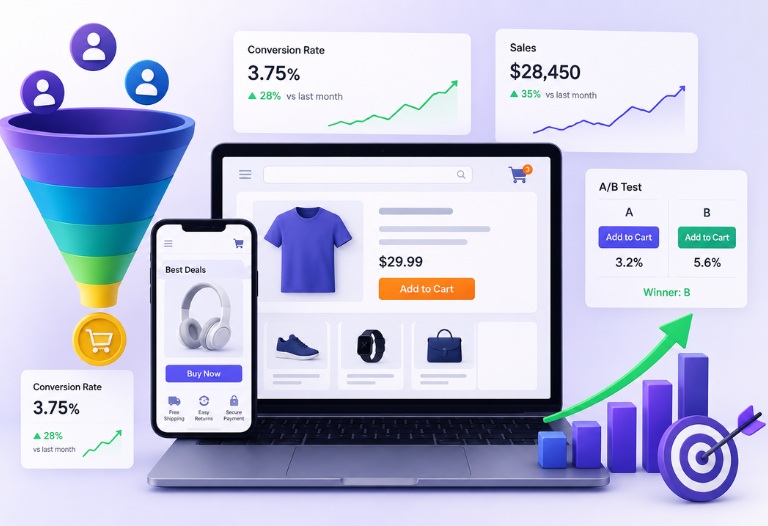
Driving traffic to your store is only half the job. You can pull in thousands of visitors, but if they never take the one step that matters, the purchase, that marketing spend is just a leaking faucet.
eCommerce Conversion Rate Optimization is what plugs the leak. Strip away the jargon, and it is the work of turning more of your hard-won browsers into paying customers. That is where real, durable profit hides.
Plenty of brands sink their budget into ads and SEO, then ignore everything that happens after the click. That is the expensive mistake. A confusing layout, a checkout that asks too much, a missing trust signal, and the shopper is gone in seconds, usually to a competitor who made it easier.
This guide runs through the CRO strategies delivering real results right now. How to build trust, fix every step from the product page to the checkout, use personalization without being creepy, and test your way to a store that actually converts.
Understanding Your Baseline: The Role of Data and Analytics in CRO
Before you optimize anything, you need to know how the store performs today and where the biggest leaks are. Guessing is not a strategy. Data is.
What Is a “Good” Conversion Rate in 2026?
It is one of the top questions everyone seems to ask, and the honest answer annoys people, because it depends.
Average ecommerce conversion rates sit between roughly 1% and 3% globally, but that number swings hard by industry, traffic source, device, and season. Desktop usually beats mobile. A cheap impulse buy converts very differently from a luxury one. Chasing some universal benchmark is a waste of time. Beat your own last quarter instead.
Essential CRO Metrics to Track
You only need a handful of numbers to see where the store is bleeding.
- Conversion rate: Orders divided by unique visitors, times 100. The headline figure, and the one everyone quotes.
- Cart abandonment rate:The share of shoppers who add to the cart and then walk. It is grim across ecommerce, parked near 69 to 70%.
- Checkout abandonment rate: Drop off once checkout has actually started. This one is more useful than it looks, because it points the finger straight at the flow.
- Average order value: More orders are one way to grow. Bigger orders are the other, and people forget it.
- Customer lifetime value: What a customer is worth across the whole relationship, not just the first receipt.
Tools for Gathering Insights
The metrics tell you what is happening. These show you why.
- Google Analytics 4: Tracks the traffic and maps the conversion paths through custom funnels.
- Heatmaps and session recordings (Hotjar, Microsoft Clarity): These show where people click, how far they scroll, and the exact point they give up. Watch ten real recordings. You will learn more than a month of staring at dashboards ever taught you.
Strategy #1: Building Unshakeable Trust with Social Proof and UGC
Online, trust is the whole game. Nobody can pick up your product or read an honest face on a salesperson, so they look for signals instead. The loudest signal by far is other customers.
The Overwhelming Power of Authentic Customer Reviews
Reviews stopped being a “nice to have” years ago: The numbers are blunt about it.
- Around 98% of shoppers read reviews before they buy.
- Displaying them well can lift conversion by up to 270%: A product with even a few reviews outsells one sitting at zero.
- On pricier items, the effect is stronger still, climbing toward 380%, because the nervous shopper is hunting hardest for reassurance.
So collect them properly and put them where they count. On the product page, the category page, at checkout, and inside the emails that chase a lost sale. A review system that gathers text, photo, and video feedback after purchase is the kind of setup Primotech builds into a store rather than leaving it to chance.
Visual UGC: Letting Your Customers Sell for You
Written reviews matter: Customer photos and videos matter more. They do the one thing your studio shots cannot.
Real customer content shows the product in an actual kitchen, on a real person, under bad lighting, and that ordinariness is exactly what tips a wavering browser over. It pays off in engagement, too. Sites that show off user content can see a 90% jump in time spent on the page. Collect it, then put it in on-site galleries, on the product page, even in your ads. Your happy customers become the most persuasive salespeople you have, and they work for free.
Strategy #2: Optimizing Your Product Pages for Maximum Persuasion
The product page is your sales floor. It is where a browser decides to become a buyer, and every element on it is either helping or getting in the way.
High-Quality Product Photography and Videography
Customers cannot touch the product, so the visuals carry the load.
- Multiple high-res images: Every angle, plus close-ups of the details and materials people squint to see.
- Lifestyle shots. The product in use, in the real world, so a shopper can picture it in theirs.
- Video. Demos, 360-degree spins, customer clips. Putting video on a page can lift conversion by 80% or more, which is too big a number to skip.
Compelling and Persuasive Product Descriptions
Do not just list specs. Sell what the product does for someone.
- Lead with the benefit. How does this fix their problem or make their day better?
- Write like a human. Appeal to the senses, not the spec sheet.
- Work keywords in naturally.For search and SEO, without stuffing.
- Keep it scannable.Short paragraphs, bullets, bold on the bits that matter, because most people never read the full thing.
Clear Calls-to-Action and Honest Urgency
- An “Add to Cart” button you cannot miss: Big, distinct, always in reach.
- Urgency, but only the real kind. A genuine low-stock note works: A fake countdown clock teaches people that you lie to them.
- A reason to choose this one. Reinforce the value right next to the button.
Streamlined Navigation and Site Search
If a shopper cannot find the thing fast, they leave:They do not email you about it.
- Clean navigation:Logical menus, clear categories, breadcrumbs that work.
- Search that actually works: Fast, forgiving of typos, fluent in synonyms. Fix this before almost anything else on the list.
Strategy #3: Mastering the Checkout Process and Slashing Cart Abandonment
You talked a shopper into adding to the cart. Then a clumsy checkout throws it all away. With abandonment near 70%, this is the single fattest opportunity most stores are sitting on.
Simplifying the Funnel
Every extra step and pointless field is another exit.
- Offer guest checkout. Forcing account creation alone is enough to make 18% of shoppers quit. That is not a rounding error.
- Show a progress bar. People want to know how much is left.
- Cut the form down. Ask only for what you truly need.
- Test single-page against multi-page.Plenty of stores find that one clean page wins.
Transparency in Pricing and Shipping
A surprise cost at the final step is the number-one reason carts die.
- Put every cost on the table early. Tax and shipping before the last click, not after it.
- Give a few shipping choices. Standard, fast, and free over a threshold if the maths works.
Building Trust at the Point of Conversion
This is the moment nerves spike. Calm them.
- Security badges. The SSL and payment seals people scan for.
- A return policy they can find. Hidden policies read as red flags.
- The payment options they expect. Cards, UPI, wallets, Buy Now Pay Later.
The Power of Abandoned Cart Recovery (Email and SMS)
Some abandonment is inevitable, no matter how clean the checkout. A recovery flow claws back revenue you had already written off.
- A short email sequence. Two or three messages, the first going out a few hours after the cart is left.
- A reason to come back. Remind them what they left, and hold a small incentive for the final email if they still have not budged.
- SMS for the opted-in crowd. Near-perfect open rates make it hard to ignore.
Here is where it gets powerful. Drop the abandoned product’s star rating and a review snippet straight into that recovery email, and a flat “you forgot something” turns into proof that other people love the thing. This is exactly the kind of automated, multi-step email and SMS flow Primotech sets up for stores, often on WooCommerce, where the platform’s flexibility makes eCommerce conversion optimization a high-return job rather than a rebuild.
Strategy #4: Leveraging Personalization for a Tailored Shopping Experience
The same store for everybody feels dated now, and shoppers clock it. Some 71% of them expect a personalized experience and quietly mark down the brands that cannot be bothered.
AI-Powered Product Recommendations
Go past the lazy “related items” strip. Real AI-powered eCommerce optimization reads a shopper’s live behavior and past purchases, then serves products that actually make sense on the page, in the category, and inside the cart. Done with a light touch, it feels like good service. Done badly, it feels like being followed around a shop, so mind the line.
Dynamic On-Site Content and Offers
Your homepage should not greet a loyal customer the same way it greets a stranger. Shift the banners, the offers, even the navigation based on whether someone is new, returning, or a VIP. Small change, real lift.
Personalized Email and SMS Marketing
The same logic runs through your messaging.
- Segment by behavior. Purchase history, engagement, loyalty status.
- Send what fits the segment. Targeted offers, not a blast to the whole list.
- Personalize inside the email. Dynamic blocks that swap in the right offer for the right person.
Pull customer data together from purchases, reviews, and browsing, and the personalization gets sharp enough to move the numbers instead of just looking clever.
Where AI-Powered Optimization Fits
This is the part Primotech leans into for clients chasing conversion optimization services: behavioral data feeding recommendations, search, and segmented messaging, all tied back to what the store can actually measure.
Strategy #5: Winning on Mobile: Optimizing for the Dominant Channel
Mobile is not the second screen anymore. It is the main one. Mobile commerce is set to drive over 60% of all ecommerce sales in 2026, and in India, the share already runs higher. A store that sings on a desktop and stumbles on a phone is leaving most of its money on the floor.
Responsive Design Is Not Enough: Think Mobile-First
Responsive design shrinks your desktop site to fit. A mobile-first build is designed for the phone from the start.
- Buttons big enough to hit with a thumb.
- Menus stripped back, not crammed.
- Content that collapses instead of sprawling.
- Layouts built for one hand.
Blazing-Fast Mobile Page Speed
Mobile shoppers have even less patience than desktop ones. Every kilobyte counts. Compress the images, trim the code, lean on caching, and get those pages loading almost before the tap lands.
Simplified Mobile Navigation and Checkout
Cut the taps. Cut the fields. A mobile checkout should be ruthlessly short, and one-tap options like Apple Pay and Google Pay collapse it down to a tap or two. Every extra field on a small screen is another handful of people gone.
Easy SMS Opt-Ins for Mobile Users
SMS converts hard on mobile, so make opting in effortless. A single-tap subscribe drops a visitor straight into flows like abandoned-cart reminders and flash-sale alerts without the usual friction.
Strategy #6: Continuous Testing and Iteration (The CRO Loop)
Conversion work is not a project you finish and file away. It is a loop. The brands that win at it have testing baked into how they run, not bolted on for a quarter.
The Importance of A/B Testing
A/B testing means running two versions of a page or email against each other to see which wins. You can test almost anything.
- Headlines and subheads
- Button copy, color, and placement
- Product images and video
- Page layouts
- Offers and discounts
The lifts come out bigger than they have any right to. One famous test moved conversions by over 34% on button colour alone.
A/B Testing Tools
Dedicated testing platforms (Optimizely, VWO, Convert). Visual editors, statistical engines, and analytics hooks for running split and multivariate tests without engineering every change by hand.
Learning From Every Test, Win or Lose
Not every test wins, and that is fine. A flop still tells you something true about your customers that a guess never would. Work out why it lost. Feed that into the next hypothesis. The point was never to win every round. It was to keep learning.
Frequently Asked Questions
How fast does conversion optimization show results?
Some of it moves quick. A guest-checkout option or a cleaner cart can shift the numbers inside a couple of weeks. The bigger gains come from steady testing over months, because this is a loop and not a one-off patch. The early quick wins are what buy you the patience for the slow, compounding stuff.
What conversion rate should you actually aim for?
Most stores land in that 1 to 3% band, but the number that matters is your own last one. A shop climbing steadily off its own baseline is in far better shape than one chasing an industry average that may not even fit its category. Forget the benchmark. Beat yourself.
Does any of this work on WooCommerce?
Yes, arguably better than on the locked-down platforms, because WooCommerce bends. Checkout, layouts, recovery flows, you can adjust the lot without tearing it down and starting over. Most WooCommerce conversion optimization is configuration and testing rather than heavy development, which is what makes it such a high-return job.
Where does AI fit into CRO?
Mostly personalization, search, and recommendations, where it reads behavior and tailors the experience at a scale no human team matches by hand. Strong tool inside a program. Not a stand-in for the basics, though, so trust, a clear page, and a checkout that does not fight the shopper still come first.
Hire a CRO agency or keep it in-house?
Comes down to bandwidth and how much testing muscle you already carry. An eCommerce CRO agency hands you the tooling and the scars from a hundred other stores, which skips a lot of trial and error. Teams with the time and the skill can run it themselves. Just rarely as fast.
Conclusion
In ecommerce, standing still is just sliding backward at a slower pace.
The exact tactics that convert today will shift as shoppers change and new tools arrive, which is why CRO has to be ongoing rather than a thing you tick off once. The fundamentals hold steady, though. Build trust. Strip out the friction. Personalize what you can without being creepy. Get mobile right. Test every assumption you are quietly making.
You can run all of this in-house if you have the hands and the hours. Plenty of teams do not, and that is the gap a CRO agency fills. Primotech works this end of the job with a team that leans on A/B testing, heatmaps, and close reads of how people actually move through a site, then turns the findings into fixes across the product pages, the checkout, the personalization, and mobile. Tie the work to the numbers up top, on your own or with a partner, and the store quits being a leaky funnel and starts pulling its weight.
Turn More Browsers Into Buyers With Primotech
Most stores do not have a traffic problem. They have a conversion problem, and it is usually hiding in plain sight. A checkout that asks too much. A product page that does not reassure. A mobile experience that fights the thumb.
Primotech is an eCommerce CRO agency built to find those leaks and close them. The work starts with an audit against your real analytics, the GA4 data, the heatmaps, the session recordings, so the fixes are aimed at where shoppers actually drop off instead of where someone guessed they might. From there a prioritized program runs across the product pages, the checkout, personalization, and mobile, with A/B testing behind every change so nothing ships on a hunch.
The conversion optimization services cover the full stack. Automated email and SMS flows that claw back abandoned carts. AI-powered eCommerce optimization for search and recommendations. And because the team builds across WooCommerce, Magento, and Shopify, WooCommerce conversion optimization usually means real gains through configuration and testing rather than an expensive rebuild.
Every bit of it stays tied to the numbers that matter to your business, not a vague promise of a bump.
Ready to see where your store is leaking? Get a free CRO audit from Primotech.