 June 1, 2026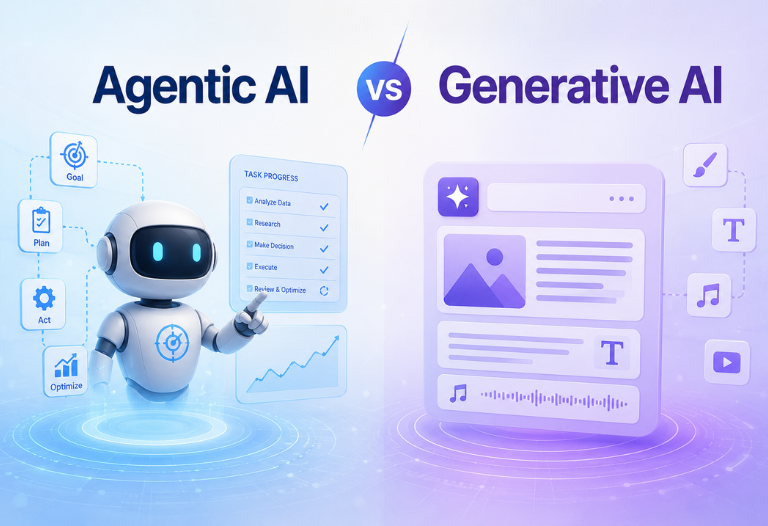
You built the chatbot. You connected it to your website, maybe even ran it through a few internal workflows. People on the team were impressed for about two weeks. Then the questions started: “Why does someone still have to check everything it outputs?” “Why can’t it just do the next step?”
That frustration is not a failure of execution. It is a signal that generative AI was never designed for what you were trying to use it for.
What Generative AI Is Actually Good At
Generative AI is a content engine. It takes your input and produces output — text, images, code, and summaries. Fast. Often impressively good. If you need a first draft, a translated document, a support reply template, or a 20-slide deck structure, it handles all of that well.
What it cannot do is act on the world. Every time you want it to do something, you have to be in the room. You prompt it, it responds, you take that response somewhere. The model itself has no concept of what happens next. It doesn’t know it sent a message. It doesn’t know the message bounced. It has no idea there’s a follow-up needed in three days.
That’s not a flaw, exactly. That’s the design. Generative models were built to respond, not to run.
According to McKinsey’s 2024 State of AI report, companies that moved beyond basic generative AI to integrated AI workflows reported significantly higher productivity gains than those still using models as standalone tools. Most companies are still in the standalone camp, which tells you where the opportunity sits.
So What Does “Agentic” Actually Mean
Agentic AI is a system that can pursue a goal across multiple steps, using real tools, without needing you to supervise each one.
Here’s a useful way to think about it. A generative AI tool is like a very capable consultant you can call any time, but they only work when you’re on the phone with it. The moment you hang up, they stop. They won’t follow up. They won’t notice that a step went sideways. An agentic AI system is closer to a staff member who has been briefed on what success looks like, has access to the relevant systems, and gets on with it.
The actual mechanics involve a few things working together:
- Tool use. The agent can call your CRM, email system, database, and internal APIs. Don’t just talk about them.
- Planning. You give it an objective. It breaks the objective into steps and determines the order in which to run them.
- Memory across sessions. It knows what it did yesterday. It doesn’t start from zero every time.
- Handling failure. When a step doesn’t work, it tries something else instead of stopping and waiting for you.
That last one is underrated. A lot of automation breaks the moment reality doesn’t match expectations. Agentic systems are designed to handle that gap with some degree of judgment rather than just throwing an error.
A Gartner report on agentic AI trends for 2025–2026 identified this as one of the top enterprise technology priorities globally, with CIOs specifically flagging autonomous agents as a focus area for the next 18 months. That attention is not theoretical.
Why 2026 Is Not Like Previous Years
Every year for the past four years, someone has declared that this is the year AI changes everything. So why should 2026 actually be different?
Because the underlying conditions have shifted in ways that weren’t true before.
The models are good enough now that agents don’t fail constantly on basic reasoning tasks. That sounds like a low bar, but it wasn’t cleared reliably until recently. Early agentic experiments collapsed because the model would make a wrong turn in step two and confidently sprint in the wrong direction for the next eight steps.
The orchestration layer has also matured. Frameworks like LangGraph, AutoGen, and Azure AI Agent Service are no longer experimental. Teams are building production deployments on them. There is now real operational knowledge about how to design agents that fail safely, escalate appropriately, and don’t go rogue when they encounter edge cases.
And enterprises have spent the last two years cleaning up their data infrastructure. Vector databases, internal knowledge bases, and cleaned API layers. Without that foundation, agents don’t have anything useful to work with. Many companies quietly did that work during the “generative AI pilot” phase and are now in a position to use it.
For Indian enterprises specifically, there’s a timing argument worth considering. The agentic AI development company in India ecosystem is still early enough that custom builds are feasible. Give it another 18 months and you’ll mostly be choosing between packaged solutions with limited flexibility.
What This Looks Like for Real Business Functions
The gap between generative and agentic AI is easiest to see when you apply it to a specific example.
Customer support.
A generative AI tool drafts a reply and waits. An agentic system reads the ticket, pulls the customer’s account history, checks whether a similar issue was raised before, writes the response, sends it, and flags the ticket for human review only if the issue matches a defined escalation rule. Same starting point, completely different end state.
Sales operations.
Generative AI helps a rep write better emails. Agentic AI monitors the pipeline, notices that a deal hasn’t moved in 18 days, checks the last five interactions, drafts a re-engagement message tailored to what was discussed, schedules it for the right send time, and updates the CRM stage when the prospect replies. The rep sees a summary, not a to-do list.
Finance and compliance.
Generative AI summarizes a document and answers questions about it. Agentic AI runs reconciliation against defined rules, flags discrepancies with enough context to act on, routes items to the right reviewer, and maintains an audit trail of every decision made along the way.
The pattern is the same across all three. Generative AI makes one step easier. Agentic AI completes the sequence.
How to Pick a Development Partner Who Can Actually Deliver This
Building a genuinely capable agentic system is harder than most vendors will admit upfront. It’s not just a matter of wrapping GPT-4 in a task loop and calling it an agent. The architecture involves orchestration design, tool integration, memory management, guardrail logic, and significant work on failure handling.
If you’re evaluating an agentic AI development company in India for a real deployment, the things worth probing:
- Have they built agents that use actual external tools in production, or do their demos only show the model talking about using tools? The difference is large.
- Do they have a clear answer for what happens when the agent hits an unexpected input? How it escalates, what it logs, how a human steps back in?
- Have they worked in your industry before? The compliance requirements in BFSI differ from those in logistics. Domain knowledge matters more in agentic systems than in generative ones because agents make decisions autonomously.
- Primotech is one of the few agentic AI development companies in India that approaches this with genuine engineering depth. Their work spans multi-step agent design, enterprise tool integrations, and production deployments across regulated industries — not just proof-of-concept builds that look good in a boardroom and fall apart three months later.
The best AI agent development services companies will have opinions about your architecture, not just a list of capabilities. If the sales conversation is mostly about the model rather than the orchestration design, that’s worth noting.
Conclusion
The generative AI wave gave companies a taste of what AI-assisted work looks like. Agentic AI is where the actual productivity shift happens. If 2026 is the year you start seriously evaluating that move, partnering with a team like Primotech — one of the best agentic AI development companies in India — will be the difference between a system that works in a demo and one that quietly handles a thousand decisions a day while your team focuses on things that genuinely need human judgment.
Ready to move beyond chatbots?
Primotech helps enterprises design and deploy agentic AI systems built for real operational use. Whether you’re starting with a single workflow or planning a multi-agent rollout, the team brings both the engineering capability and the industry context to get it done right.
FAQs
We already use ChatGPT and Copilot across the company. Do we need to throw that out to adopt agentic AI?
No. Agentic systems are built on top of the same foundation models you’re already using. The difference is the orchestration layer and tool access sitting around those models. Your existing generative AI usage stays relevant and often feeds directly into the agent’s reasoning.
How do we know if our internal data is ready for an agentic deployment?
The honest answer is that most companies discover gaps during the scoping phase. A decent development partner will conduct an infrastructure-readiness assessment before committing to a timeline. What you’re looking for is clean API access to core systems, a workable internal knowledge base, and some version of identity and permission management so the agent doesn’t have unconstrained access to everything.
We’re in a regulated industry. Is autonomous AI even viable for us?
Yes, but the design has to account for it from day one. That means human-in-the-loop checkpoints at high-stakes decision nodes, full audit trails on every action the agent takes, and clearly defined escalation paths. It’s more work to build, but it’s absolutely viable. Agents running in BFSI and healthcare already exist in production.
What’s a realistic timeline for a first agentic deployment?
A single well-scoped workflow, like customer support triage or sales pipeline monitoring, typically runs 8 to 14 weeks from scoping to production. Multi-agent systems covering several functions take 4 to 6 months. The biggest variable is usually how clean your existing data and API layer is when the project starts.
Why not just hire a global AI firm for this instead of an India-based company?
Cost is part of the answer but not the whole answer. India-based agentic AI development teams often combine serious engineering depth with familiarity with the enterprise systems and compliance environments common in Indian markets. Timezone alignment also makes a real difference during the integration-heavy phases of a project when you need fast back-and-forth.